
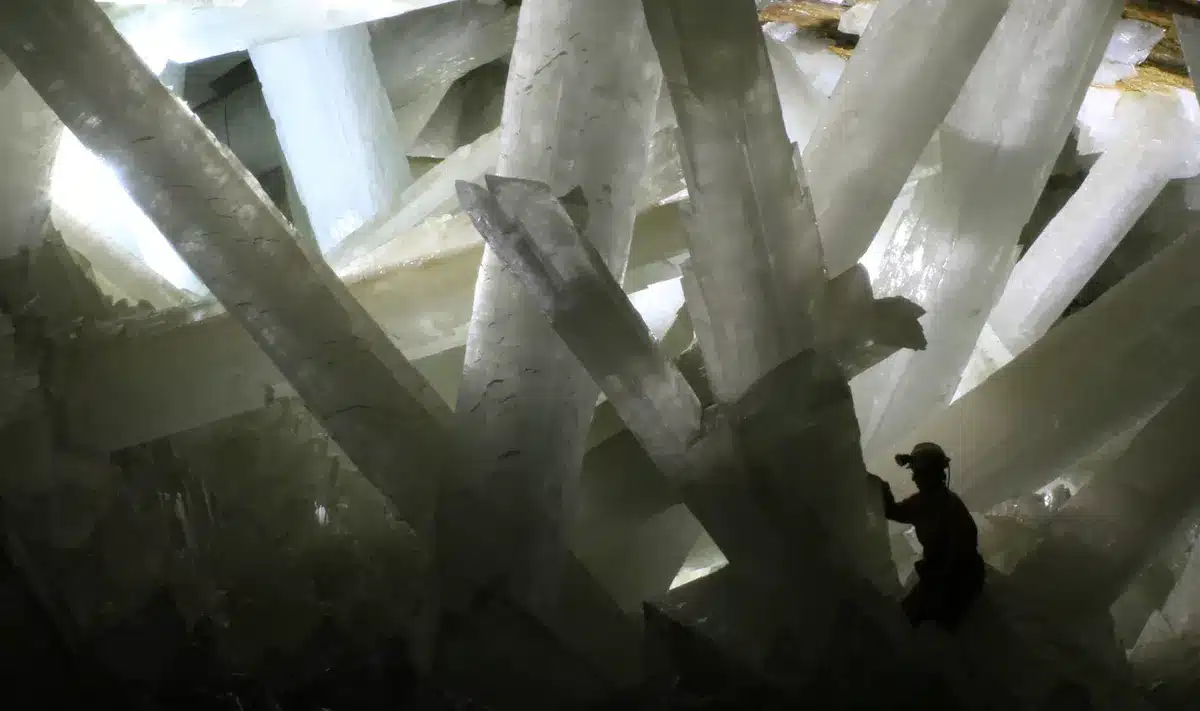
About 300 meters beneath the surface of the Sierra de Naica in Mexico lies one of the planet’s most surreal spectacles: the Crystal Cave. Discovered by chance in 2000 by miners, this cavern houses the largest crystals known to humankind. Yet behind this science-fiction-worthy beauty lies an environment of absolute hostility, where a person can survive only a few minutes without high-tech equipment.
What you will learn
The staggering dimensions of the planet’s largest selenite crystals.
Why the cave’s atmosphere can prove deadly in less than 10 minutes.
The 500,000-year-old geological secret that allowed these giants to grow.
A climate hell 300 meters underground
The Crystal Cave presents itself as a U-shaped chamber roughly 30 meters by 10, entirely lined with milky-white monoliths of gypsum known as selenite (a translucent variety of gypsum). The largest of them is a titan of 12 tonnes, 1 meter wide by 11.4 meters tall — more than six times the height of an average human.
While the site captivates photographers, it is strictly off-limits to the public for a simple reason: it is a deadly trap. The temperature is held at a steady ~58 °C, combined with an oppressive humidity spanning 90 and 99 %. In such conditions, the human body cannot dissipate its own heat. Staying more than 10 minutes without thermal protection leads to systemic failure and a lethal accumulation of fluid in the lungs. To explore the chamber, scientists must wear specialized refrigerated suits and oxygen masks, which restrict their endurance to a maximum of 15 to 60 minutes.
The secret behind ultra-slow growth
The birth of these gypsum giants dates back 26 million years, when a pocket of magma uplifted the mountain. The cavities filled with acidic thermal waters, saturated with calcium sulfate, calcium, and gypsum (anhydrite).
The key to the size of Naica’s crystals lies in the water’s incredibly slow cooling:
-
Originally, as the water was hot, enormous deposits of anhydrite formed.
-
Over millennia, the water cooled very slowly until it stabilized around 58 °C.
-
At this precise thermal plateau, the anhydrite began to dissolve, enriching the water with calcium and sulfate.
-
Those minerals then redeposited to form gypsum (selenite).
For comparison, a neighboring chamber dubbed the “Sword Cave,” located closer to the surface (120 meters), cooled far too quickly. The result: the water emptied of its minerals in one go, creating millions of tiny sharp crystals. In the Crystal Cave, the temperature remained stable for an estimated period between 500,000 and one million years, allowing a handful of crystals to grow indefinitely and reach record weights of over 50 tonnes.
As evidence of the extraordinary nature of this environment, NASA microbiologists discovered in 2017 micro-organisms trapped inside the crystals for 50,000 years. Extracted and successfully revived in the laboratory, these extremophile microbes fed exclusively on iron and manganese to survive.
Threatened by human activity, saved by water
The Naica hill hosts a major deposit of lead, zinc, and silver. In order to exploit the galleries, mining companies had to continuously pump groundwater, discharging the equivalent of an Olympic-sized swimming pool every 40 minutes into an artificial lake. It was this forced drying that inadvertently opened access to researchers in 2000.
However, removing these crystals from their original bath endangered them greatly. Deprived of the water’s natural buoyancy, the largest monoliths began to bend and crack under their own weight, especially since gypsum is a very soft mineral (rated 2 on the Mohs scale) and can fracture under a researcher’s footsteps. The absence of water also halted their growth abruptly.
Facing these risks and following the mine’s closure in 2015, the pumps were shut off. The deep galleries are gradually filling with water again. Although the water has not yet fully reasserted itself in the grand Crystal Cave, geologists hope the groundwater will reclaim its rights. Immersed once more in their hot, mineral matrix, these gypsum giants could resume their millennial growth, far from human eyes.
