
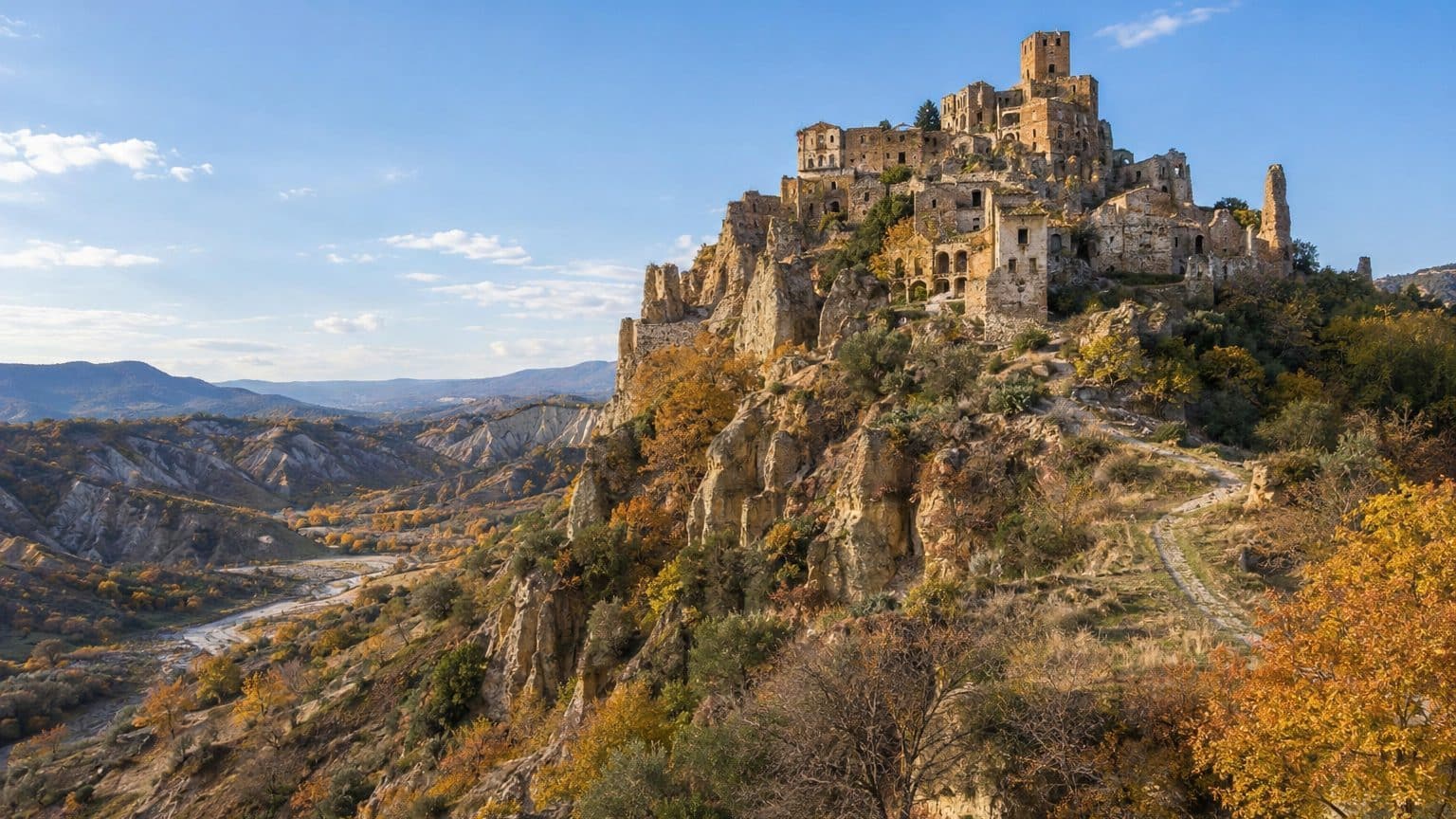
Craco, in Basilicata, saw its historic center evacuated starting in 1963. About 1,800 inhabitants left the summit to settle in the valley, at Craco Peschiera, a newly built settlement created for them. The old village remained standing, empty, and film crews moved in where families once lived.
No one has lived there permanently since 1980.
- Around 1,800 inhabitants left Craco’s historic center starting in 1963.
- The village has been devoid of permanent residents since 1980, according to the most commonly cited date.
- The site has served as a backdrop for several films, including The Passion of the Christ and Quantum of Solace.
An Eagle’s Nest Perched on Clay
On the map, Craco sits in the province of Matera, about 40 kilometers inland from the Taranto Gulf. The town was built on a very steep summit for defensive reasons, giving it that sculpture-like silhouette clinging to the rock. The figure of 400 m, often cited for the cliff, is sometimes given as the altitude of the historic center, around 390 m according to some records: the order of magnitude remains the same.
The site’s history is long. Some sources trace the foundation to the 8th century, and the entire collection of houses is organized around a Norman tower that dominates the center. The population is believed to have reached a peak of 2,590 inhabitants in 1561, before plague, emigration, and landslides caused it to shrink. The last two centuries did the rest, with successive departures.
The problem lay in the ground. The hills surrounding Craco are calanchi, bare clay ridges carved by erosion, with no vegetation for several kilometers. It is this geological instability that caused the landslides of 1963.
The village had already been thinning out well before. Between 1892 and 1922, part of its population emigrated to North America, and more than 1,300 poor inhabitants are said to have left for the United States around the turn of the century. By 1963, there remained the 1,800 people who had to relocate.
1963: the Descent, then Two Blows of Fate
Infrastructure works intended to improve water and sewer networks would very likely have triggered or worsened the landslide of 1963, according to Italian trade press. The soil, saturated and unstable, began to move. The authorities ordered evacuations, and residents were rehoused in Craco Peschiera, in the valley below. The operation was gradual: the village began to be evacuated in 1963; it was not emptied overnight.
The houses, for their part, remained standing.
Some residents attempted to stay nonetheless. A flood in 1972 made a return to the historic center impossible, and the 1980 Irpinia earthquake completed the abandonment. Since then, the village has been empty, and the walls still frame doors whose floors have collapsed.
The municipality of Craco still exists administratively. According to figures found online, it would count around 630 inhabitants, all living away from the rock.
Cinema Takes the Place of the Inhabitants
The first major role dates to 1979. Francesco Rosi shot several scenes there for Christ Stopped at Eboli, adapted from the novel about rural Basilicata. Mel Gibson returns in 2004 for The Passion of the Christ, and several sources place the film’s final scene in Craco. In 2008, Quantum of Solace, the James Bond film with Daniel Craig, opened with a sequence filmed there.
The list does not end there. The village also appears in King David (1985), Catherine Hardwicke’s The Nativity Story, and Basilicata Coast to Coast, by Rocco Papaleo. These authentic ruins spare productions the need to build a biblical or medieval set.
The World Monuments Fund placed it on its watch list in 2010.
This fragility explains the current visiting regime. You cannot wander Craco freely: access is allowed only with a guide, on a secured route that follows the main street to the remnants of the old square, then enters the heart of the village. The routes are steep, with sharp slopes and irregular dirt paths. In 2007, descendants of emigrants founded the Craco Society, a nonprofit organization based in the United States, to preserve the town’s history and culture.
Sources do not all agree on the date of the definitive abandonment: 1980 is the most frequently cited, but some tourist sheets advance 1991.
Sources: podcast.ausha.co | shango.media
