
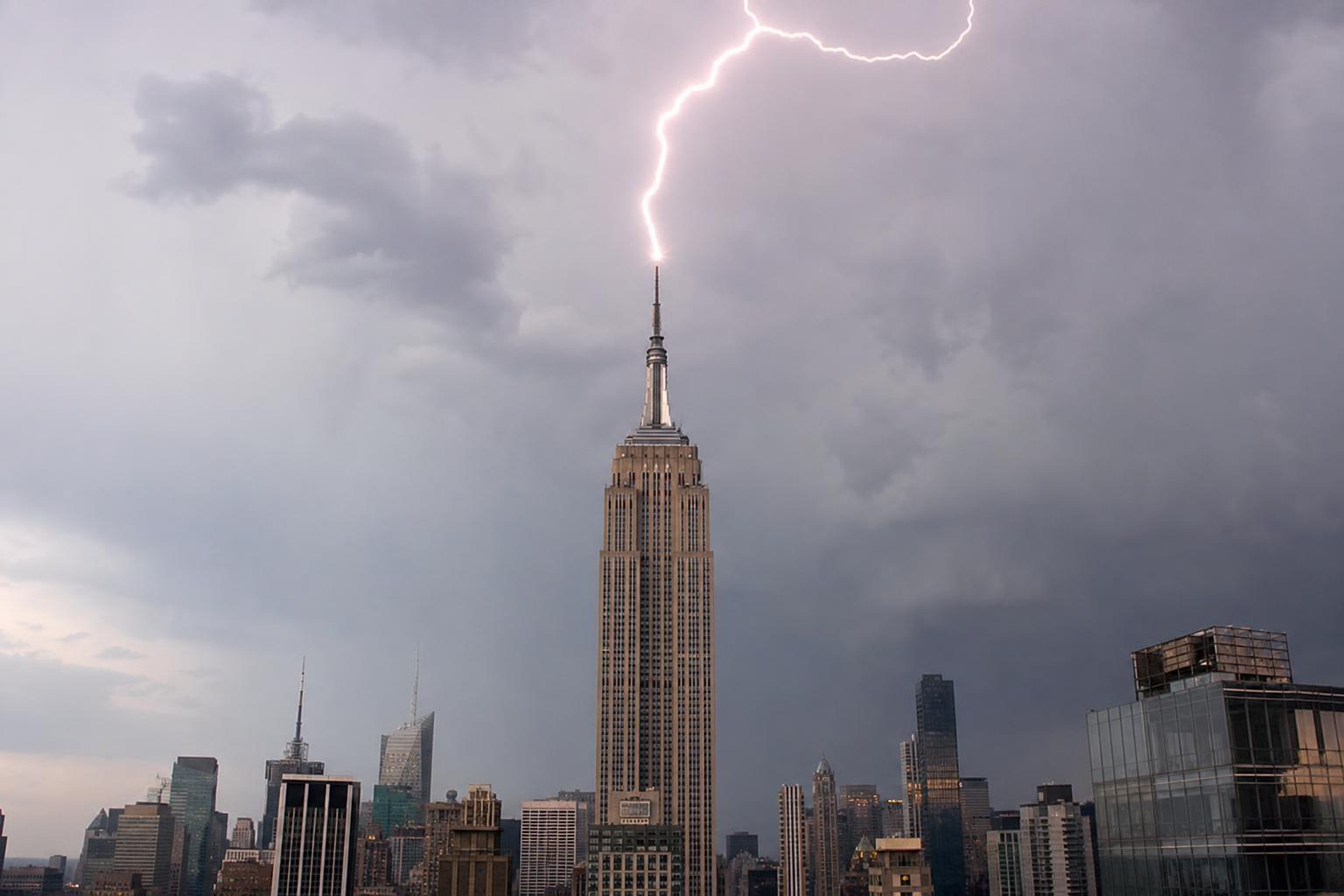
Few myths stick like the schoolyard idea that a bolt won’t return to the same spot. In the real world, tall structures are magnets for repeated electrical attention. That’s why New York’s famous skyscraper is struck roughly 25 times per year. The lesson isn’t about luck; it’s about physics.
The myth that wouldn’t die
People love tidy sayings that sound like wisdom. “It won’t happen again” feels comforting when storms roll over a city’s bright horizon. But comfort isn’t a great guide to reality. As one safety mantra puts it, “probability doesn’t keep a ledger.”
Why tall buildings get hit
Lightning seeks the fastest, most conductive route to neutralize charge between cloud and ground. A skyscraper presents a shorter air gap and a purpose‑built metallic path. “Lightning favors the tallest, most conductive path,” say field guides for storm observers. That’s why iconic towers are frequent targets.
The Empire State Building effect
The famous Manhattan spire carries heavy rods, cables, and deep grounds that invite strikes and safely steer current into the earth. On active summer days, it can be hit multiple times within minutes as storms train overhead. Across a typical year, observers count on the order of two dozen distinct events. Far from disaster, those hits showcase deliberate engineering.
How a strike actually works
A storm cell separates charge, piling positives and negatives into unstable layers. From the cloud, a stepped leader snakes downward in jagged, dim segments. When it nears an upward streamer from a tall structure, a brilliant return stroke flashes skyward along the completed channel. The entire dance lasts milliseconds but can repeat in rapid succession along the same ionized path.
Designing for the inevitable
Engineers assume repeat strikes and channel them with Franklin rods, bonding, and low‑impedance grounds. The aim is not to prevent lightning but to control current, heat, and electromagnetic effects. That’s why occupants in well‑protected towers remain generally safe while storms write bright cursive across the skyline.
Counting the hits
How do we know a tower takes dozens of strikes? Instrumented masts, rooftop sensors, and national detection networks log discharges with microsecond precision and kilometer‑scale location. Time‑lapse cameras sometimes capture multiple flashes to the same spire in a single turbulent hour. Data, not aphorisms, settles the question.
What this means for personal safety
The fact that one spot can be hit again doesn’t mean you’re personally doomed. It means you plan around the most likely conductive paths and the storm’s shifting electrical mood. The simplest rule still holds: “When thunder roars, go indoors.”
- Seek a fully enclosed building with plumbing and wiring, or a hard‑top metal‑roofed vehicle.
- Avoid open fields, isolated trees, rooftops, and hilltop vistas.
- Stay off wired electronics and corded phones; keep away from plumbing and metal rails.
- Wait 30 minutes after the last audible thunder before resuming outdoor activities.
The camera’s favorite shot
Photographers love the repeat‑strike spectacle. A single storm can produce layered frames of branching fire, each stroke tracing the same air‑ionized corridor to a city’s highest points. In composite images, the repetition becomes obvious and oddly beautiful.
Weather, warming, and urban heat
Warmer air holds more moisture and fuels deep convection, the engine behind vigorous thunderstorm towers. Some studies project more lightning in a warming climate, though changes will vary by region. Urban heat islands can also tweak local storm paths, nudging cells toward convergence zones at city edges. None of this abolishes chance, but it shifts odds.
Beyond the proverb
Why does the myth matter? Because catchy lines can breed complacency. If people believe a place “already got hit,” they might linger on rooftops or near tall masts. Risk isn’t a punch card; it’s a rolling set of probabilities governed by terrain, materials, and the storm’s evolving charge.
A better takeaway
Trade the comforting line for practical truth: lightning strikes where conditions make it easy, even if that’s the exact same address. Skyscrapers are engineered to take the punishment so the city beneath can hum along in relative safety. As one trainer likes to remind crews, “Nature isn’t fair or random—it’s opportunistic.” In the end, good design and wise habits beat tidy myths every time the sky goes electric.
