
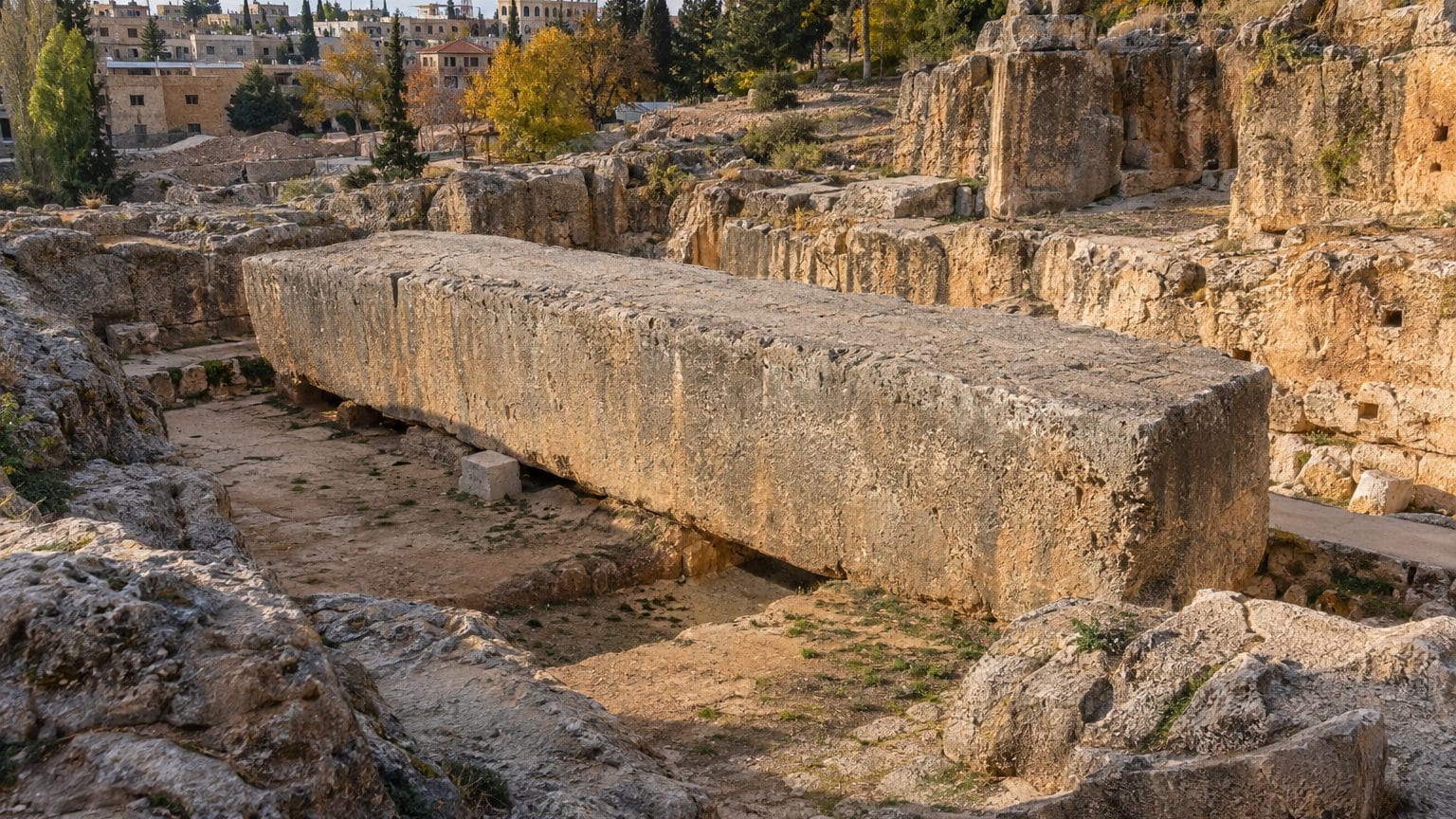
- The block measures 20.76 m in length and is estimated at about 1,500 t.
- It has remained in the quarry, 900 m from the Baalbek temples.
- A heavier third monolith was discovered in 2014.
A monolith remained in its quarry, 900 m from the site
The block still lies within the ancient quarry, about 900 meters from the Baalbek temple complex. It is known as the “stone of the pregnant woman” (Hajar el-Hible in Arabic). Roman workers shaped it from limestone, and no one has ever managed to extract it from its bed.
A single block of roughly 20 meters in length was left behind on site.
Its measured dimensions are 20.76 m long, 4 m wide and 4.32 m high. The weight is more debated: World History Encyclopedia estimates about 1,000 tonnes, Atlas Obscura cites around 1,200 t, and a high-end estimate of about 1,500 t is used here. No one has placed the block on a scale; these figures come from volume calculations multiplied by the stone’s density.
Using the 1,500 t figure, the mass corresponds to roughly 250 adult African elephants, assuming an average mass of around 6 t each. The 20-meter length is near the breadth of a tennis court, whose standard length is 23.77 m. The block stayed where it was quarried, a massive rectangular mass slightly inclined above ground. Visitors view it from a designated overlook below.
Why 900 m was enough to stop everything
On paper, the maneuver did not look particularly daunting. The quarry sits a bit above the temple complex, so there was no need for lifting gear to move the stones. Large blocks could be rolled along temporary earthen slopes on rollers. This remains a reconstruction rather than an archaeologically documented trace of the operation.
All this worked to the Romans’ advantage.
The Jupiter Temple, about 2,000 years old, rests on three colossal stones—the Trilithon. These stones come from the same limestone quarry where three additional giant monoliths lie. The “pregnant-woman” block was believed to be destined for the base of these temples. Historians propose two possibilities: it was planned for the Jupiter Temple’s podium, or it was abandoned due to its size and weight. No written sources settle the question.
Local legend says a pregnant woman allegedly convinced the people of Baalbek that she could move the stone if she were fed until she gave birth. Hence the monolith’s name. Other tales endow it with fertility-related powers.
A second block, heavier, found in 2014
In 2014, archaeologists uncovered in the same quarry the “forgotten stone,” or third monolith. It was found by researchers from the German Archaeological Institute, lying just beside the pregnant-woman stone. It remains partly buried and is estimated to weigh around 1,650 t.
This block stood only a few meters from a stone well known to all, yet it was only identified in 2014.
A third block complicates the tally. The “South Stone” had been rediscovered in the 1990s. Its weight is estimated at 1,242 t, placing it above the weight of the pregnant-woman stone in that assessment. Since its position had been forgotten, some sources use that name for the pregnant stone. This mix-up helps explain some of the weight discrepancies found across pages.
Three Roman monoliths rest within the same quarry.
Where to find it, and what you can see there
On a map, the quarry sits near 34.00° N and 36.20° E, set apart from the monumental site. It is just a short walk from the Roman ruins and Baalbek’s temples. A viewing platform lets you see the stone from above, and you can also walk around it on the ground level. Visitors mention a small souvenir shop and restrooms on site.
The site has seen recent digging, and ancient tombs were uncovered nearby. They lie next to the blocks and remind us that the quarry served purposes beyond mere extraction.
To grasp the scale, combine the numbers: a 1,000–1,500 t block cut roughly 2,000 years ago, and the 900 m distance to the temples. Initially, there would have been a quarry on a gentle slope, with rollers and earthen banks, perhaps. In the end, there is a stone that never left its rock bed.
The forgotten stone, the heaviest at an estimated 1,650 t, remains partly underground, and there is no sign it will be removed.
Sources : worldhistory.org | atlasobscura.com
