
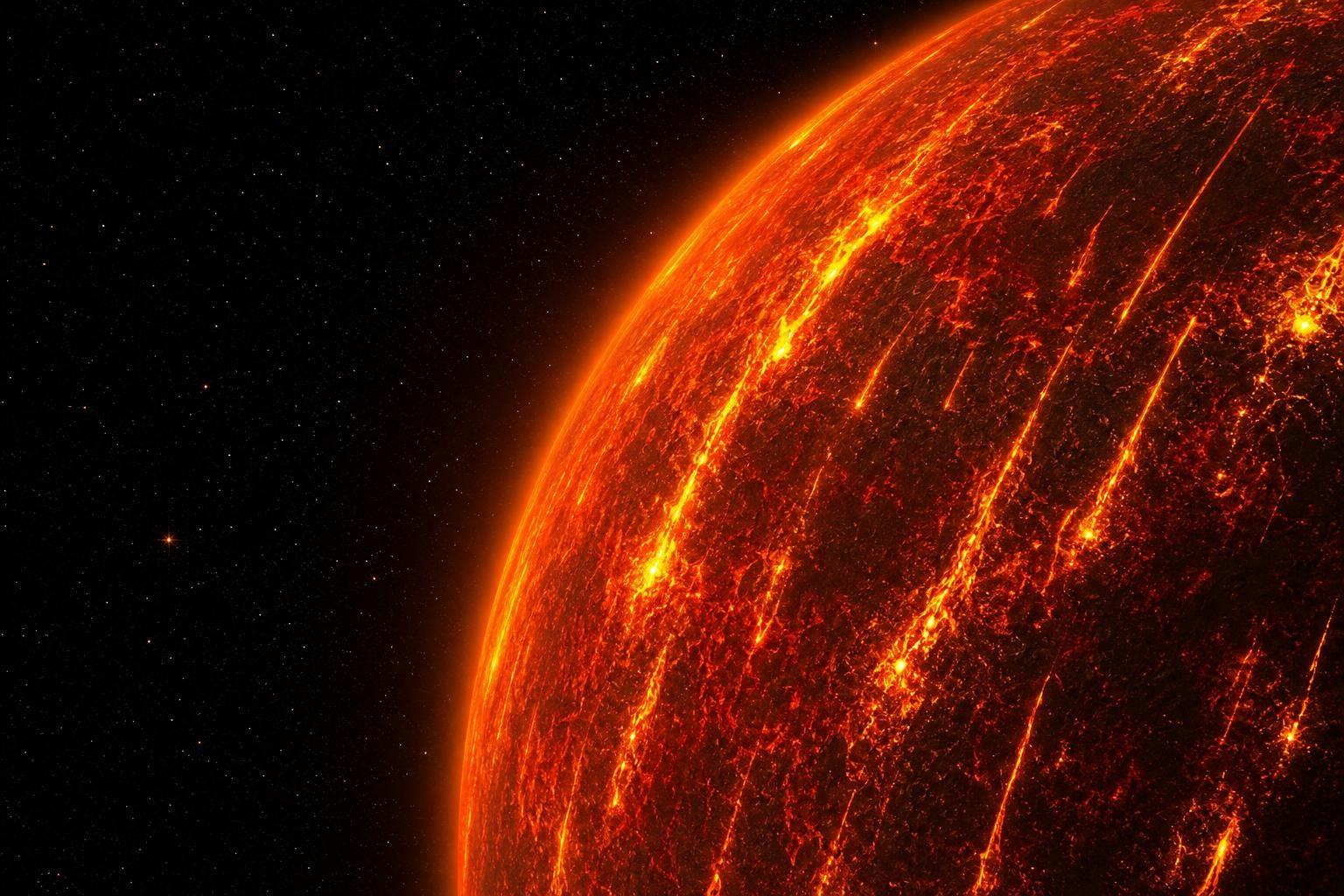
Some nights on a distant giant, the sky does not just darken — it hardens. Astronomers peering across light‑years have found a world where twilight brews metal, and darkness wrings it from the air. “The night doesn’t fall; it condenses,” one researcher said, trying to wrap words around a storm born in a furnace.
This is an ultra‑hot Jupiter, swollen by heat and shackled by gravity to perpetual day on one side and endless night on the other. On the blazing hemisphere, iron turns to vapor; on the shadowed face, that same iron rains. “It’s not weather; it’s metallurgy,” joked a planetary scientist, marveling at a forecast that reads like alchemy.
A sky forged in fire
The dayside is a crucible, drenched in star‑light so fierce it boils metals. Temperatures soar beyond what we call scorching, pushing atoms to escape their bonds and drift as metallic mists. Winds then seize that vapor and hurl it across the terminator, where light surrenders to dark.
On the other side, the thermometer plunges by thousands of degrees. What was a gaseous ghost becomes liquid steel, gathering into droplets and falling like glowing rain. In the quiet of alien midnight, the clouds are not white or gray — they are iron.
How metal becomes weather
It begins with physics, plain and relentless. Heat from the nearby star breaks molecules, freeing atoms of iron to drift alone, like sparks in a forge. As winds sweep them into cooler regions, those atoms meet, link, and condense, building the seeds of metallic clouds.
Then gravity does what it always does. Droplets fatten, grow heavier, and begin to fall. Somewhere below, they splatter on impossibly hot surfaces, perhaps vaporizing again in a cycle that never ends. “We are watching chemistry write the climate,” said one observer, equal parts awed and humbled.
The lock of perpetual dusk
This planet is tidally locked, with one cheek forever to the flame and the other to infinite shade. The day‑night divide is a razor, a ring of endless dusk where winds scream at supersonic speeds. Air races from the day’s pressure cooker to the night’s vast vacuum, dragging along the ingredients of metallic rain.
Nothing here is gentle. The sky is a machine, converting starlight into motion, motion into weather, and weather into rivers of molten iron. What looks like chaos is a precise equation, solved every second by heat, flow, and time.
What the instruments saw
We learned this from spectra, not snapshots — fingerprints of light that betray the elements floating in a planet’s air. When iron vapor crosses a star’s glare during transit, it chews tiny bites from the spectrum, lines that scientists can read. On the nightside, those lines thin or shift, hinting that iron has vanished into droplets, no longer visible as gas.
“Think of it as a weather map made from starlight,” said an astronomer involved in the analysis. A map with isobars of temperature, with currents of wind, with shaded regions where metal turns to rain.
A quick tour of this extreme world
- A giant, close‑in planet orbits its star in a brief, blistering loop, locking one side to day and the other to night. Dayside heat vaporizes iron; nightside cold condenses it into droplets that fall like molten rain.
Why this alien storm matters
Worlds like this bend our intuition, but they sharpen our tools. By chasing metals through phases, scientists calibrate models that predict clouds, winds, and chemistry on far cooler, more Earth‑like planets. Today it’s iron rain; tomorrow it might be water, methane, or exotic salts — each a clue to how atmospheres breathe.
The payoff is not just in numbers; it’s in imagination. We are learning to read climates we can never touch, to hear weather in the way light sings through gas. “Every strange world expands the possible,” one team member said. And in the hiss of alien rain, you can almost hear the universe inventing new ways to be a planet.
Back on our blue home, rain is gentle, almost ordinary. Out there, weather writes with metal, and night comes down as liquid fire. It’s a reminder that the cosmos is both familiar and ferociously creative, turning the simple grammar of heat and gravity into a poetry of storms.
