
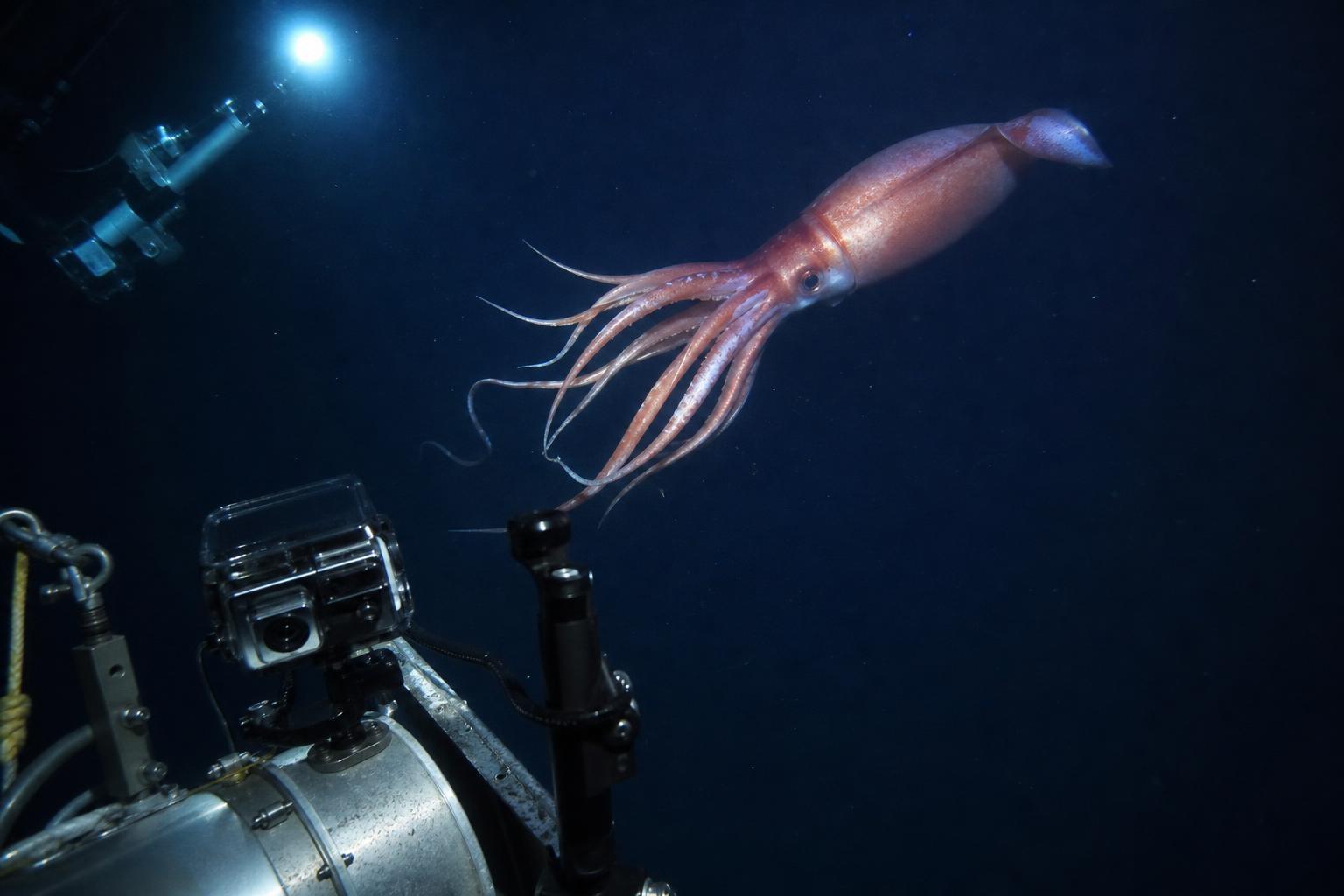
The camera saw it before anyone else did: a long, deliberate shape rising from the black water, a glinting eye, a flourish of suckers—then a sudden retreat into the abyss. For a handful of seconds, at roughly 750 meters below the Gulf of Mexico, a living giant squid slipped across a frame and into history.
No submersible floodlights. No roaring thrusters. Just a patient trap of weak red light, the promise of prey, and the deep sea’s endless night.
A fleeting moment in the midnight zone
The animal appeared at depth, in the oceanic twilight known as the mesopelagic, where daylight thins into velvet darkness and bioluminescence becomes the grammar of survival. A low-light “ambush” camera waited in silence, disguised by darkness and tuned to see what the eye cannot.
Then came motion—first a hint of arms, then the unmistakable reach of a tentacle. The shape filled the frame, tested the lure, and vanished as quickly as the moment arrived. “For a breath,” the scene felt like “watching a myth exhale and slip away.”
Why this sighting matters
Giant squid, likely Architeuthis dux, occupy a rare tier of legend, perched at the intersection of scientific fact and maritime myth. They are enormous, elusive, and exquisitely adapted to darkness, living far beyond the casual reach of humans. Until very recently, most encounters were dead specimens hauled up by chance, their bodies distorted by pressure and time.
Capturing one alive, on video, in American waters, marks a boundary-crossing first. It anchors a ghost to a geography, turning “somewhere out there” into a map point. And it proves that with the right tools, patience, and a little deep-sea serendipity, we can observe giants as they are, not as we imagine them to be.
The quiet camera that fooled a legend
At the heart of the encounter was a specialized system designed to see without being seen. Instead of blasting the water with bright light, it used dim red illumination and a bioluminescent lure that mimics a distressed Atolla jelly—an evolutionary signal that can draw predators from the dark.
This design flips the usual script: let the ocean come to the camera, not the camera crash into the ocean. “Technology doesn’t have to be loud to be revolutionary,” one field note reads. The team engineered a patience-powered trap, a kind of luminous whisper that said: “Something is dying here.” The squid, curious and opportunistic, answered the whisper.
What the footage shows
On screen, the animal is all intent and economy: sleek mantle, vast eye, and a tentacular club bristling with suckers. It approaches in a measured surge, tasting the scene with an outstretched arm before delivering a fast, decisive strike.
The proportions suggest a not-yet-colossal individual, still large enough to hush the deck when the clip first played. “It’s the eye that stays with you,” a notebook entry muses—an ancient, unblinking lens that seems to hold its own small galaxy of light.
From Kraken to camera trap
For centuries, giant squid were “proof” that the sea kept monsters, their appearances stitched into sailor’s fear and seaside lore. Science has since replaced dread with detail, but the animal keeps some mystery intact. It lives where light is rare, hunts where echoes write the landscape, and pulses with muscle tailored to endless night.
Moments like this pull the creature across a threshold—from anecdote to evidence, from rumor to record. “You can almost feel the scale of the ocean in that single frame,” a log line notes.
What this unlocks next
A sighting is not an ending—it’s a beginning. Every verified encounter refines search patterns, informs non-invasive methods, and sharpens the ethical lines of how we look without driving what we seek to hide. More quiet cameras. More dark deployments. More listening before we speak.
In practical terms, the path ahead looks like this:
- Expand low-light, lure-based surveys across continental slopes and canyon systems where currents concentrate life.
Each step shifts the odds from chance to choice, building a scaffold for future observations—longer clips, multiple angles, and, perhaps, behavioral sequences that move beyond the hit-and-run glimpse.
The bigger picture in American waters
The Gulf of Mexico is both working sea and wild frontier—a place of rigs, shipping lanes, spinning eddies, and deep pelagic voids. To confirm a giant squid here is to underline how layered this basin really is, how much still moves beneath the grid of human activity and the blue gloss of daylight.
“Find the giants,” the ocean keeps telling us, “and you learn the food web that feeds them.” You learn where carbon falls, where currents braid, where light becomes language and silence becomes strategy. You learn that seeing is a privilege, not an entitlement we can take for granted.
So the frame loops again: a pale limb unfurls, tests the water, and tightens on a flashing decoy. Then the animal slides back into a world we barely know, leaving a bright thread of evidence and a simple charge for the next voyage—go quieter, look longer, and meet the deep on its own terms.
