
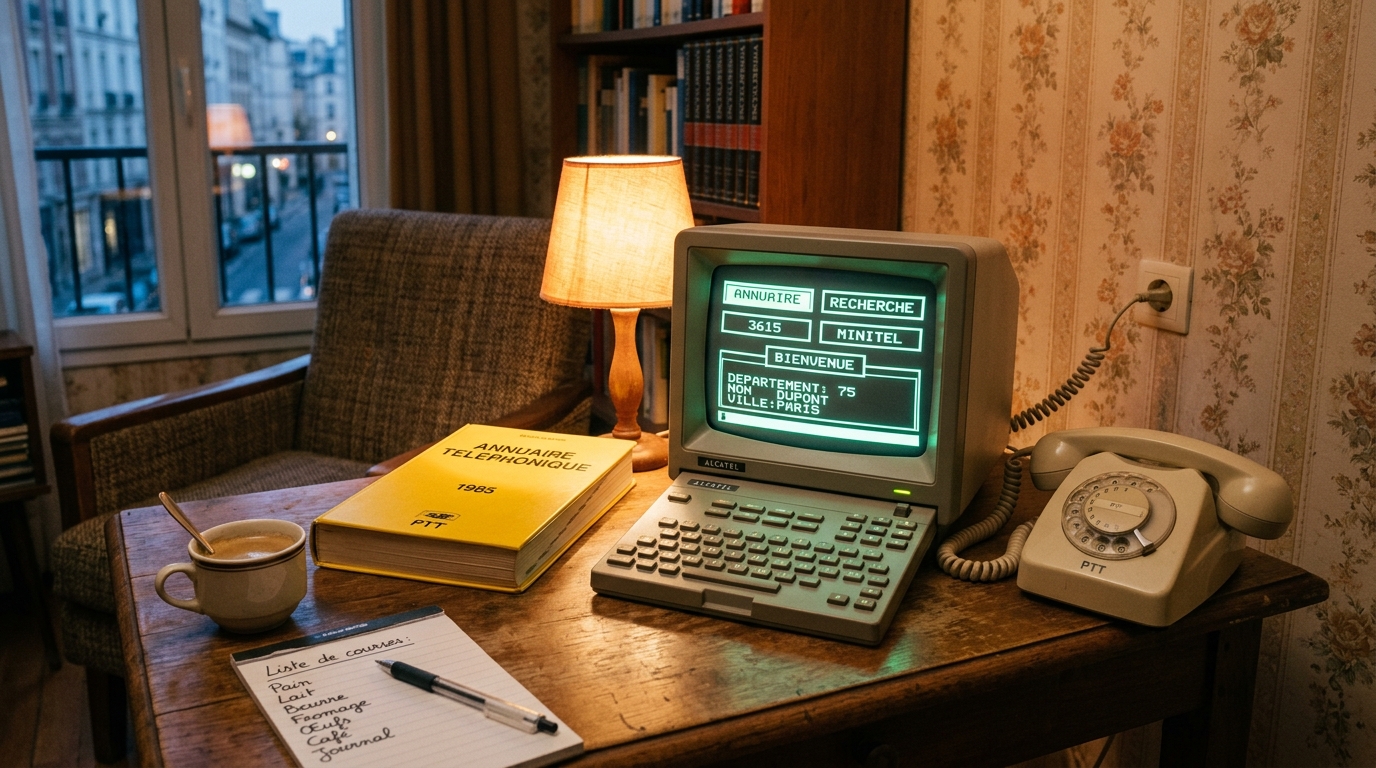
Imagine for a moment being offered at home, free of charge, a device capable of consulting the directory, booking a train ticket, or chatting with strangers, and this long before the word internet entered common vocabulary. This is precisely what France experienced with the Minitel, that small beige box distributed by the millions to households starting in the 1980s. For nearly three decades, this seemingly modest object shaped the digital habits of an entire country, before fading away quietly, without fanfare, leaving behind hundreds of thousands of die-hard users who never wanted to part with their old communication companion.
- Distributed free starting in 1982 by the State to replace the paper directory, the Minitel equipped up to nine million households and businesses in France by 2002.
- Operating on the X25 network, it already offered messaging, forums and online booking services long before the internet reached households.
- Orange permanently shut down the network on June 30, 2012, while around 810,000 terminals were still in use.
- A State Gift That Changed the Daily Lives of the French
- How This Beige Box Invented the Internet Ahead of Its Time
- Why Hundreds of Thousands of Households Remained Loyal to It Despite the Web
- On June 30, 2012, the Last Connection and Its 810,000 Die-Hards
A State Gift That Changed the Daily Lives of the French
To understand how much the Minitel left its mark, one must place it in the context of its launch in 1982. At that time, the French state, through its telecommunications sector, took a bold gamble: instead of continuing to print and distribute paper telephone directories on millions of copies, it would equip households directly with an electronic terminal capable of displaying this information on demand. The result is that the Minitel was lent for free, with the French people not having to pay a penny for the device itself. A shrewd strategy that enabled a widespread and nearly instantaneous diffusion, far faster than any conventional commercial launch.
This choice had consequences that extended well beyond the simple use of the directory. In just a few years, millions of households found themselves with access to services that did not exist anywhere else in the world in this form. The Minitel thus became a day-to-day object, almost as ordinary as a landline telephone, and its peak of success came in 2002, a period when it equipped no fewer than nine million households and businesses across the French territory.
How This Beige Box Invented the Internet Ahead of Its Time
What makes the Minitel so fascinating in hindsight is that it anticipated uses that are now exclusively associated with the web. Instant messaging, discussion forums, online booking services, reading news or weather: all of this existed already on the Minitel, years before the French public discovered the internet. The famous 3615 Météo service from Météo-France is a perfect example, a service consulted daily by thousands of people before giving way to modern websites.
Technically, the Minitel ran on a network called X25, a packet-switched technology that allowed data to be exchanged reliably, even if it now seems slow and archaic compared with fiber optics. It’s a bit like comparing a stagecoach to a high-speed train: the transport principle remains the same, but the time scale is completely different. Yet this technology was enough for years to power an entire ecosystem of services, proof that innovation does not depend solely on raw power, but also on the relevance of the uses proposed.
Why Hundreds of Thousands of Households Stayed Loyal to It Despite the Web
One might think that the arrival of the internet in French homes in the late 1990s and early 2000s would have immediately sounded the death knell for the Minitel. Yet that was not the case, or at least not as quickly as one might have imagined. A significant portion of the population, often older people or those not comfortable with the nascent computer world, continued to use their Minitel for many more years, reassured by the simplicity of a tool they mastered perfectly.
This loyalty can also be explained by the complete absence of a learning curve. No need to install software, configure a connection, or fear a computer virus; you simply turned on the device and dialed a four-digit code to access the desired service. For many, this was a guarantee of peace of mind that the web, seen as more complex and sometimes anxiety-inducing, could not offer in the same way. It is this understandable technological conservatism that explains why the shutdown of the network had to be postponed several times by Orange, to give service editors and users time to migrate smoothly to other solutions.
On June 30, 2012, the Last Connection and Its 810,000 Die-Hards
The definitive closure of the Minitel did not happen overnight. A decree from December 2009 had already established that France Télécom was no longer obliged to maintain the packet-switched service on the X25 technology, opening the way to a gradual dismantling. The technical closure was initially planned for September 2011, but Orange preferred to push back the deadline, first by stopping sales in March 2012, then by scheduling the definitive shutdown of the network for June 30, 2012, exactly thirty years after its launch.
That day, the X25 network fell silent for good, ending three decades of loyal service. And the figure is striking: according to a France Télécom spokesperson, around 810,000 terminals were still in operation at the time of the stop, a rough estimate echoed by a question raised in the National Assembly that cited nearly 800,000 active devices. In other words, nearly thirty years after the start of its free distribution to French households, the Minitel still counted hundreds of thousands of die-hards at the moment Orange finally unplugged the device. To aid the transition, terminal rental had already ceased in March 2012, and a recycling program was put in place directly in Orange stores to ensure these old beige boxes did not simply end up in the trash.
Looking back, the fate of the Minitel nicely summarizes how an innovation can leave a lasting mark on a society before fading away in the face of a more powerful technology. It never rivaled the visual richness and the power of the web as we know it today, but it earned its place by educating entire generations of French people to the idea that a screen could carry information, social connection, and practical services right into their living rooms. A chapter of French technological history, in short, deserving of a moment’s reflection before it falls completely into oblivion.
