
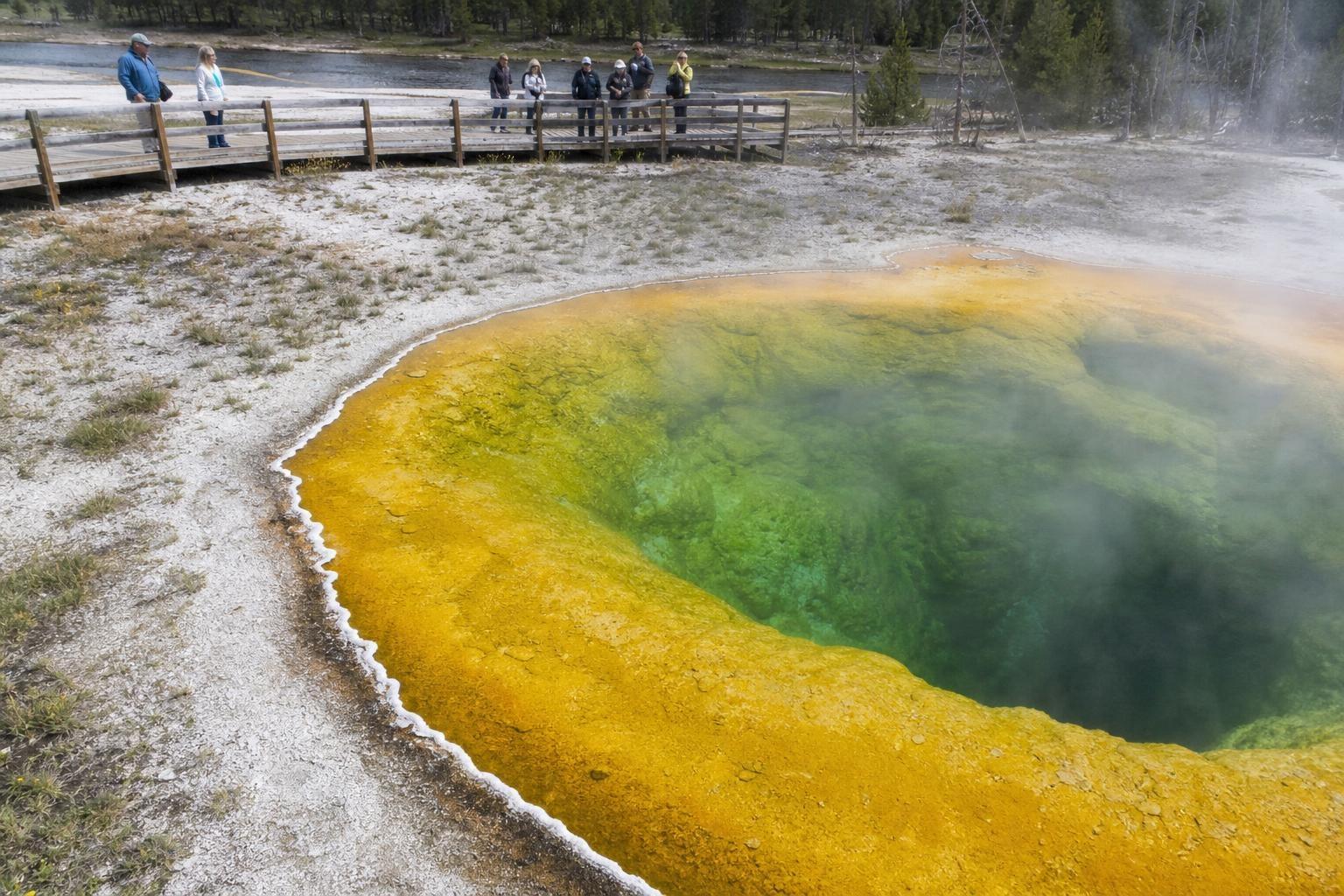
Steam rises like silk from a turquoise eye in Yellowstone, and sunlight scatters into jewel tones. For decades, visitors have leaned over the sinter rim, whispering “just one coin,” and letting metal ping into the depths with a wish. That ritual felt harmless, even charming — until the colors began to shift, and the pool’s microbiology began to answer.
A rainbow rewritten by small acts
What looks like magic is really physics plus biology. Tossed coins — along with rocks, trash, and windblown debris — accumulated on the pool’s vent and floor. That clutter altered the hot spring’s plumbing, nudging water flow and temperature. Cooler water invited heat-loving but shade-tolerant microbes, whose pigments paint the pool in greens and golds.
“Just one coin” turns into thousands, and thousands become a new environment. Layer by layer, the bottom mat gets more textured, more alive, and the pure optical blue of deep, clear, scalding water competes with living pigments that twist the final hue.
How metal changes a hot spring
Coins don’t act like dye, and they rarely “leach” color at meaningful scales. Their bigger impact is mechanical. Metal piles disrupt convection cells, change where superheated water rises, and blanket porous vents like a loose cap. That cap cools the system by a few crucial degrees, enough to shift which microbes can thrive.
Some metals can seed mineral crusts, encouraging silica and carbonate to deposit differently. Bits of foil, hair ties, and bottle caps add rough surfaces where biofilms can get a foothold. In a hot spring, fluid motion is everything; change the flow, and you change the palette.
The microbial bloom that followed
When the water cools slightly, thermophiles with chlorophyll and carotenoids crawl across the margins like living paint. Their yellows and oranges blend with the water’s natural blue, which the eye reads as rich greens. Near vents that remain hottest, the blue can still flash, a memory of what the pool once showed before the slow accumulation of metal and time.
Microbial mats are not graffiti; they’re the ecosystem’s honest response. Give them the right temperature and substrate, and they bloom with precision. Pull those conditions away, and the mats retreat, but not without scars to fragile mineral edges and plumbing that took centuries to form.
What the science shows
Spectral measurements and thermal models have traced the color change to modest drops in temperature and increased light scattering from microbial mats and suspended particles. Reconstructed scenarios show that a slightly hotter, clearer pool reads as deep blue, while a cooler, debris-influenced pool trends toward green. In other words, the system didn’t shift by a mile — it nudged by a few careful degrees, and the colors followed suit.
Park records also document decades of vandalism both casual and intentional — soap, rocks, pennies — all adding up to a chronic pressure. “Tiny choices, big outcomes,” as one ranger likes to tell passing families by the wooden railing.
Why scooping it out isn’t simple
You might think: just send a diver, grab the coins, reset the clock. But these pools are dangerously hot, chemically caustic, and structurally delicate. A single misplaced boot can crush the brittle sinter rim, opening new flow paths that won’t “heal” on a human timeline. Mechanical removals risk stirring sediments, stripping mats, and shocking a finely tuned plumbing network.
Rangers do periodic cleanups with specialized tools, but total removal is rarely possible or wise in one aggressive go. The goal is to reduce ongoing stress while letting the system find a new, stable equilibrium without further harm.
How to honor the pool instead
The most powerful restoration tool is restraint. Keep your wishes and your coins in your pocket, and give the microbes and minerals the quiet they need.
- Stay on boardwalks, keep items secured, never toss objects, and share the “no coins” message with the next visitor.
What the colors are saying now
The green isn’t a failure; it’s a message. It says the spring has been forced a few degrees toward a different story, and that life will seize any chance we give it. Stand there a minute longer and you’ll hear the soft boil, see convection cells trace slow spirals, and feel the tug of wanting to leave a tiny, metal mark behind.
Resist that urge. The most generous souvenir is the one you don’t throw. As the steam lifts and the wind flicks it away, the pool returns your gaze with a living spectrum — blue where heat still rules, green where our habits have made room for pigment and light. If enough people choose empty hands over clinking wishes, tomorrow’s palette may drift a little bluer, and the park’s quiet chemistry can keep doing its ancient, invisible work.
