
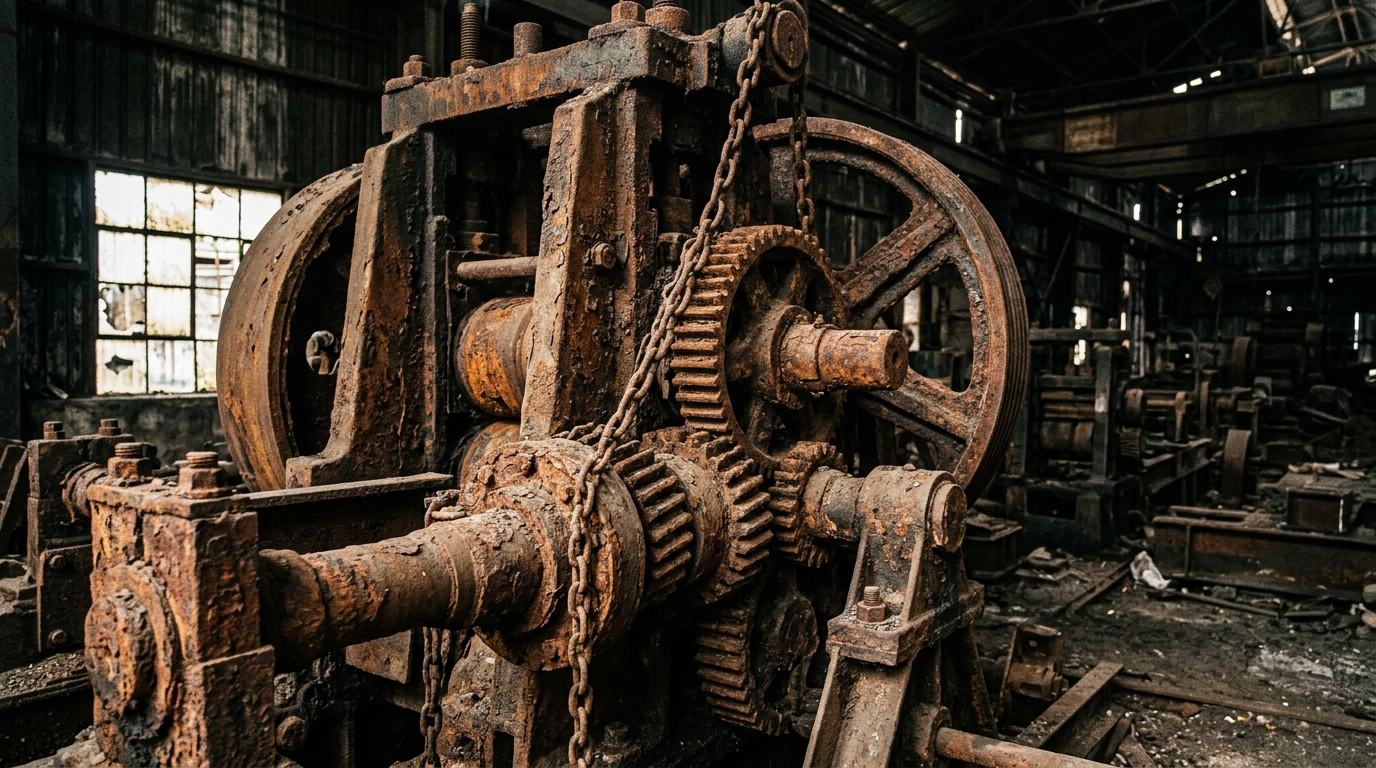
Imagine a factory nearly finished, 98% complete according to its promoters, that has slept for more than forty years without ever producing a single marketable sheet of steel. This paradox has a name: the Ajaokuta Steel Company, in Nigeria. On paper, everything was in place to make it the flagship of West Africa’s industry. In reality, this steel complex has become the symbol of a dizzying financial chasm, where coups, recycled political promises from one decade to the next, and payroll invoices keep piling up for a plant that is shut down. Nigeria has spent more than $8 billion there over forty years, including $495 million in arbitration in 2022, and has still listed 6.21 billion naira in salaries in the 2025 budget. A dossier that, by its scale and absurdity, deserves closer attention.
- Launched in 1979, the Ajaokuta steelworks has remained stalled after the 1983 coup and has never produced a single commercial sheet despite an officially cited 98% completion rate.
- Nigeria has spent between $8 and $10 billion since 1979 (well over the cost of building comparable steel plants) in addition to a $495 million arbitration win against it in 2022.
- The 2025 budget earmarks 6.21 billion naira in salaries for the idle plant, representing 91.19% of the entire 2025 budget for the facility, even though on-site visits report only a dozen people present against 10,000 listed on the payroll.
- A ghost plant 98% finished that never produced a sheet
- Forty years of promises and more than $8 billion swallowed
- The $495 million arbitration that exposed the scale of the fiasco
- 6.21 billion naira in salaries in 2025 for a plant still idle
A ghost plant 98% finished that never produced a sheet
The Ajaokuta project was born in 1979, driven by the ambition to equip Nigeria with a heavy industry capable of rivaling the great steel powers. The idea was simple on paper: build an integrated complex, from ore extraction to the production of commercial sheets, to free the country from its steel imports. But the project never survived Nigeria’s political upheaval. In 1983, a military coup led by General Muhammadu Buhari overthrew President Shehu Shagari, and works on the site were brutally halted. Since then, the plant has carried a nearly mythic reputation: officially completed at 98%, it has never delivered a single commercial steel sheet. A figure that, in itself, sums up the absurdity of the situation: we are almost at the end of the industrial journey, but that last mile seems insurmountable for four decades.
What is striking, above all, is the contrast between reported on-site visits and the company’s official records. It claims to employ no less than 10,000 people on its payroll. Yet, during site visits, no more than about a dozen people were observed. In other words, the plant resembles more a static backdrop than a functioning industrial site, with buildings that continue to exist on administrative paper far more than in the reality on the ground.
Forty years of promises and more than $8 billion swallowed
Between 1979 and 1994, the Ajaokuta project would have consumed between $8 billion and $10 billion of public funds, according to available estimates. To give a sense of the scale, comparable on-site integrated steel plant projects today cost between $1 billion and $4 billion. Nigeria has thus spent, on a plant that never operated, two to ten times the budget needed to build similar facilities that are fully operational elsewhere in the world. It is as if one paid the price of an entire building to end up with an empty lot with a few foundations.
This financial abyss did not close with the years. Each decade brought its share of promises to revive it, announced investors, and modernization plans supposedly finally to bring real production to life. Since 2023, the administration of President Bola Tinubu has likewise multiplied reassuring statements about a forthcoming revival of activity. But no tangible progress has ever been observed on the ground. Even more, personnel and operating costs continue to rise each year, as if the plant’s inactivity paradoxically carries an ever-higher price.
The $495 million arbitration that exposed the scale of the fiasco
Beyond the construction figures, the Ajaokuta dossier has also seen its share of international legal twists and turns. In 2022, arbitration proceedings led to a ruling valued at $495 million, an amount that ultimately highlighted the chaotic management of the site since its origins. The decision reminded how the project, initially conceived as a national industrial showcase, morphed into an expensive dispute, adding a new line of expenditure to an already dizzying bill. For a country seeking to diversify its economy beyond oil, this kind of episode weighs heavily in public debate, especially as it adds to a long list of unkept promises.
This legal dispute also illustrates the complexity of the site’s governance, mixing foreign investors, public authorities, and contractual commitments never fully honored. The result is a piling up of financial liabilities that accumulate year after year, without any sheet of steel ever coming off the production lines to offset, even partially, these colossal sums.
6.21 billion naira in salaries in 2025 for a plant still idle
The most troubling perhaps is the current budgeting mechanism. For the 2025 fiscal year, the Nigerian federal government allocated 6.21 billion naira to the salaries of Ajaokuta’s employees alone, up from 4.29 billion naira the previous year. An increase that raises questions, since the plant has produced no commercial sheet since its inception. Even more striking, these personnel costs accounted for 91.19% of the total 6.81 billion naira budget allocated to the company for that same year. In other words, the overwhelming majority of public money poured into Ajaokuta is not used to restart production or modernize equipment, but solely to pay salaries for an activity that, on the ground, appears almost non-existent.
The 2026 finance bill, presented by President Tinubu in December, confirms this trend. The Nigerian steel sector receives a total envelope of 22 billion naira, of which 6.5 billion goes directly to Ajaokuta Steel Company, the largest allocation in the sector. At the same time, the company’s chief executive, appointed by President Tinubu in April 2025, earns a personal monthly salary of about 5.5 million naira, a payment confirmed at 5.578 million naira for August 2025 alone. This situation has not gone unnoticed within Nigerian institutions themselves. In February, Natasha Akpoti-Uduaghan, the senator representing Kogi Central, left a meeting of the Senate committee after a disagreement specifically about the management of this idle steel plant, a sign that the malaise now extends beyond the circle of economic observers to reach the highest political echelons of the country.
In the end, the Ajaokuta dossier perfectly illustrates how an ambitious industrial project can, over decades, transform into an administrative machine that sustains itself regardless of any tangible result. Billions of dollars swallowed, salaries paid to a workforce largely invisible on the ground, repeatedly renewed revival promises for years: the Ajaokuta plant resembles less a construction site and more a monument frozen in time, whose cost nonetheless keeps climbing. The question remains whether the coming years will finally bring the long-awaited first sheet of steel, or whether this case will continue to feed, year after year, the long list of major projects never completed.
