
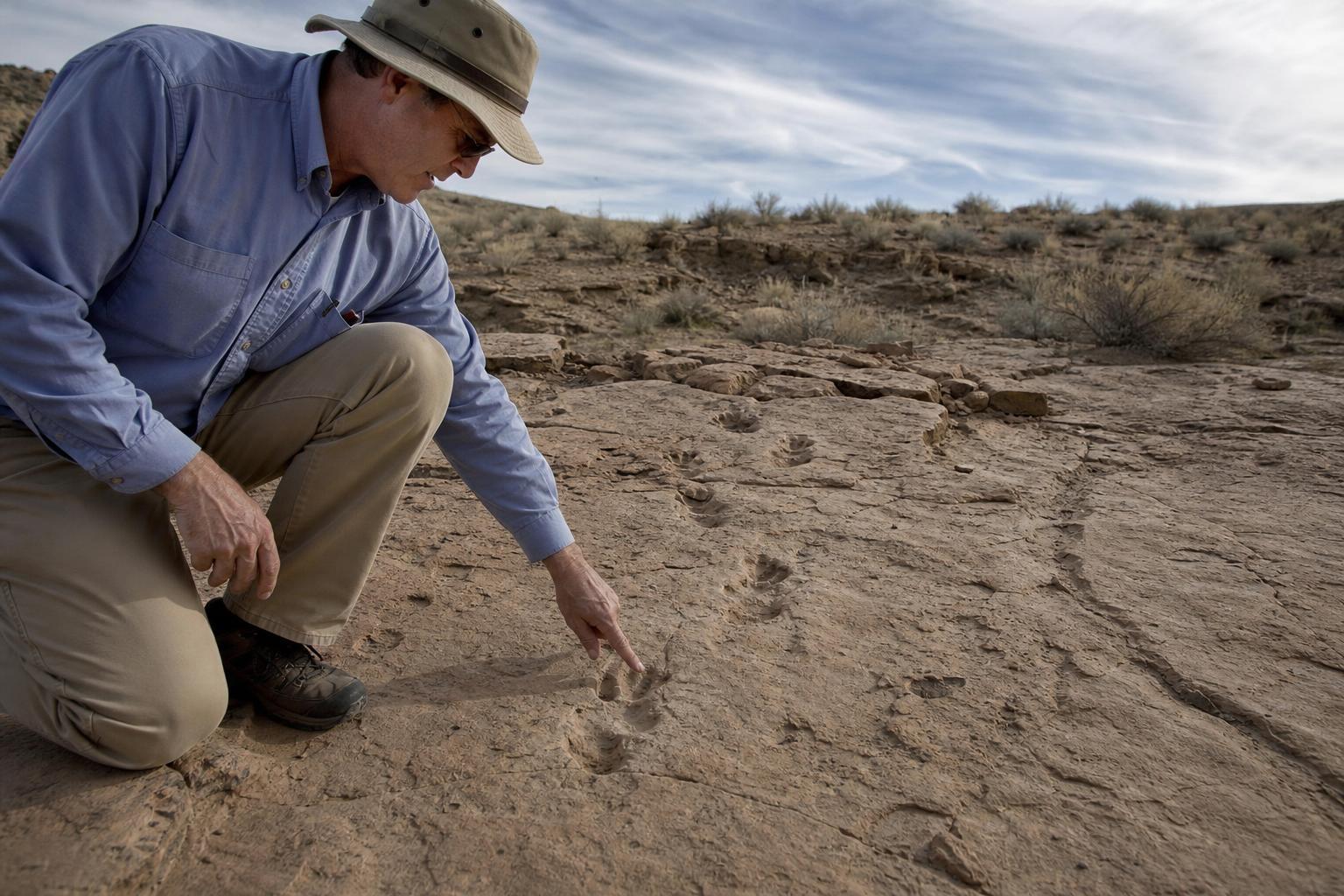
The wind lifts a skin of gypsum and reveals human steps that shouldn’t be there. In the heart of New Mexico, along the pale flats of White Sands, trackways press through ancient mud as if someone just walked away. The dates say roughly 23,000 years. The textbooks say that’s too early. Between those poles of data and doctrine stretches a story about how we know the past—and how often it steps ahead of us.
Sand that remembers
Across these shimmering dunes, prehistoric footprints drift in and out of visibility, preserved where lakeshore mud once gripped soft soles. Children sprint. Adults pace. A teenager lingers, turning mid-stride toward a companion. Nearby, the gouged ovals of giant sloths swing and stagger, mammoths stamp and pivot, and wolves cut arc-like paths. It is a living scene, not a scatter of tools or a solitary bone.
“Tracks are the most honest archaeology,” people like to say, because they show an action, not just an artifact. Here, the action spans hours, perhaps days, capturing a moment when humans were already entangled with Ice Age ecologies in a place we once thought empty.
How the clock was set
The claim of such antiquity rests on layers of dating, not a single test. Researchers used radiocarbon on tiny seeds from the sediments hugging the prints, then cross-checked with pollen grains tied to terrestrial plants and optically stimulated luminescence to date the sands themselves. Multiple lines of evidence, different labs, converging ranges—the picture sharpened with each pass.
Critics first raised the specter of reservoir effects—could aquatic sources make radiocarbon ages seem older? That challenge forced fresh sampling and independent methods, which, in turn, reinforced the timeline. As one scientist put it, “If you test a claim like this, you should expect the answer to get better.” In this case, better still points back—deep into the Last Glacial Maximum.
Why this shakes the timeline
For decades, the North American narrative tilted toward a late arrival, anchored to the spread of Clovis points around 13,000 years ago. Then pre-Clovis sites nudged the date earlier—to 14,000 or 16,000—suggesting coastlines and corridors rather than a single pulse through an ice-free gate. But footprints at ~23,000 years? That places people here when ice was thickest, climate was harshest, and corridors were more myth than map.
It implies either an even earlier pulse of movement, a coastal maritime strategy skirting ice-choked shores, or a patchwork of refugia that we have barely mapped. It also reframes “first Americans” not as a sudden debut but as a long, messy prologue marked by experiments in movement and survival.
What tracks can tell that tools can’t
Stone tools reveal technology. Bones reveal diet. But footprints narrate behavior in continuous time. You can see speed variations, detours, group size, even intimate moments—the pause, the pivot, the smaller prints wedged between the larger. They anchor humans to the same mud as megafauna, not by inference but by literal overlap.
“Footprints don’t lie,” goes another field saying. They can erode, distort, or be misread, but when preserved in stratigraphic order and backed by robust dating, they demand we reconcile presence with possibility.
Healthy skepticism, necessary revision
Skepticism is the engine of science, and the White Sands claim has had to run that gauntlet. That’s good. Extraordinary claims deserve layered tests, attempts at replication, and open data. What’s notable is how the case has strengthened under pressure—new methods, new samples, convergent results. The debate isn’t over, but it’s no longer a simple dismissal.
If these dates hold, they don’t just alter a chapter—they move the opening scene. And that means revisiting assumptions about routes, resources, and the tempo of human adaptation at the cold edge of the world.
What changes now
With the prints as a north star, several shifts come into view:
- Broader searches along submerged coastlines, lake margins, and eolian basins, using integrated dating suites and targeted microstratigraphy to catch brief human episodes that artifacts often miss.
We may also see a pivot from “first entry” questions to “how did people live here?” questions—wintering strategies, plant use, mobility loops, and social networks braided across ice, water, and open steppe. That line of inquiry treats early peoples not as pioneers on a timer but as neighbors in dynamic landscapes.
A timeline with footprints on it
History is not a single path but a tangle of tracks, some sharp, some half-blown by weather. On the White Sands playa, those tracks make a clear claim: humans were already on this ground far earlier than our tidy charts would allow. “Rewrite the margins,” the prints seem to say. “Start the story sooner.”
And maybe that’s the deeper lesson. The past doesn’t wait for our theories. It steps out of the sand, taps the glass of our certainties, and keeps walking.
