
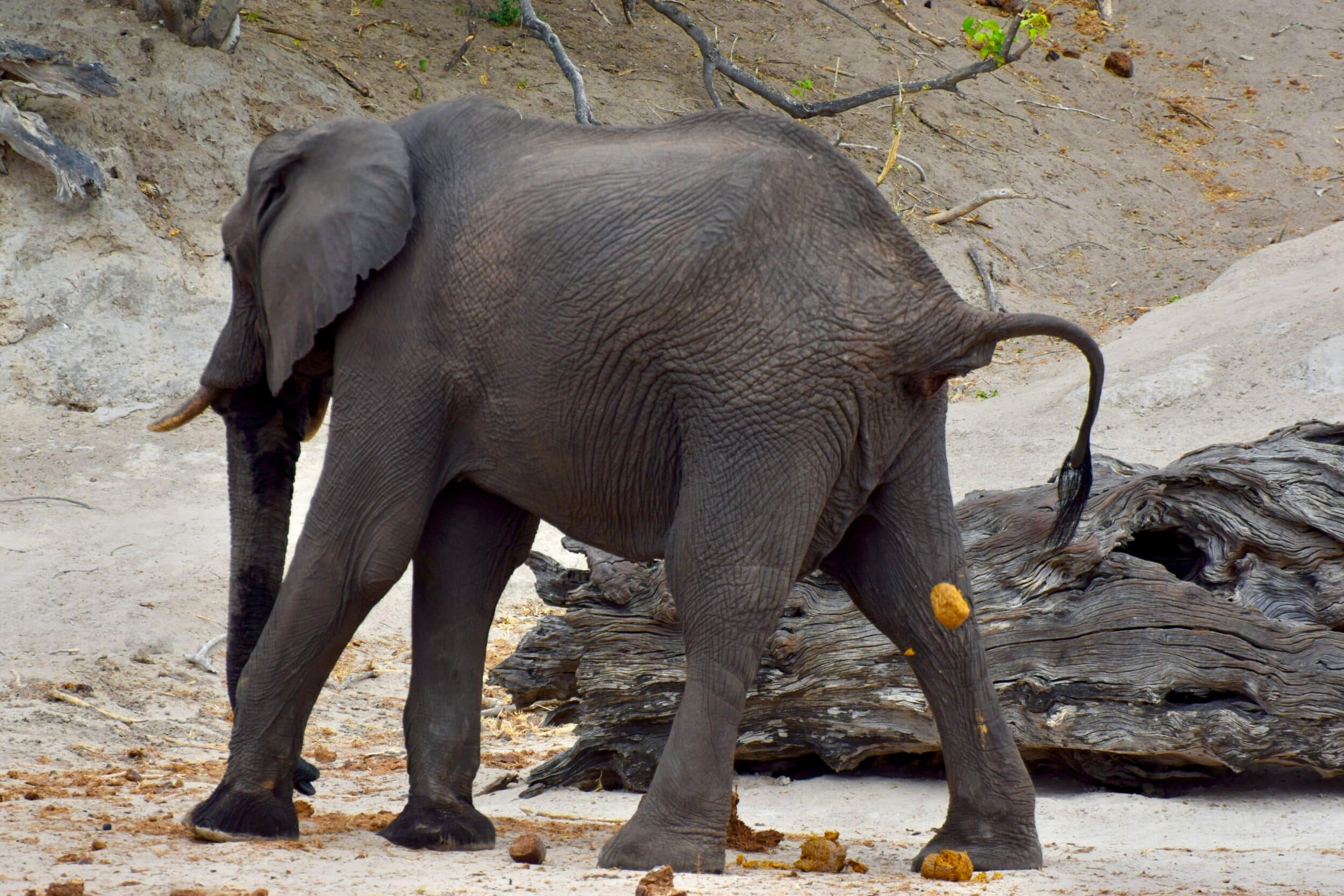
It is a culinary paradox that fascinates as much as it repels. To savor one of the planet’s most exclusive and expensive coffees, you must accept that the beans have traversed the digestive tract of a four-ton pachyderm. The “Black Ivory Coffee,” produced in Thailand, is sold at royal prices for its legendary smoothness and chocolatey notes. Until now, this unique taste bordered on anecdote or marketing. But a new scientific study has confirmed that the secret of this superior aroma truly lies in a “bacterial alchemy” taking place deep inside the elephant’s guts.
Natural fermentation at the heart of the jungle
Forget Kopi Luwak, the coffee harvested from civet excrement (a small Asian mammal), often criticized for the conditions in which the animals are kept. The new king of “luxury coffee” is Black Ivory. Produced exclusively in a sanctuary in Thailand, this coffee follows a rather unusual manufacturing process: Asian elephants (Elephas maximus) are fed Arabica coffee cherries mixed into their usual fruits and rice.
Once ingested, the cherries embark on a digestive journey lasting several hours. The stomach acids and the animal’s body heat act as a natural fermentation vat. The beans, resistant to digestion, are then manually collected by the mahouts (elephant keepers) from the droppings, before being meticulously washed, dried, and roasted. The result? A brew devoid of the traditional coffee bitterness, sold at prices hovering around 2,000 euros per kilogram.
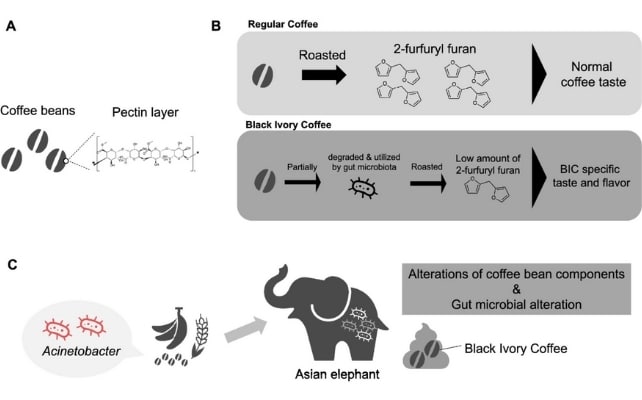
The secret lies in the disappearance of pectin
To understand the chemistry behind this “silky” taste, a team of researchers led by genomicist Takuji Yamada of the Institute of Science in Tokyo studied the elephants’ microbiome. Their hypothesis was simple: the bacteria in the elephant’s gut alter the chemical structure of the bean even before harvest.
To prove it, the team compared the dung of elephants that had consumed coffee with that of a control group that had not eaten. The results, published in the journal Scientific Reports, are definitive. The elephants who “drank coffee” showed an explosion of specific bacterial populations equipped to degrade two key substances: cellulose and pectin.
This is where the flavor is made. Pectin is a complex sugar found in the cell walls of plants (this is what makes jam gel). However, in a standard coffee bean, pectin poses a problem: during roasting, it breaks down and produces bitter compounds, notably the 2-furfuryl furane.
The study reveals that the elephant’s bacteria, by digesting this pectin to feed themselves, literally “clean” the bean of its bitter precursors. The bean that emerges from the elephant is therefore chemically purged. When roasted, it can no longer develop this harsh bitterness, making way for the subtler aromas of cocoa and spice.
The elephant: a unique chemical factory
Researchers pushed the investigation further by comparing the elephant’s microbiota with that of other farm animals such as cows, pigs, or chickens. They sought to determine whether any herbivore could produce an exceptional coffee.
The answer is no. Although other animals harbor certain bacteria capable of degrading cellulose, the Asian elephant is the only one with the complete and specific enzymatic arsenal necessary to effectively break down these structures on coffee beans. It is this unique combination of bacteria, paired with the length of the animal’s intestinal transit, that creates the perfect conditions for this biological fermentation.
As described in the full study available in Scientific Reports, this discovery opens a fascinating path: by understanding which microbes are responsible for this aroma, one could theoretically reproduce this fermentation process in the laboratory, without needing to go through the animal. But for now, the softest coffee in the world remains the one that has undergone the strangest journey.
