
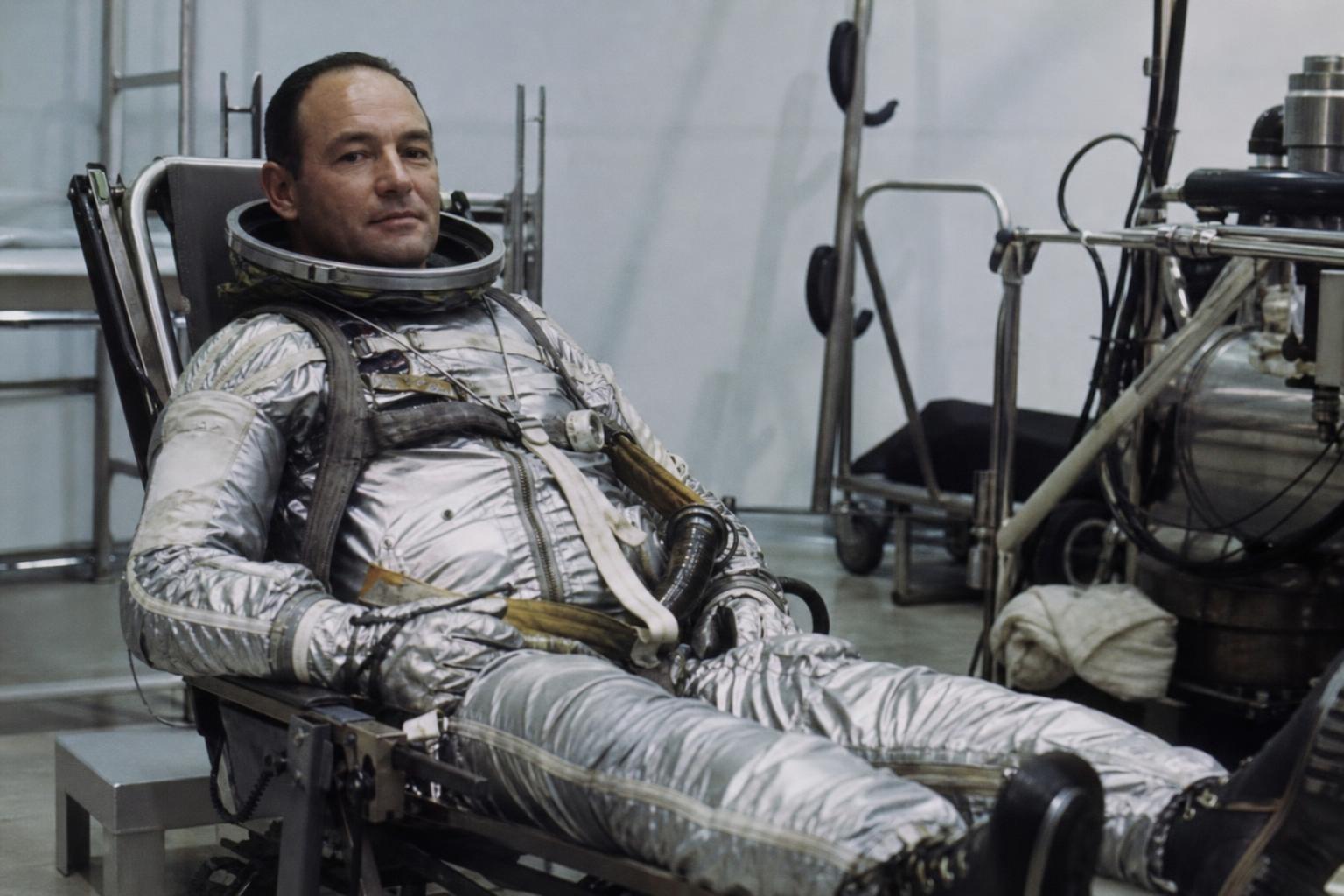
Dawn over the desert, a helium balloon rising until the blue thins to near-black and the ground blurs into a map. A man in a pressurized suit stands on a tiny metal platform, 31 kilometers up, where sound is muffled and time feels bent. He steps into the void, a white dot shrinking against a vast sky, and after four minutes and thirty-six seconds of wind and stillness, silk flowers open and the Earth takes him back.
The problem that sent a human off the edge
High-altitude flight in the late 1950s forced a hard question: What happens if a pilot must leave an aircraft in the stratosphere? “Can a human survive the fall?” engineers asked, “and under what conditions?” Military and medical teams needed data, not guesswork, to design ejection systems and suits that would keep aircrew alive.
Project Excelsior answered with bold experiments: ascend under a massive balloon, step off at the edge of near-space, and measure everything that follows. The man who volunteered was a calm test pilot with an appetite for measured risk, trusting instruments more than luck.
Engineering a path back to Earth
The ascent tool was a gossamer giant—a helium balloon big as a cathedral when fully expanded, lifting a slender gondola bristling with gauges and radios. The pilot wore a sealed pressure suit and helmet, a one-person spaceship designed to keep his blood from boiling in the near vacuum and to protect him from brutal cold.
One glove failed to pressurize, and his hand swelled painfully during the climb, a reminder that at this height even small leaks have big consequences. A stabilizing drogue parachute—not the main canopy—hung ready to tame any spin that could turn a human into an unconscious gyroscope, as had nearly happened in an earlier test.
At the top, the wind was almost nothing, the horizon a curved line, the Sun harsh and clean. “This is the thin place,” one might whisper, “where Earth ends and blackness begins.”
Four minutes and thirty-six seconds that rewrote limits
He stepped off with a gentle push, and the gondola slid silently away. At first there was no rush of air—only the eerie sense of hanging—because the air at that altitude is too thin to make noise. Then, as he fell into thicker layers, drag built, wind found him, and the fall turned from dreamlike to very, very real.
In that long arc, the physics are stark: less air, less drag, higher terminal velocity. He accelerated quickly and reached roughly 614 mph, still below the local speed of sound, but fast enough for the suit to work its absolute limits. “It doesn’t feel like falling,” some jumpers say, “it feels like the Earth is rising.”
Blood oxygen stayed steady, the suit stayed sealed, and the drogue kept him from a catastrophic spin. As altitude unwound on the instruments—numbers tumbling like a mechanical waterfall—the sky brightened from cosmic indigo to ordinary blue. Only after four minutes and thirty-six seconds did the main canopy blossom, the violent to gentle in a single, glorious snap.
Why the thin air behaves so strangely
The stratosphere’s extreme environment makes a fall at 31 km profoundly different from a skydive at a few thousand meters. Key factors include:
- Air density is dramatically lower, so acceleration lasts longer before significant drag builds and terminal velocity is much higher.
- Temperatures can plummet to well below freezing, which stresses suit materials and gas systems.
- Pressure is so low that any suit breach risks ebullism—body fluids beginning to boil at normal body temperature.
- Unchecked spin can exceed 100 rpm, causing blood to pool and the jumper to blackout; a small drogue adds stabilizing drag.
- The main parachute typically deploys far lower—around 18,000 feet—to avoid high-speed canopy damage.
What we learned—and how it lives on
This single, audacious fall fed reams of data to aerospace medicine and ejection-seat designers. It validated pressure-suit architectures, informed oxygen flows, and refined automatic deployment devices that trigger canopies even when a person is incapacitated.
Its ripple carried across decades. Later high-altitude jumpers—using more modern materials and refined life-support systems—pushed beyond this early benchmark. One returned to the program as a mentor and radio voice, proof that hard-won knowledge can become someone else’s quiet confidence.
Beyond checklists and charts, the image endures: a tiny human stepping from a tiny ledge, trusting math, fabric, and steady breath. “Risk without learning is just danger,” the mantra goes, “but risk with learning becomes progress.” That difference is written in every seam of the suit, every rivet of the gondola, and every crisp number logged on the way down.
In the final moments, canopy rustling and desert air full in the ears, the world turned ordinary again—scent of dust, the tug of gravity at human scale. The grand experiment ended the way all great experiments should: with a safe landing, a notebook full of answers, and new questions reaching higher than before.
