
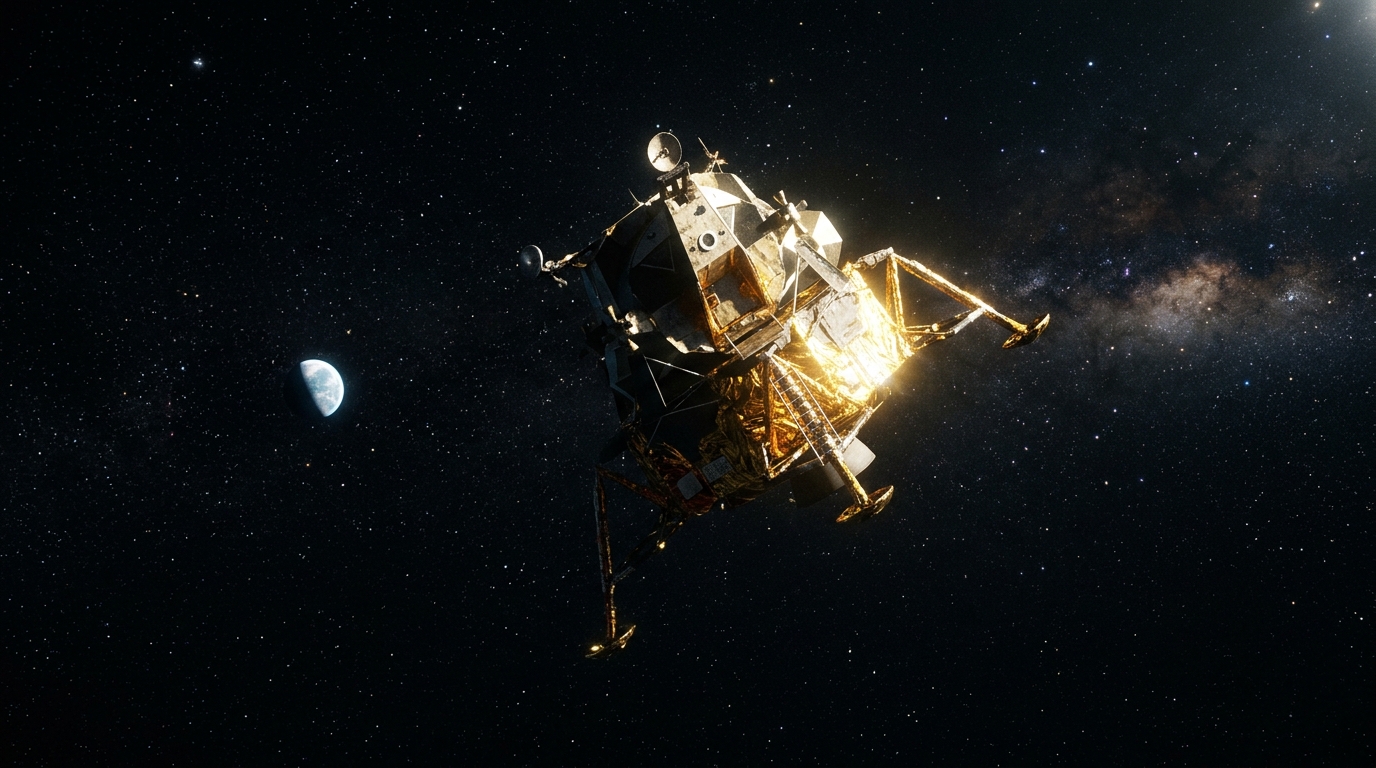
Imagine a spacecraft abandoned for more than half a century, silently gliding between the orbits of Venus and Earth, unseen by the world since it departed from terrestrial control. That is the fate that befell Snoopy, that piece of American space history never seen again since its release into solar orbit. As autumn nights grow longer and skywatchers gaze upward with a bit more attention, a new announcement has late-night enthusiasts of lunar exploration buzzing: a British astronomer claims he may have found this relic, millions of kilometers from home.
- The Snoopy ascent stage, jettisoned into solar orbit after the May 1969 Apollo 10 mission, vanished from NASA radar due to a propulsion miscalibration
- British astronomer Nick Howes puts the odds at 98% that the asteroid catalogued as 2018 AP4 could be that module, given its heliocentric orbit, its size, and hints of an artificial origin
- Because spectral analysis at such distance is not feasible, confirmation or refutation may have to wait about eighteen years, until the next close approach of the object
- Why NASA Abandoned Snoopy in Space
- A Suspect Asteroid Spotted Millions of Kilometers Away
- How Howes Carried Out the Investigation Without Definitive Proof
- What This Discovery Would Change for Space History
To understand this extraordinary space hunt, we must go back to the Apollo 10 mission, launched in May 1969. That mission represented the penultimate test flight before the first lunar landing of Apollo 11, a few weeks later. Astronauts Thomas Stafford and Eugene Cernan were tasked with rehearsing the entire descent procedure without actually setting foot on the Moon. They carried the lunar module, affectionately nicknamed Snoopy in homage to the famous comic strip beagle, to a mere 15.6 kilometers from the Moon’s surface — an awe-inspiring flyby that validated the critical descent maneuvers.
Once this dress rehearsal was complete, the astronauts climbed back into the command module, nicknamed Charlie Brown, leaving behind Snoopy’s ascent stage. NASA’s original plan was to send this stage into a heliocentric orbit, thereby removing it from Earth’s gravitational influence for good. The problem: the propulsion used at that moment apparently was not calibrated optimally. As a result, the space agency simply lost track of the craft once it was released onto its trajectory. Since May 1969, Snoopy has been roaming somewhere in the solar system, with no one knowing precisely where to search for it.
A Suspect Asteroid Spotted Millions of Kilometers Away
That is where Nick Howes, a British amateur astronomer and member of the Royal Astronomical Society, enters the narrative. As early as 2011, Howes embarked on what could seem like a fool’s errand: locating a small metallic object that had vanished decades earlier amid the billions of bodies populating our solar system. At the time, Howes himself assessed his odds at about one in 235 million, underscoring the magnitude of the challenge.
Yet years of patient work and cross-checking gradually paid off, at least in part. Howes focused his attention on an object catalogued as 2018 AP4, previously treated as a mere asteroid in astronomical databases. Its size, its heliocentric path, and certain indications of an artificial origin drew his curiosity. In June 2019 — roughly fifty years to the day after Snoopy disappeared — the astronomer announced he was now 98% confident that this object could indeed be the abandoned lunar module. The claim stirred significant attention within the space-enthusiast community, even as it carried a cautious note.
How Howes Carried Out the Investigation Without Definitive Proof
In an interview with Newsweek magazine, Nick Howes detailed the elements leading him to this hypothesis. He argued that the heliocentric orbit aligns with what one would expect from Snoopy after its abandonment, the object exhibits characteristics compatible with an artificial rather than a natural origin, and its estimated size matches that of an ascent stage from a lunar module. Taken together, these clues paint a portrait that is intriguingly suggestive.
Yet Howes and his team remain cautious, which is to their credit. To definitively identify the object, far more extensive observations would be required — notably spectroscopic analyses that could reveal the signature of manufactured metallic materials. However, 2018 AP4 is currently too remote from Earth for such precise study. Even after years of meticulous effort, researchers cannot say with absolute certainty that they have located NASA’s lost Snoopy. The investigation remains open, perched between scientific intuition and the practical limitations of verification.
What This Discovery Would Change for Space History
If Howes’ hypothesis were someday confirmed, the implications would extend far beyond a mere curiosity. Reuniting Snoopy with the annals of history would complete a loop of more than half a century, giving a tangible existence to an object that long occupied only a footnote in the chronicles of lunar exploration. For space enthusiasts, it would also serve as a powerful reminder of just how rigorously the Apollo missions were prepared: every test flight, even those that did not culminate in a Moon landing, helped to secure the ultimate success of Apollo 11.
One major constraint remains: according to current orbital calculations, we must wait roughly eighteen years for the next close approach of the suspected object near Earth. It will be then, and likely only then, that instruments capable of providing the needed measurements could finally confirm or dismiss the true identity of 2018 AP4. Until that distant milestone arrives, the Snoopy case will continue to fuel discussions among amateur and professional astronomers alike, perched somewhere between historical fascination and scientific rigor.
This story reminds us how jealously the cosmos guards its secrets, even those we ourselves planted there. Between Nick Howes’s measured certainty and the absence of official confirmation, Snoopy’s mystery perfectly illustrates the tension inherent in amateur astronomy: the thrill of spotting something extraordinary, with no immediate proof that it is what it appears to be. Will we really have to wait nearly two decades to learn whether this forgotten module has found its rightful place in the pages of history?
