
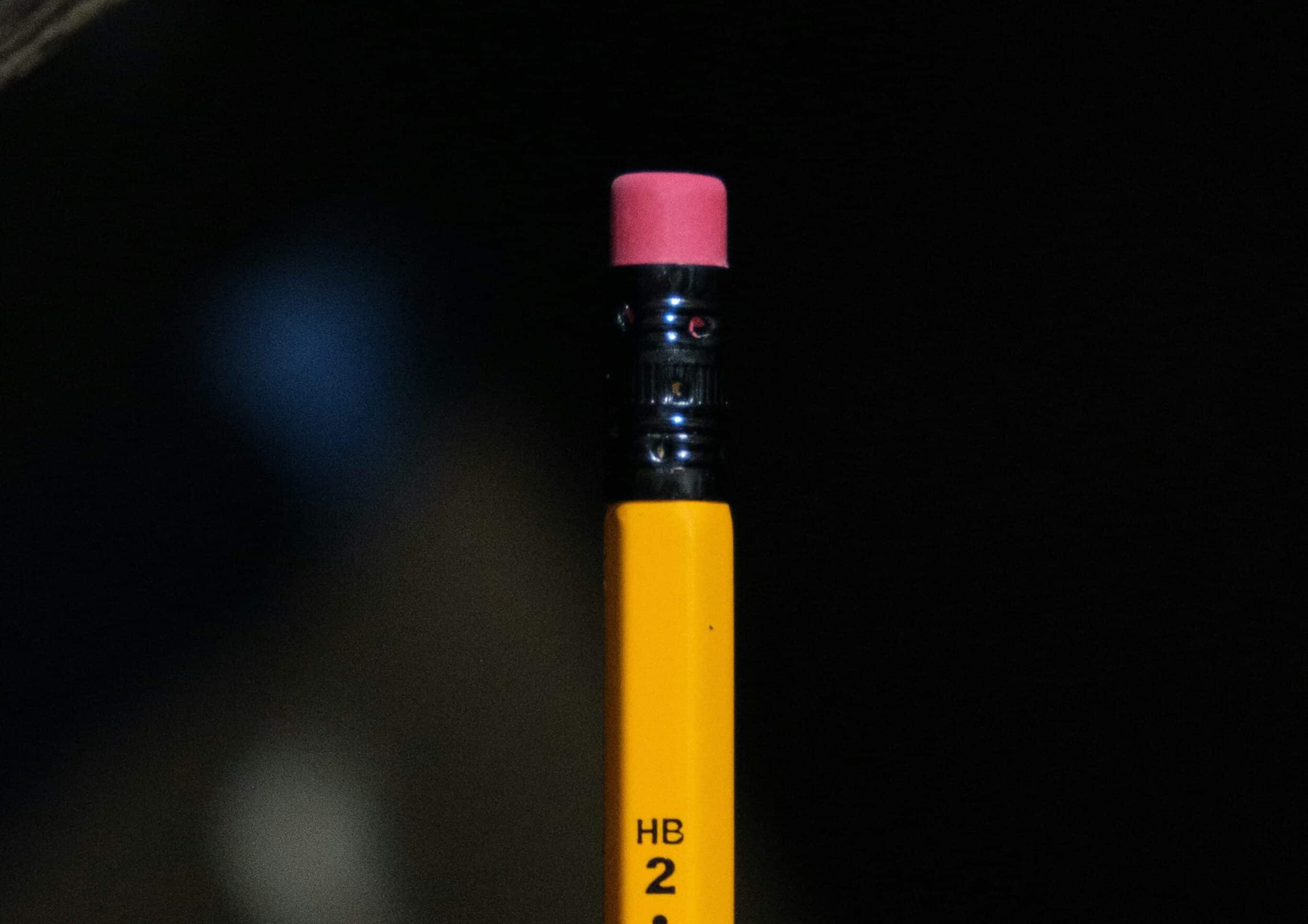
The pink eraser attached to the end of your pencil is one of the most banal objects in everyday life. Yet what it accomplishes at the molecular level every time you rub it is surprisingly sophisticated. Van der Waals forces, fluctuating electron clouds, controlled abrasion — behind this seemingly harmless gesture lies a physics that two chemistry professors have agreed to unravel.
What you will learn
- Why graphite clings to paper and how the eraser exploits this weakness to pull it away
- What van der Waals forces are and why they govern both the pencil and the eraser
- Why erasable pens work thanks to heat — and why your writing may reappear if you put them in the freezer
When you write, electron clouds come into play
A pencil does not contain lead — despite what it is still often called the “lead.” It contains graphite, a material made of sheets of carbon stacked on top of one another, known as graphene.
Each of these sheets is neutral. But its electrons are not stationary — they constantly fluctuate, making one face slightly positive and the other slightly negative at any moment. These temporary charges attract opposite charges from neighboring molecules.
That is what van der Waals forces are. And it is thanks to them that graphite sticks to paper when you write.
The eraser exploits a hierarchy of attraction
The principle of the eraser rests on a simple molecular competition.
Graphite adheres to paper via van der Waals forces — but this attraction is relatively weak. The eraser, whether natural rubber or synthetic plastic, exerts a stronger attraction on graphite particles than the paper does.
« These tiny graphite particles cling more to the rubber than to the paper , explains Dr. Joseph Schwarcz, professor of chemistry at McGill University. « By rubbing rubber against paper, we pull them off. »
Friction also plays a mechanical role: it dislodges graphite particles trapped between the fibers of the paper, while the eraser captures them as it passes. That is why erasers wear down and leave those characteristic gray specks — graphite particles trapped in fragments of torn rubber.
Soft erasers, hard erasers: a matter of balance
Not all erasers are the same — and it isn’t merely a marketing issue.
Abrasion from rubbing slightly wears the surface of the paper. An overly hard eraser can tear fibers, leave marks, or puncture the sheet. An overly soft eraser erases less precisely but protects the support.
Choosing hardness is thus a trade-off between erasing efficiency and preserving the paper — a balance that manufacturers tune depending on the intended use, whether for artistic sketches or corrections on administrative forms.
Erasable pens: a thermal illusion
Traditional inks behave differently from graphite. They penetrate the paper fibers and anchor themselves deeply — impossible to lift with a rubber eraser without tearing the surface.
Erasable pens from brands like Pilot solve this problem through another mechanism: thermochromic ink. This ink doesn’t truly erase — it becomes transparent when the temperature exceeds 60°C.
The rubbing of the eraser at the end of the pen generates exactly that heat through friction, breaking the chemical bond between the dye and its developer. The writing vanishes. Yet it remains, technically present in the paper.
Proof: place a sheet written with a erasable-pen in the freezer at around −20°C, and the ink components recombine. The writing reappears.
From Ancient Egypt to the 1868 patented eraser
Correcting writing mistakes is a need as old as writing itself. Scribes in ancient Egypt used white paint to mask errors on papyrus — a logic similar to that of Tipp-Ex, invented twenty centuries later.
Modern erasers have taken a more winding path. Before rubber, people used stale bread crumbs or wax. Natural rubber appeared in the 18th century, then hardened through vulcanization in the 19th. Synthetic plastic erasers arrived in the 20th century — partly because economic blockades during World War II cut access to natural rubber.
The pencil-eraser combination, patented in Philadelphia in 1868, itself did not take off immediately: the Japanese manufacturer Tombow launched its first pencil in 1913 — and its first eraser 26 years later.
