
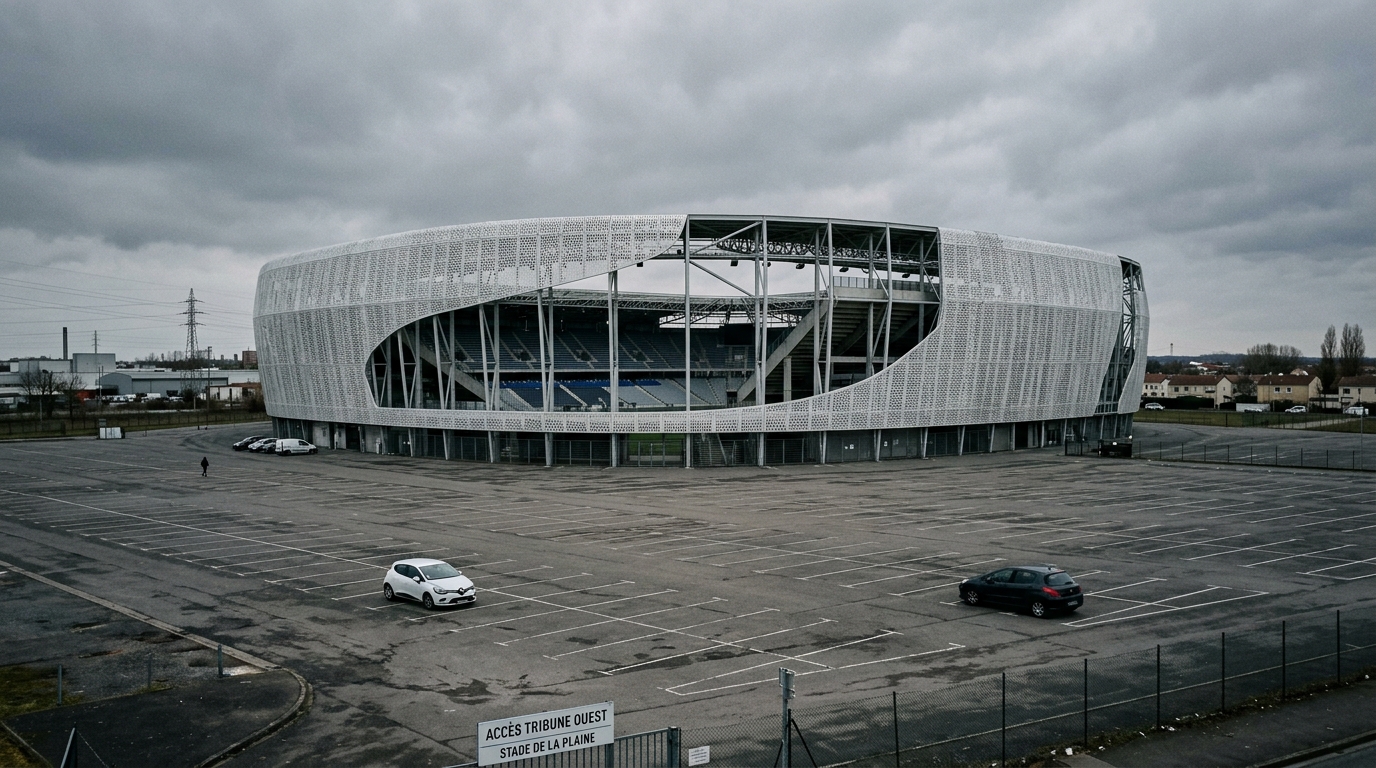
How can a brand-new stadium become a financial trap for an entire city? That is the question on the minds of Le Mans residents today, who are still paying the consequences of a contract signed fifteen years ago. In 2011, the Sarthe city proudly inaugurated a modern venue intended to accompany the growth of its football club. A few seasons later, the opposite happened: the team sunk, and the bill remained very real for local taxpayers. A look back at a story that perfectly illustrates the possible drift of large sports facilities funded through public‑private partnerships.
- The MMArena stadium, inaugurated in 2011 for 104 million euros funded half by Vinci and half by local authorities, saw its club relegated and then liquidated as early as 2013.
- The concession contract contains a sporting risk clause obliging the authorities to compensate Vinci if the club does not play in Ligue 1, an expense that can reach up to 4 million euros per year.
- Ending the contract proved even more costly, so the city had to renegotiate the agreement through 2025, but the club’s ascent to Ligue 1 for the 2025-2026 season now lightens the financial burden.
- A brand-new stadium, a club that collapses in two years
- The clause that turns sporting failure into a public financial sinkhole
- Local authorities trapped by a locked-in contract
- MMArena today: a symbol of oversized stadiums and their excesses
A Brand-New Stadium, a Club That Collapses in Two Years
On January 29, 2011, Le Mans unveiled its new jewel: a 25,000-seat stadium, then named MMArena after insurer MMA, which had paid several million euros to have its name attached to the building. The total project cost was 104 million euros, financed half by construction giant Vinci under a 35-year concession, and half by local authorities. The city of Le Mans committed 31.48 million euros, while the department and region each contributed 8.76 million. A substantial collective effort, designed to support a club playing in Ligue 1 and fueling grand ambitions.
But the story took a brutal turn. Barely two years after the opening, Le Mans’ professional club was liquidated in 2013. The brand-new stadium, built to host an elite team, was left almost empty, with no tenant worthy of the investment. An absurd situation: they built a cathedral of concrete and steel for a club that no longer exists, or that started again at a very low level in the lower divisions.
The Clause That Turns Sporting Failure into a Public Financial Sinkhole
This is where the heart of the problem lies. In the concession contract signed with Vinci, there is a provision called the sporting risk clause. On paper its principle is simple, but in practice it is formidable: if the resident club does not play in Ligue 1, the municipality must compensate the concessionaire to cover the revenue shortfall from tickets, luxury boxes, and the usual commercial receipts generated by an elite club. In other words, the sporting performances of a football team directly determine the amount that residents must pay, without them ever stepping foot on the pitch.
Concretely, this clause can push the bill up to 4 million euros per year for the city of Le Mans and the metropolitan area. A colossal amount for local finances already strained. In 2014, municipal officials had to approve an additional budgetary effort of more than one million euros per year, and this for five consecutive years, on top of the sums already committed to Le Mans Stadium, Vinci’s subsidiary responsible for operation.
Local Authorities Trapped by a Locked-In Contract
Facing such a drain, one could imagine the city trying to break the contract. But that is precisely where the trap closes: Le Mans’ mayor, Stéphane Le Foll, himself acknowledged that ending the concession agreement would have represented an even higher cost for the authorities. In short, the room for maneuver is almost zero. You must pay, year after year, for a stadium the local club no longer fills, under the threat of having to shell out a termination amount far greater than the annual penalties.
The liquidation of the professional club nevertheless led to renegotiation of the initial contract. A new agreement was reached, extending to June 30, 2025, bringing the total annual stadium-related bill to more than 4 million euros. A rise that weighs heavily on the budget of a mid-sized city, illustrating how ill-anticipated a public-private partnership can become a lasting burden, well beyond the term of a political mandate.
MMArena Today: A Symbol of Oversized Stadiums and Their Excesses
Renamed since as the Stade Marie-Marvingt, the building remains a textbook case frequently cited when discussing the excesses of stadium construction in France during the 2000s and 2010s. Designed for a Ligue 1 club, the stadium never truly found its financial balance, successive underperformances preventing the concessionaire from recouping the investment as initially planned.
There is, however, a glimmer of hope for local finances. Mans FC’s promotion to Ligue 1 in the 2025-2026 season mechanically shifts the balance: the closer the club gets to the top flight, the less the sporting risk clause weighs on public accounts. A return to the top tier that, this time, benefits both supporters and local taxpayers after years in which football and the budgets of the authorities seemed to move in opposite directions.
The Le Mans stadium affair sums up the limits of these large sports projects funded on the future of a club. Between oversized ambitions, locked-in contractual clauses, and unpredictable sporting realities, the community often finds itself caught in a vise, with no real way out. While other French cities have encountered similar misadventures with their arenas, perhaps it is time to rethink how these modern cathedrals are built—giving less room to sporting bets and more to budgetary prudence.
