
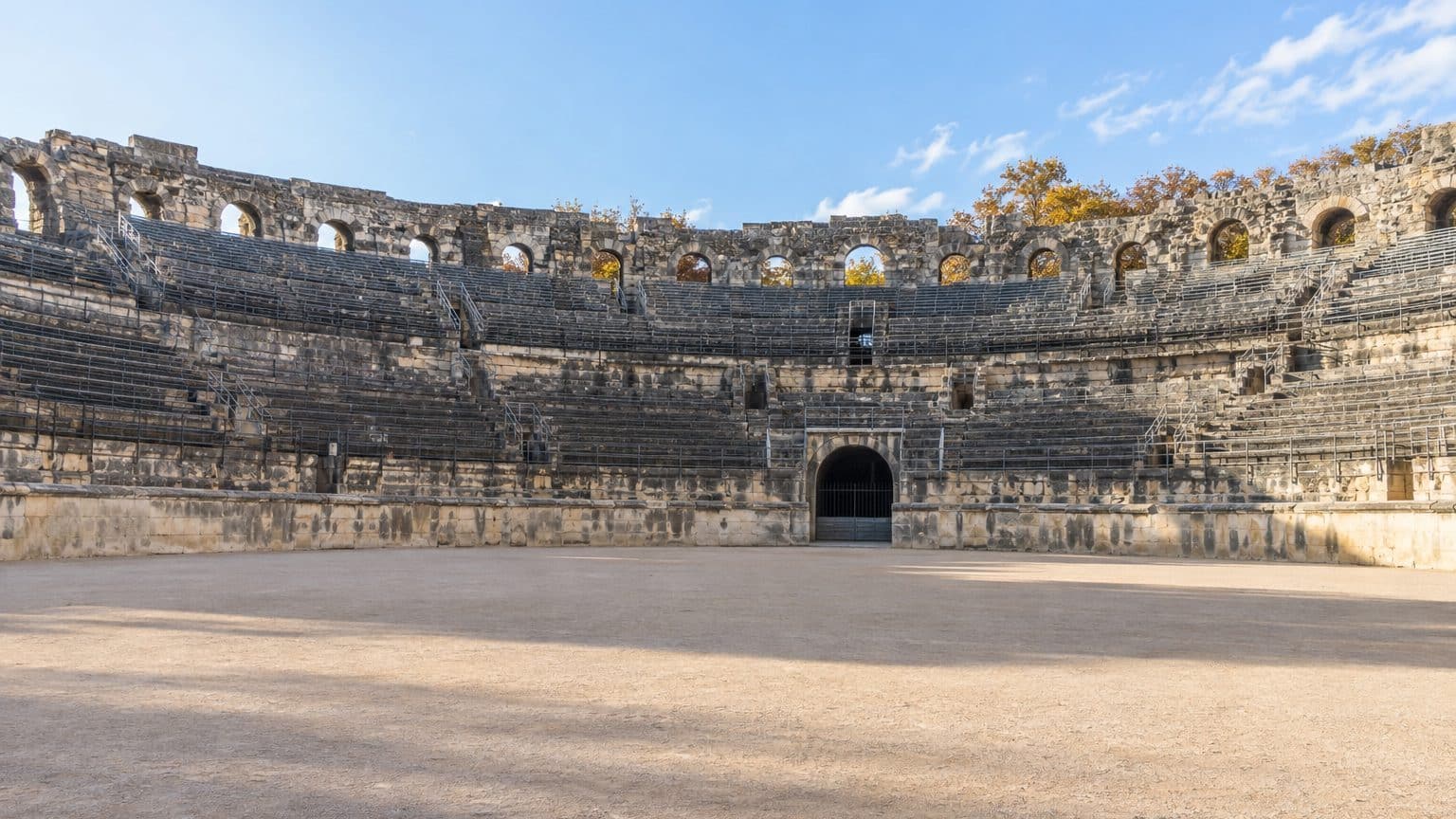
In the arenas of Nîmes stood 220 houses, two churches and a small castle: the castrum arenae, a fortified village tucked inside a late 1st-century Roman amphitheatre. To rid it of this settlement, a royal council decree was required in 1786, followed by an imperial decree signed on February 2, 1809. According to Wikipedia, the monument was not fully cleared of its intrusive structures until around 1812.
- The arenas of Nîmes housed a fortified castrum, featuring houses, churches and a castle.
- Two decrees, in 1786 and then in 1809, ordered the demolition of the quarter.
- The monument was completely cleared of its constructions around 1812 or 1813.
A 24,000-seat Amphitheatre Turned Fortress
The building measures 133 meters in length by 101 meters in width, with a façade 21 meters tall and two levels of 60 arches each. It could accommodate about 24,000 spectators who came to watch gladiator combats and hunts of animals.
Subsequently, the combats were banned.
The Visigoths then converted the amphitheatre into a fortress: the arches were filled in, a moat was dug, towers added. During the Late Antiquity Great Invasions, and during periods of insecurity in the Middle Ages, the population sought refuge within the enclosure. The site is referred to as castrum arenae, the “Castle of the Arena,” as early as the 9th century. In the 12th century the Knights of the Arenes appeared, and a historical chronology places about a hundred people inside in 1226.
An amphitheatre is, after all, a large hollow shell of stone, easy to defend. The inhabitants understood this long before urban planners did.
Two Churches, 220 Houses, a Castle: What the Castrum Really Contained
A clarification is needed on the figure of 220. It describes the medieval castrum as reported by Wikipedia and the Heritage Museum, not the neighborhood that still existed at the time of the 1786 decree. As for the number of inhabitants, no consulted source provides a solid figure to be cited here.
To house all these people, stone was not scarce: many tiers served as quarries. The Arenes Castle was abandoned around 1390, and occupation by the population began shortly after, following the same chronology.
Streets, shops, lanes: an entire quarter, lasting into the 19th century.
Some authors argue that such density could only have occurred at the cost of severe unsanitary conditions. The hypothesis is plausible, but remains a historical reading rather than a numerical fact. What is established is the scale of damage inflicted on the amphitheatre: the seating was dismantled to build, the arches were occupied, the arena floor transformed into an inner courtyard.
1786, Then 1809: Two Decrees to Clear the Monument
The royal council decree of March 28, 1786 ordered the restoration of the arenas and the destruction of the dwellings, both inside and those pressing against the edifice. It fits into the broad beautification plans for Nîmes pursued since the mid-18th century, alongside the Jardin des Fontaine around 1740–1750. The arena works advanced in tandem with the demolition of medieval ramparts to create boulevards and promenades. The City then purchased the houses to demolish them.
The Revolution put the project on hold.
The imperial decree of February 2, 1809 restarted it. A plan from the same year, preserved and reproduced on several heritage sites, distinguishes by color the houses already demolished, those slated for demolition, and those to fall later. Tourism Gard sums up the episode thus: in 1809, houses, chapels and the castle of the viscounts of Nîmes were demolished.
To illustrate the scale: what had been a village for centuries disappeared in a few years. And the demolition did not occur in a single day, since the 1809 plan envisaged phased destructions, some postponed to later.
From Inhabited Ruin to the Sand Track
Once the monument was cleared, the amphitheatre regained its purpose as a venue for performances. Tourism Gard dates the first Camargue bull-running in 1839 and the first bullfight in 1853. The monument was listed as a historic monument in 1840, and Wikipedia places its reconversion into arenas in 1863.
Today it hosts tours, bullfights and concerts, including those of the Nîmes Festival in summer. The same seating tiers that the inhabitants had ripped apart are once again used by thousands of spectators, in a structure that specialists rank among the best-preserved antique amphitheatres in the world.
One calendar detail that guides do not settle: the end of the demolitions is dated to 1812 by Wikipedia, 1813 by other sites. A one-year difference for a project that began in 1786, and for a district whose earliest mentions go back to the 9th century.
Sources : gralon.net | cultea.fr
