
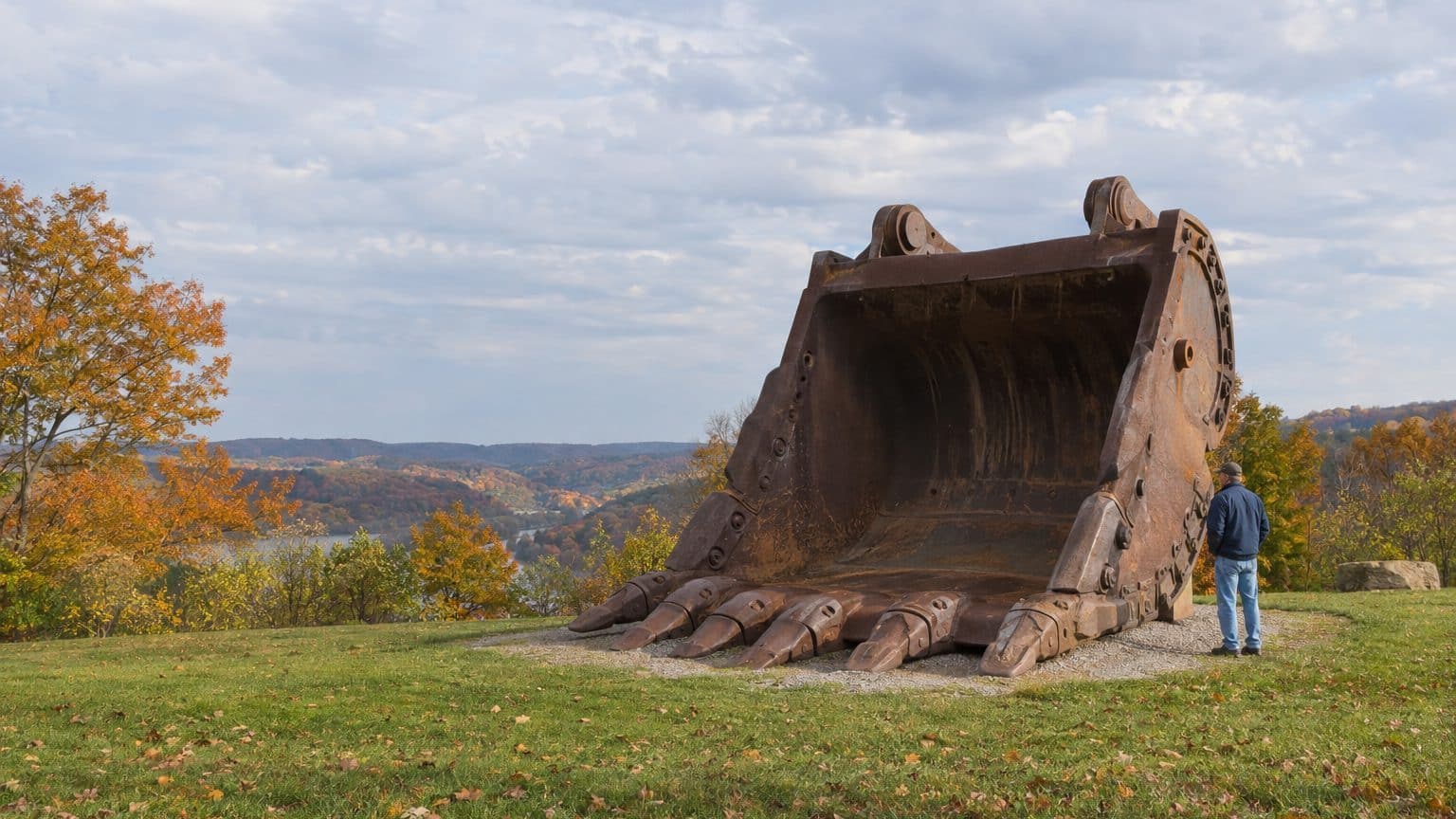
Big Muskie weighed about 12,250 tons and carried a 220-yard³ bucket, or 168 m³, into the hills of Muskingum County, Ohio. From 1969 to 1991, this dragline excavator stripped the ground for the Central Ohio Coal Company, a subsidiary of American Electric Power (AEP). In 1999, it was dismantled on site, due to a lack of buyers and insufficient funds to move it.
Today, only the bucket remains, placed in a park near McConnelsville.
- Big Muskie weighed about 12,250 tons and was the only dragline of its model.
- The 1990 amendments to the Clean Air Act deprived the machine of its market and it stopped in 1991.
- In 1999, the machine was cut up on site for $700,000 worth of metal.
- Only the bucket, weighing around 210 tons, was preserved in a park near McConnelsville.
A unique specimen, assembled on site
The Bucyrus-Erie 4250-W never had a smaller sister: Big Muskie remains the sole example of its model. Too massive to travel in one piece, it was shipped in components, via 340 railcars and 260 trucks, and then assembled on the site in 200,000 hours of work. Once assembled, it stood about 73 meters tall, the height of a 22-story building, and measured 146 meters in length. According to Caterpillar, the mining company preferred it to a shovel because its footprint, 110,000 acres of rugged terrain (about 44,500 hectares), made the dragline more economical at those depths.
The principle rests on three actions. The bucket, suspended from the boom by cables, is swung out, dragged toward the machine, and then hoisted. With each cycle, it moved 220 yards³, or 168 m³, which amounts to roughly 325 short tons of earth and rock (nearly 295 metric tons), the weight of a Boeing 747 according to Ohio NPR.
The bucket was the size of a twelve-car garage.
To put it concretely, 168 m³ corresponds to about a dozen dump trucks of 14 m³ each, emptied at once. The machine’s mission: remove the material covering the coal vein so that other equipment could mine it, notably for the Muskingum River Power Plant. In 1976, it moved 8,000 yards³ of material per hour, more than 6,000 m³.
Over its 22 years of operation, it displaced more material than the Panama Canal construction, according to Caterpillar. The total climbs to 483 million yards³ (about 369 million m³), moved to clear nearly 18 million tons of coal. On May 22, 1969, the Morgan High School band played inside the bucket, the same year it was put into service.
1990: the law that emptied the mine
The coal in this part of Ohio is sulfur-rich. The 1990 amendments to the Clean Air Act tightened air-quality requirements and pushed power plants toward low-sulfur coal or natural gas. The local market collapsed, and Big Muskie’s job—uncovering that coal—had no client. The machine ceased operation in 1991 after 22 years of service.
Eight years of uncertainty followed. Enthusiasts, historians and residents pressed for a museum; others wanted to preserve pieces, and a source cited by Ohio Newsroom captured the mood: no one knew what to do with the machine.
The financial calculation settled the matter. Moving a machine that had become obsolete would have cost several million dollars, and further delays could have triggered fines of a similar magnitude, according to historical accounts. Central Ohio Coal Company therefore opted for on-site scrapping.
In May 1999, Big Muskie left as scrap for $700,000 in metal.
The contract went to Mayer-Pollock Steel Corporation. Given the weight, this amounted to roughly $57 per ton for a machine whose assembly had required 200,000 hours of work.
The bucket, last witness
Only one piece escaped the torch: the bucket, weighing around 210 tons (about 460,000 pounds) according to the park, with some sources putting it at 240 tons. It was installed at Miners’ Memorial Park, near McConnelsville, within Jesse Owens State Park. The site, initially named in honor of Ronald V. Crews, a mine superintendent, now bears the name of all miners in southeast Ohio. An information center traces the history of the Central Ohio Coal Company, and a memorial honors miners who died on the job.
Visitors can climb into the bucket and read the inscriptions left by those who worked with the machine. Nearby, AEP restored roughly 30,000 acres (more than 12,000 hectares) of former open-pit mines into a landscape used for hunting, fishing, hiking, ATV riding and horseback riding. In June 2025, Ohio’s Department of Natural Resources unveiled a historical panel devoted to Big Muskie.
To reach it, the address listed by Ohio magazine Ohio Cooperative Living is 4470 State Route 78, in McConnelsville (ZIP 43756), within Jesse Owens State Park. Once there, one can gauge with the naked eye what 168 m³ of hollow steel looks like, i.e., the twelve garage spaces referred to above.
Sources: theclio.com | consistentlycurious.com
