
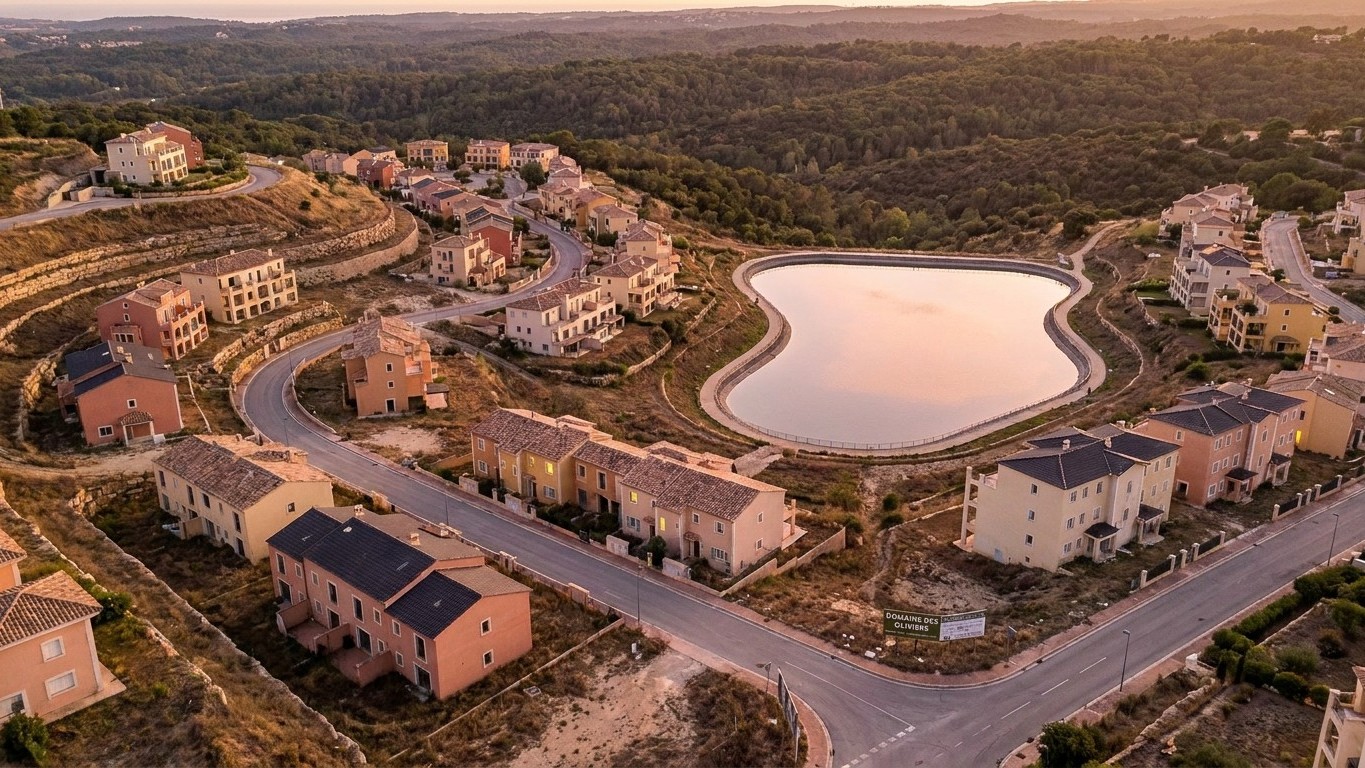
About a hundred square kilometers of hills transformed into a blank canvas for a visionary urban planner: that was the gamble undertaken by India’s Hindustan Construction Company (HCC) in the early 2000s near Pune, in the state of Maharashtra. The result is called Lavasa. Twenty years later, hundreds of completed buildings with pastel façades inspired by Italy still wait for their inhabitants. A city brought to life from the ground, yet never truly born.
Key takeaways
- How an Indian developer attempted to redraw urban planning in a single stroke over 100 km²
- The one secret that blocked everything: an environmental clearance never sought from the federal government
- Why 612 completed buildings still await residents after two decades
A city designed as a painting, not as a neighborhood
The project sprang from an exaggerated ambition: to redraw the map of Indian urbanism by constructing, in one sweep, a complete agglomeration on the foothills of the Western Ghats, a mountain range classified as a UNESCO World Heritage site. Spanning 25,000 acres across seven hills, Lavasa was envisioned for 300,000 residents, with five self-contained towns including housing, offices, schools, hospitals, and leisure hubs. The American architectural firm HOK was entrusted with the master plan, among other things, while investors such as the Avantha group joined the venture.
The inspiration did not come by chance: the project’s founder wanted to recreate the atmosphere of Portofino, that Italian coastal village where tourists stroll in search of color and calm. When construction began in 2004, Lavasa captured the imagination of the entire country, and by 2009 its first town, Dasve, came to life with pastel-hued houses, winding streets, and a shimmering waterfront. A dam was built, a lake created, and a hotel management school affiliated with the École hôtelière de Lausanne was installed. Everything, absolutely everything, seemed designed to sell a dream to an Indian middle class tired of pollution and the grinding traffic of Mumbai or Pune.
The permit that did not exist
The snag arrived at the end of 2010, and it was far from trivial. The Ministry of Environment and Forests issued a stop-work order, because the company had never secured the central environmental clearance required for such a project. The problem was almost suspiciously simple: the company had never submitted a request to the federal government under the 1994 Environmental Impact Assessment regulation, even though 58 hectares of the site rose above 1,000 meters in altitude and the project’s cost far exceeded the legal threshold that mandated this clearance.
The company’s justification? It already had clearance from the Maharashtra state administration, and thus argued that federal approval was superfluous. An argument that convinced few. Added to this were more sensitive accusations: the land used for the project originally belonged to tribal communities (adivasis) and landless people from eighteen villages in Pune district, who had received it under 1960s land reforms—land used for a luxury urban development built, in part, on land meant to protect the poorest. The affair took a political turn when it emerged that figures close to regional power, including the family of former minister Sharad Pawar, were among the project’s shareholders between 2001 and 2004.
A conditional clearance finally fell in 2011, accompanied by a symbolic fine. But the damage was done: a full year of construction halted, investors wary, a tarnished reputation. The machine never fully recovered its pace.
The debt wall, then bankruptcy
The final blow came from finance, not courts. Lavasa Corporation, a subsidiary of the construction giant HCC, defaulted on loans totaling 7,700 crores of rupees after the 2010 stop-work order. In 2018, there was no turning back: the situation became critical and the National Company Law Tribunal approved a petition declaring Lavasa Corporation insolvent, initiating bankruptcy proceedings. The debt then climbed to staggering levels, estimated in the hundreds of millions of euros.
On the ground, daily life turned surreal. Trash collection ceased, security cameras failed, guards abandoned their posts. The École hôtelière de Lausanne, symbol of the city’s supposed prestige, ultimately packed up to move to Mumbai. Today, a few hundred retirees, second-home owners, and hotel workers coexist in this half-finished landscape, surrounded by empty towers and a convention center that never rose beyond a concrete skeleton. The contrast is almost comic: on one side, villas with a Mediterranean flair; on the other, neighboring villages that still lack the most basic services.
A real estate turnover that does not lie
The accounting of the failure is dizzying. According to an estimate submitted to the Environment Ministry during the renewal of environmental clearance, Lavasa Corp has built 612 buildings to date, with 196 more at various stages of construction. Yet owning a roof in Lavasa can be a slog: about a thousand owners have taken possession of their property, while 500 others bought homes that were never completed, and 400 additional homes are finished but remain unsold. A wall of brand-new, literally unsellable apartments.
A glimmer of hope did surface in 2023: the bankruptcy court approved a resolution plan of 1,814 crores of rupees proposed by Darwin Platform Infrastructure Ltd, based in Mumbai. Its founder, touted as the project’s unlikely savior, claimed, rather eccentrically, a lineage linked to the Hindu deity Rama, and his rescue plan included, among other promises, the construction of a giant statue. Once again, this raised doubts about the seriousness of the next chapter.
What is striking, at bottom, in Lavasa’s story is not so much the failure itself—common in Indian real estate—but the naiveté of the initial gamble: to believe that a city could be drawn up entirely on a plan, without anticipating environmental laws, the land rights of local populations, or economic cycles. A few hundred kilometers away, another private project of a similar nature, Aamby Valley, met the same fate and ended up at auction. Two isolated cases, or the symptom of a model of urban development that confuses real estate storytelling with real planning?
Sources: rts.ch | lalibre.be
