
On June 6, 1944, at the dawn of the D-Day landings, Caen goes up in flames. Allied bombings strike the city with such ferocity that the Norman town, battered for 78 consecutive days, will be 75% destroyed. For thousands of inhabitants trapped between the bombs and the Germans, there seems to be only one way out: to go underground. Beneath their feet for centuries, Caen’s stone quarries would become one of the war’s most unlikely refuges.
Key takeaways
- Why did thousands of Caen residents choose to descend 30 meters underground?
- How did an organized society emerge in the darkness of the quarries in a matter of days?
- What forgotten objects reveal today the hidden story of these shelters
An underground network carved into the city’s history
Caen stone, that pale limestone which has built cathedrals and castles across northern Europe, left beneath the city a true labyrinth. The 18th and 19th centuries mark the peak of its exploitation: on the territory of the Caen commune alone, more than 10 million cubic meters of stone were dug, both underground and in the open air. These galleries, carved over decades and centuries, would, in a twist of history, serve as shelters for those threatened as much by the liberators’ bombs as by the occupier.
These disused quarries, excavated to depths of 15 to 30 meters below ground, formed wonderful natural refuges on either bank. The very geography of the Caen area was, unknowingly, prepared to host an underground exodus. In Fleury-sur-Orne alone, four major shelter sites protected around 12,000 civilians starting on June 6, 1944.
The night of June 6: the exodus to the depths
On June 6, Caen endures several bombardments. The final blow comes in the night of June 6 to 7. Amid corpses and burning houses, hundreds of residents rush toward sanitary outposts and reception centers; some flee far from the city, while others seek shelter in the numerous stone quarries surrounding the town.
In Fleury-sur-Orne, two kilometers south of Caen, someone had anticipated the danger. As early as June 5, the Saingt brothers, warned by the Resistance and the BBC of the imminence of the Landing, open the doors of their cellars to the homeless fleeing the city. They even stand along the Harcourt road to invite Caen residents to descend. Within a few days, nearly a thousand people are installed there, surviving underground in rudimentary conditions.
During the Battle of Normandy, it is estimated that 20,000 civilians remained hidden in the quarries, sometimes for long weeks, as in Fleury-sur-Orne, nicknamed “The City of Darkness.” To put this figure in perspective: it is the equivalent of the population of a town the size of Lisieux vanishing underground overnight.
Under the bombs, an improvised society
Living in a quarry in 1944 is not camping. Yvette Lethimonnier, who descended into the Saingt quarry on June 6 at the age of 11, discovers cramped conditions, straw mattresses on pebbles, lice, cold, and damp. The testimonies gathered by historians sometimes speak of manure rather than straw. The result? A life at the edge of endurance, suspended between the roar of bombs overhead and the oppressive silence of the tunnels.
The refugees, lacking privacy and space, manage to delineate circulation routes with stones, planks, or sheets. Families are side by side, with blankets and straw as beds. The floor is muddy with beer remnants from the old brewery that once occupied the site. Two water pools remain bordered by stones, and the kettle once used to draw the indispensable water is still in place, found intact decades later.
A social order quickly emerges. Mr. Fouquet, owner of one quarry, suddenly finds himself leading a community of 2,000 souls; he divides the quarries into 13 sectors, each with a supervisor. In other shelters, the three priests from Saint-Pierre church take turns spending the night with the refugees. The sorties to resupply remain perilous: Yvette slips out through the shaft to fetch chocolate, and there she receives a shell fragment in the leg.
The German presence makes this confinement even more precarious. The Germans intrude underground: in the Fouquet quarry they trigger a dramatic evacuation on July 14 in which several people are killed by a shell; in the Coteaux, they requisition two quarries, expelling residents to install artillery; in the Saingt quarry they set up an infirmary. Coexistence is thus often difficult.
What archaeologists found intact
At the end of the fighting, the underground sections were abandoned. The quarry remained sealed, preserving on its floor the arrangements and remnants of the summer of 1944. In the early 1970s, a company bought the plant and, miraculously, did not use the quarry, thereby preserving its archaeological potential.
It was in 2014 that everything shifted. The archaeologists’ rediscovery of one of these refuge-quarries used by civilians during the Battle of Caen offered the opportunity for an experimental archaeological operation, at the crossroads of archaeology, history, and sociology. emblematic of the 44-era refuge-quarries, the Saingt quarry sits at the heart of a research program conducted jointly by archaeologists from INRAP and scientists from CNRS and the National Institute of Applied Sciences of Strasbourg.
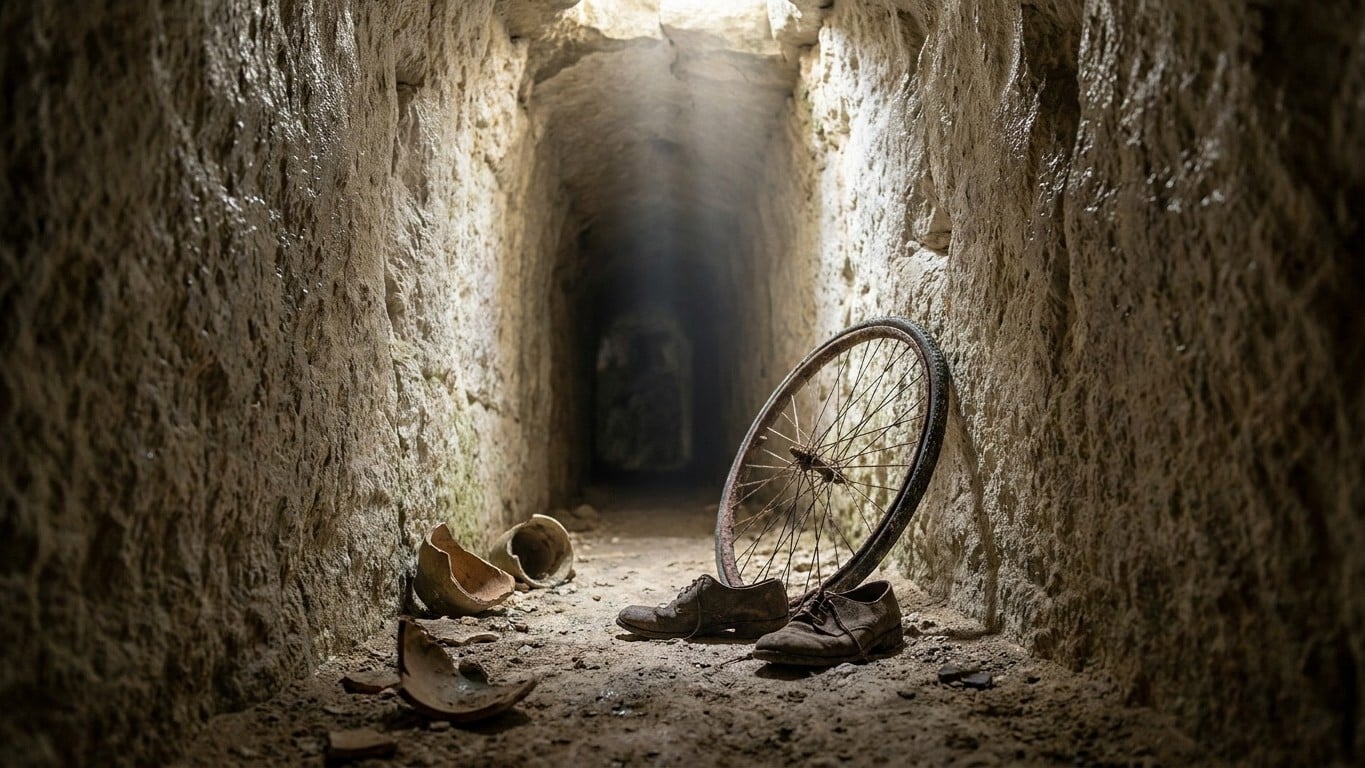
The site still today displays the modifications made by civilians to delineate spaces, and many objects were left in the darkness of the quarry: shoes, glasses, toys. Along either side of the paths lie hundreds of objects in a frozen disorder: a doll’s head, fragments of porcelain, coins, jewelry, shoes, forks; a rusty bicycle seems to wait for the push of a child’s foot. What archaeology reveals here is not a battlefield, but its margins: ordinary survival, the silent resilience of daily life.
The violence of the Normandy battles from June 6 to September 12, 1944 claimed the lives of around 14,000 civilians, while more than 100,000 men, women, and children were forced to shelter in barns, stables, cellars, and quarries. The Fleury quarries embody today much more than a local episode: they remind us that a country’s liberation also comes at the cost of its own people’s blood. Beginning July 20, civilians start evacuating the underground quarries, and by the end of the month, virtually no one remains inside. Six weeks underground. Two generations of silence before archaeologists rediscover, in the darkness, a pair of perfectly intact glasses.
Sources: academia.edu | france3-regions.franceinfo.fr
