
An aircraft carrier has awakened ancient Toulon. A paradox of history: it is to host the future successor of the Charles de Gaulle that Inrap’s archaeologists have been digging, since September 2025, into the bowels of the naval base, and they have unearthed two millennia of a city no one suspected to be so old.
Key Takeaways
- What was found just meters beneath the surface of the naval base?
- Why did the diving archaeologists have to create a giant pool at the heart of the dig?
- Could an ancient mint workshop have actually operated on this strategic island?
An island swallowed beneath military backfill
Since September 2025, Inrap has been conducting excavations, under state directive (Drassm, Ministry of Culture), in a vast sector of Toulon’s naval base redesigned over tens of hectares, on land and at sea, to host the next-generation aircraft carrier. The project, led by SID Méditerranée, bears the name PA-NG. The objective is to lay out new quays and basins capable of accommodating the future carrier, slated to succeed the Charles de Gaulle around 2038, with construction work expected to begin in 2027.
These digs required enormous earthworks to remove the backfill layers added in modern times to satisfy successive military installations, until the ancient topography of Milhaud Island could be revealed—detached from the mainland but very close to the shore. This marks the first time archaeological excavations have taken place at the heart of Toulon’s naval base. Behind each layer of twentieth-century concrete and fill lay a stratigraphy far older than anticipated.
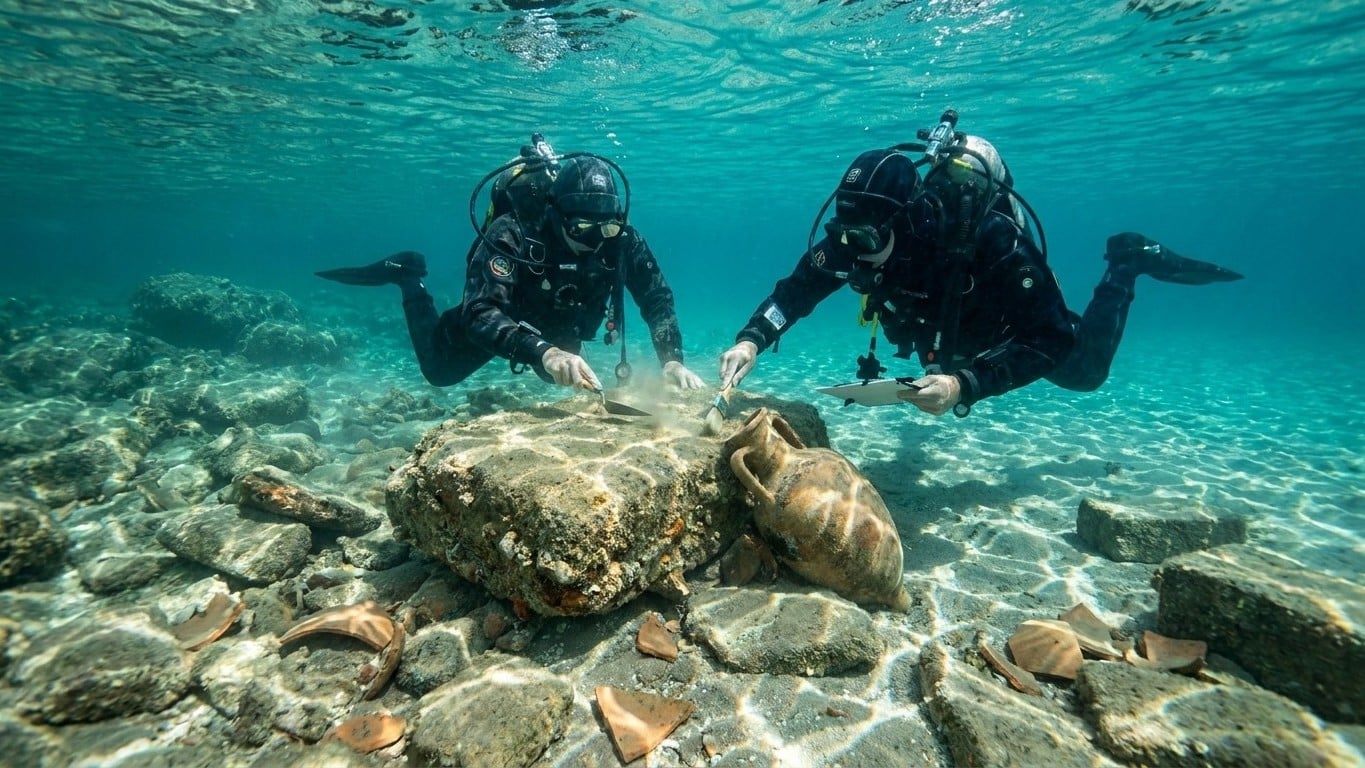
The site itself posed an unprecedented technical challenge. While today it lies entirely inland, the sea again fringes immediately beneath the first meter of soil removed. To study the powder-magazine quay, Inrap chose to re-flood that portion of the once-filled-in estuary, creating a large pool in which diving archaeologists take over from their land-based colleagues. An amphibious excavation, in the literal sense.
A century before Rome: Toulon existed already
The research reveals the extent of an ancient settlement largely focused on maritime trade between the 2nd century BCE and the early 3rd century CE. The key detail lies in this calendar nuance: as early as the 2nd century BCE, a century before the founding of the Roman town of Telo Martius, the site was already occupied by numerous houses clustered together, with foundation walls and hearths, along with ample traces of artisanal and commercial activity.
Traditional accounts place Toulon’s origin at the moment of Roman founding. The Milhaud island site proves to be a strategic commercial hub before and after the establishment of the port town Toulon, Telo Martius, in the mid-1st century CE. Toulon did not begin with the Romans; it existed prior to their official founding, and it was they who joined a preexisting trading post.
The oldest remains point to early occupancy around the 2nd century BCE, a period of conquest and transition in which Gauls, Marseille Greeks, and Romans intermingled and traded along this stretch of the Mediterranean coastline. Three peoples, one island stopover. The significance of this era preceding Telo Martius is evidenced by the quality and origin of artefacts: largely coming from the southern Italian peninsula, they attest to Roman influence on Milhaud’s settlement, while the coastline was theoretically under the dominion of Greek Marseille. The amphorae and coins tell a different story.
A complete Mediterranean outpost
The uncovered buildings cover several thousand square metres and likely combined residences with crafts, fishing, and trade activities spanning from the 2nd century BCE to at least the 2nd century CE. A wealth of material culture was recovered, notably ceramic assemblages and coins, painting a portrait of a site integrated into the Mediterranean trade networks, here notably marked by imports from southern Italy.
Analysis of the artefacts confirms occupation from the 2nd century BCE to the early 3rd century CE. These items—tableware, loom weights, adornments, and structures (hearths, ovens)—reflect dense residential groups that also hosted artisanal activities: evidence suggests flour and wine production, or oil pressing. Fishing practices are attested by leads used as net weights. Flour, wine, oil, fish—a near self-sufficient micro-economy on a rocky islet barely separated from the mainland.
Even more surprising: the coins hint at the existence of a mint workshop; this hypothesis will need to be tested in further excavations. A mint on a Toulon harbor island in the 2nd century BCE, if confirmed, would be a cornerstone in reconstructing ancient Provençal trade. According to Inrap, this site currently represents a unique instance on the Provençal coast for this period.
The discovery of this settlement must also be viewed within the context of Gallic challenges to control the coastline and the Greeks of Marseille dominating maritime trade. This is not a routine dig; it is a geopolitical flashpoint of antiquity surfacing again.
Three centuries of emptiness, then Louis XIV
Understanding how the island evolved after the founding of Telo Martius is one of the goals of the research: keeping this settlement within the Roman port city’s sphere raises many questions, as does its abandonment. From the 3rd century onward, evidence becomes scarce, and the site experiences erosion that makes continued occupation uncertain up to the late medieval period. Several centuries of archaeological silence follow, as if the island had been forgotten between the end of the Roman Empire and the modern era.
The revival comes with the monarchy. In the 17th century, a powder magazine was built on Milhaud Island as part of Toulon’s grand naval arsenal, a project pursued by King Louis XIV. The building, situated at the island’s northeast tip, stands out for its technical sophistication and storage capacity. The Milhaud port, developed between 1695 and 1696, has been repeatedly maintained, renovated, and expanded. The numerous refurbishments seen by archaeologists on its quays testify to the intensity of loading and unloading operations from the late 17th century through the 20th century.
Archaeologists have also uncovered a quay designed to resupply ships with gunpowder and ammunition, extending nearly 80 metres in length and remarkably well preserved. These findings will allow researchers to document how the quay was constructed, its wooden-pile foundations, and its distinctive features such as stairs and hoisting structures. Two millennia after Italian wine amphorae, the same rock was used to load barrels of gunpowder for Louis XIV’s fleet. The site’s strategic mission, however, had never changed.
What stands out in this discovery is not the site’s antiquity so much as the continuity of its logic: a maritime hinge for exchange or conflict, claimed by each civilization as its own. Under the Roman Empire, Telo Martius became one of the two imperial purple-dye workshops, thanks to the exploitation of murex snails and the kermes scale insects, then dominant in the region. This imperial red, produced along the harbor’s shores, tinted the togas of Rome’s patricians. Today, the naval base’s excavations reshape Toulon’s history, granting it a longer, denser past and a much more contested narrative than the textbooks have ever recorded.
Sources: france3-regions.franceinfo.fr | defense.gouv.fr
