
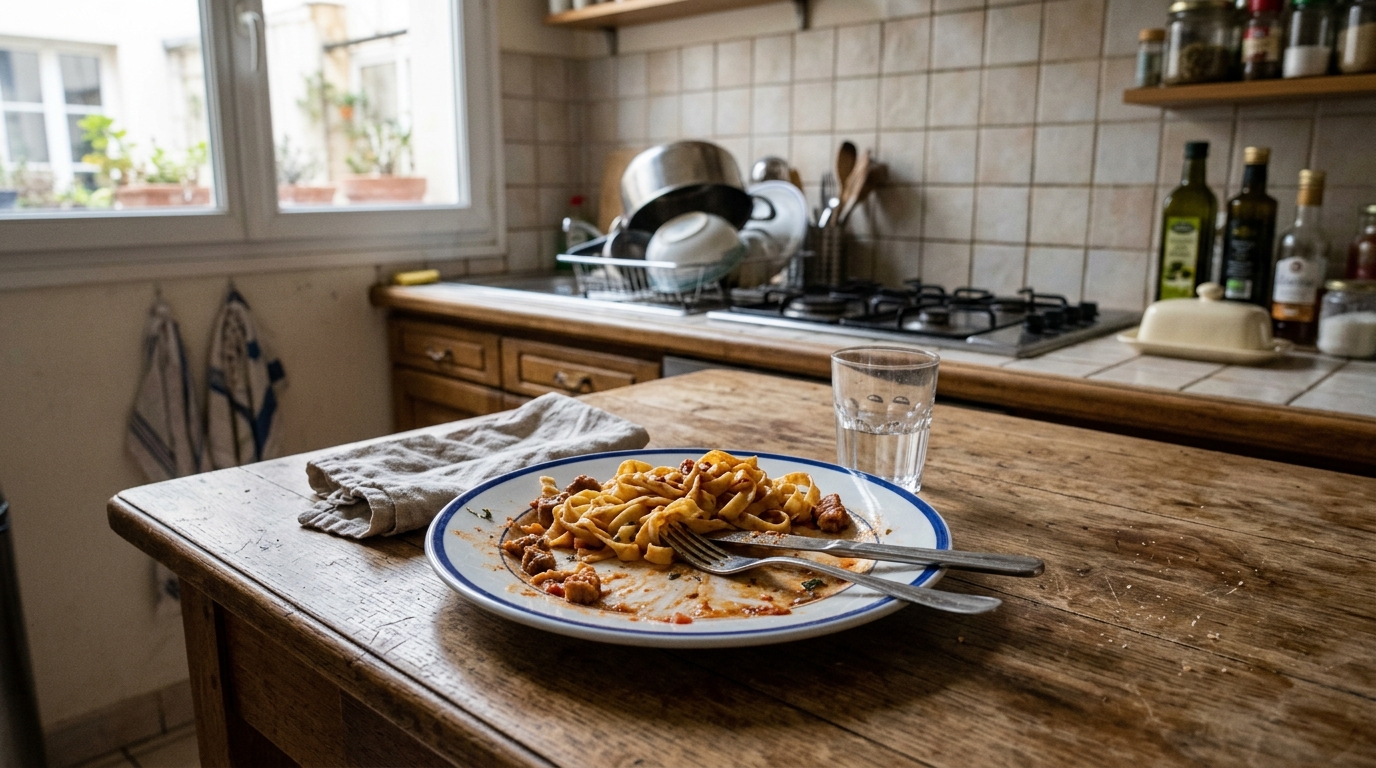
Imagine a snowball racing down a slope: it doubles in size with every turn, then again, and again, until it becomes an avalanche in just a few minutes. This is exactly what happens to the bowl of pasta left forgotten on the kitchen table, except that no one notices the ball growing. A bacterium divides into two every 20 minutes at 25 degrees Celsius, roughly the temperature of a kitchen in late-morning. This rate, seemingly trivial on paper, hides a far more worrisome reality when you extend the calculation over hours. Meat, fish, eggs, mayonnaise or simple pasta leftovers: no food escapes this silent mechanism that turns a few hours of neglect into a true playground for microorganisms.
- A bacterium divides every 20 minutes at 25°C, potentially yielding thousands of individuals in just two hours
- Never leave food at room temperature for more than two hours, especially cooked dishes, eggs, and dairy products
- Rapid refrigeration between 0 and 4°C greatly slows bacterial growth and reduces the risks of foodborne illness
- How a bacterium multiplies so fast at 25 degrees
- Meat, fish, eggs, mayonnaise, pasta: foods with different levels of risk in the heat
- The time rule: why you should never exceed this window at room temperature
How a bacterium multiplies so fast at 25 degrees
A bacterium does not simply “grow”; it clones. At 25°C, the cell-division process kicks in roughly every 20 minutes, meaning a population goes from 1 to 2, then to 4, then to 8, following a growth that accelerates incredibly quickly. In just two hours, a handful of bacteria can thus give rise to thousands of individuals, invisible to the naked eye and entirely undetectable by smell or taste. That is the whole challenge of this phenomenon: nothing warns that the dish has become a breeding ground for microbial proliferation. This mechanism helps explain why foodborne illness outbreaks remain so frequent in France, with 2,231 cases reported in 2023, affecting more than 22,000 people and causing 19 deaths. And these figures are likely only the tip of the iceberg, since the true burden of food-origin infections would be between 1.28 and 2.23 million cases each year according to Santé publique France.
Meat, fish, eggs, mayonnaise, pasta: foods with different risk profiles in the heat
Not all foods are equally vulnerable to ambient heat, though none are entirely safe. Ready-made or cooked dishes, such as leftover pasta or gratins, provide a particularly favorable ground for bacteria such as Clostridium perfringens, Bacillus cereus, or Staphylococcus aureus, responsible for a substantial share of the recorded foodborne infections. On the eggs front, Salmonella remains the pathogen most frequently identified, found in 42% of outbreaks with a confirmed agent, with eggs or egg-based products suspected in nearly four cases out of ten. Homemade mayonnaise, indeed, compounds risk because it contains raw egg and is never heated. As for dairy products, a recent health alert reminded that even some cheeses made from pasteurized milk can be contaminated by Listeria, with several dozen cases and two deaths reported. To help navigate the landscape, here are the food families that deserve particular vigilance:
- The prepared meals and composite dishes (pasta, rice, gratins, quiches)
- Eggs and preparations using raw eggs, such as mayonnaise
- Meat and fish, especially once cooked and stored
- Dairy products, including certain pasteurized-milk cheeses
In every case, the basic rule remains the same: the more water, proteins, or fat a food contains, the more it furnishes a welcoming environment for bacteria that simply seek a mild temperature to multiply quietly.
The time rule: why you should never exceed this window at room temperature
Anses recommends not leaving a food out for more than two hours at room temperature before putting it back in the fridge. But this limit applies to moderate temperatures, around 20°C. As soon as the thermometer climbs, as is often the case in a warmed kitchen or during hot weather, the safety window narrows sharply: at 25°C, it is wise not to exceed two hours before chilling leftovers. Leaving a dish containing raw egg out overnight is absolutely out of the question, just as forgetting a dish containing raw egg must be refrigerated promptly. The ideal storage temperature lies between 0 and 4°C, an interval that strongly slows, or even halts, bacterial multiplication. A simple habit to adopt, therefore: as soon as the meal is finished, head to the fridge rather than the kitchen table, even for pasta that still feels warm and harmless.
Ultimately, the issue is not the foods themselves but the time they spend at room temperature. Quick refrigeration, avoiding dishes left out overnight, and paying particular attention to egg- or dairy-based preparations can prevent the vast majority of problems. A simple reflex, in the end, to ensure that the next midday meal does not turn into a nasty surprise.
