
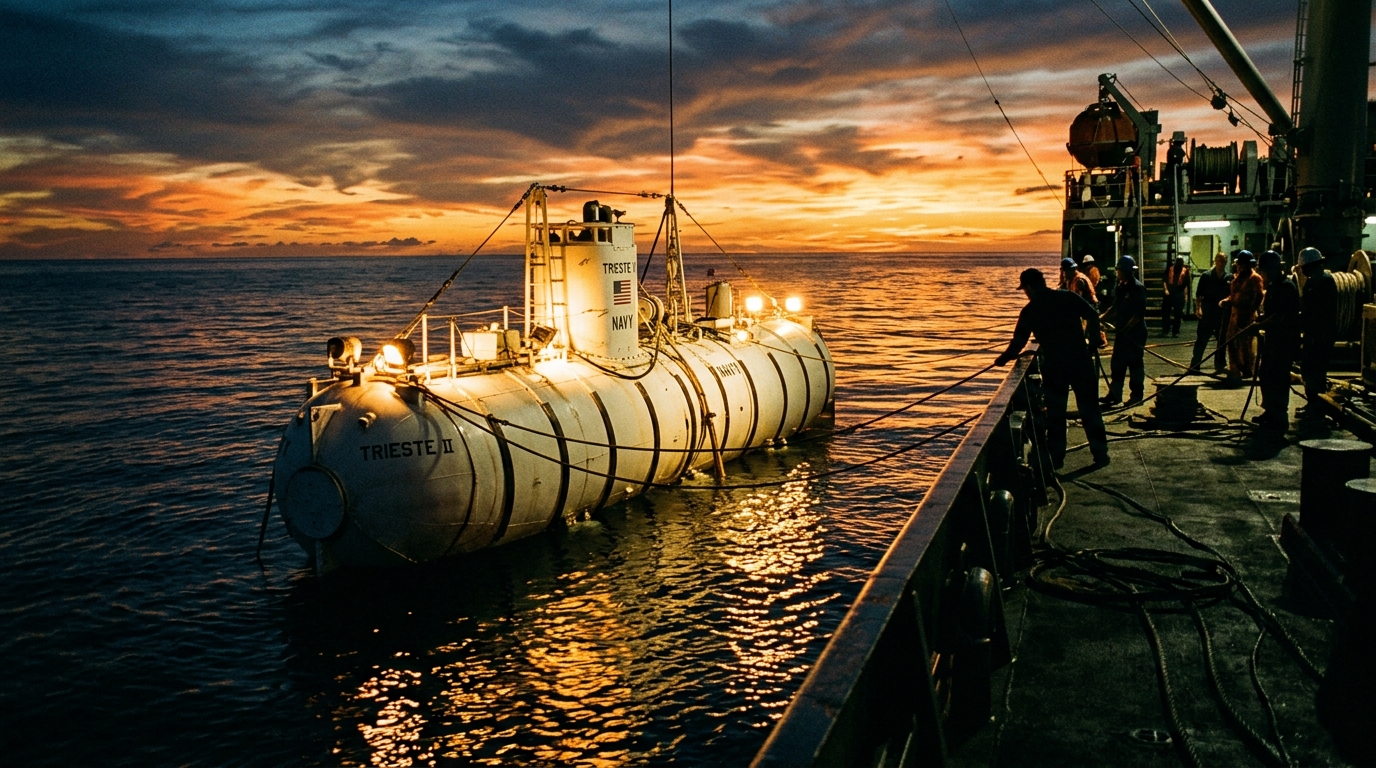
A steel sphere under two meters in diameter, two men huddled inside, and beneath their feet lay more than ten kilometers of pitch-black water. On that January day in 1960, the United States Navy achieved one of the boldest feats in its history, a feat so radical that no one dared to repeat it for more than half a century. How can we account for a technical achievement accomplished with the gear of the fifties remaining unmatched for so long, even as humanity was conquering the Moon and space at the same time? It is this fascinating puzzle that we will explore.
- On January 23, 1960, the bathyscaphe Trieste, with Jacques Piccard and Don Walsh aboard, reached the bottom of the Mariana Trench after nearly five hours of descent.
- At the bottom, the two men observed a flatfish and shrimp, a discovery that led to abandoning the project to bury nuclear waste in the trench.
- It was not until 2012 that filmmaker James Cameron, aboard the Deepsea Challenger, completed a comparable solo dive, reviving interest in abyss exploration.
- An engineering feat that no one thought worth repeating
- The Mariana Trench, this abyss humanity chose to ignore
- James Cameron and the solitary feat that revived memories
- Why deep-sea conquest remains rarer than space exploration
An engineering feat that no one thought worth repeating
On January 23, 1960, the bathyscaphe Trieste reached the bottom of the Mariana Trench in the Pacific. On board were the Swiss Jacques Piccard and the American Navy lieutenant Don Walsh. The descent lasted nearly five hours, at a speed of about one meter per second, to reach a depth now estimated between 10,912 and 10,916 meters depending on sources and the corrections applied to the original sonar measurements. A figure that induces vertigo, especially knowing that at around 9,800 meters the outer glass of the porthole cracked under the colossal pressure of the abyss, without compromising the interior structure of the craft.
This Trieste, designed by the Swiss physicist Auguste Piccard, had been purchased by the U.S. Navy in 1958. Once the mission was accomplished, the vessel was withdrawn from active service: today it is on display at the National Museum of the United States Navy, in Washington, as a relic of an achievement never repeated exactly the same way. Since that historic dive, no other bathyscaphe of this type has been built, the technology having simply given way to other approaches to underwater exploration.
The Mariana Trench, this abyss humanity chose to ignore
Once they reached the bottom, Piccard and Walsh surveyed the abyssal landscape for about twenty minutes. And the surprise was considerable: in that total darkness and under crushing pressure, life did exist, including a flatfish and shrimp calmly moving about on the sea floor. This discovery, as modest as it might seem, had a very concrete consequence: the plan to use the Mariana Trench as a site for burying nuclear waste was simply abandoned.
Paradoxically, this resounding achievement did not pave the way for regular exploration of the deep seas. Unlike space conquest, where every mission begged another, the trench fell back into near-total silence. Too costly, too risky, too scientifically unprofitable in the eyes of decision-makers of the time: the globe’s deepest abysses remained an untouched territory for more than fifty years.
James Cameron and the solitary feat that revived memories
It would take until 2012 for another human to dare descend to a comparable depth. And the name was not one you would have necessarily expected in this scientific context: filmmaker James Cameron, the director of Titanic and Avatar, but also a longtime enthusiast of ocean exploration. On board a small submarine named the Deepsea Challenger, quite different from the historical Trieste, he reached the deepest point of the Mariana Trench in solitary ascent and descent.
This widely publicized solo dive brought back into the public eye a feat that public memory had largely forgotten. It also marked a shift in era: where the Trieste was the product of a military program, Cameron’s submarine embodied a more private, personal initiative, symbolizing renewed interest in the great depths, now carried by enthusiasts rather than by states.
Why the conquest of the abyss remains rarer than space exploration
One might think that going a few kilometers underwater is easier than sending a man into space. Yet it is precisely the opposite. The pressure at depths beyond ten thousand meters is so extreme that it demands materials and engineering even more demanding than those of a space capsule. It is not uncommon to hear the claim that more people have walked on the Moon than have reached the deepest point of the oceans, a concise remark that, as surprising as it sounds, illustrates well the difficulty of this conquest.
Unlike space, where government agencies have maintained a steady effort since the sixties, deep-sea exploration long lacked a similar driving force. Less spectacular in the eyes of the public, less tied to direct geopolitical stakes, the Mariana Trench gradually became a scientific anecdote rather than a strategic objective. It took the private curiosity of a filmmaker, followed by a renewed technological interest in recent years, to make the idea of a return credible again.
From this story, one recalls a fascinating paradox: a successful first-time achievement with the modest means of 1960, yet followed by more than fifty years without a repetition. The Trieste proved that human ingenuity could tame the planet’s most extreme depths long before modern technology grasped the field again. While the spotlight today leans more toward space than the oceans, perhaps it is time to remember that the deepest mysteries are not always up there; sometimes they lie just beneath our feet, in those abysses that so few have dared to explore.
