
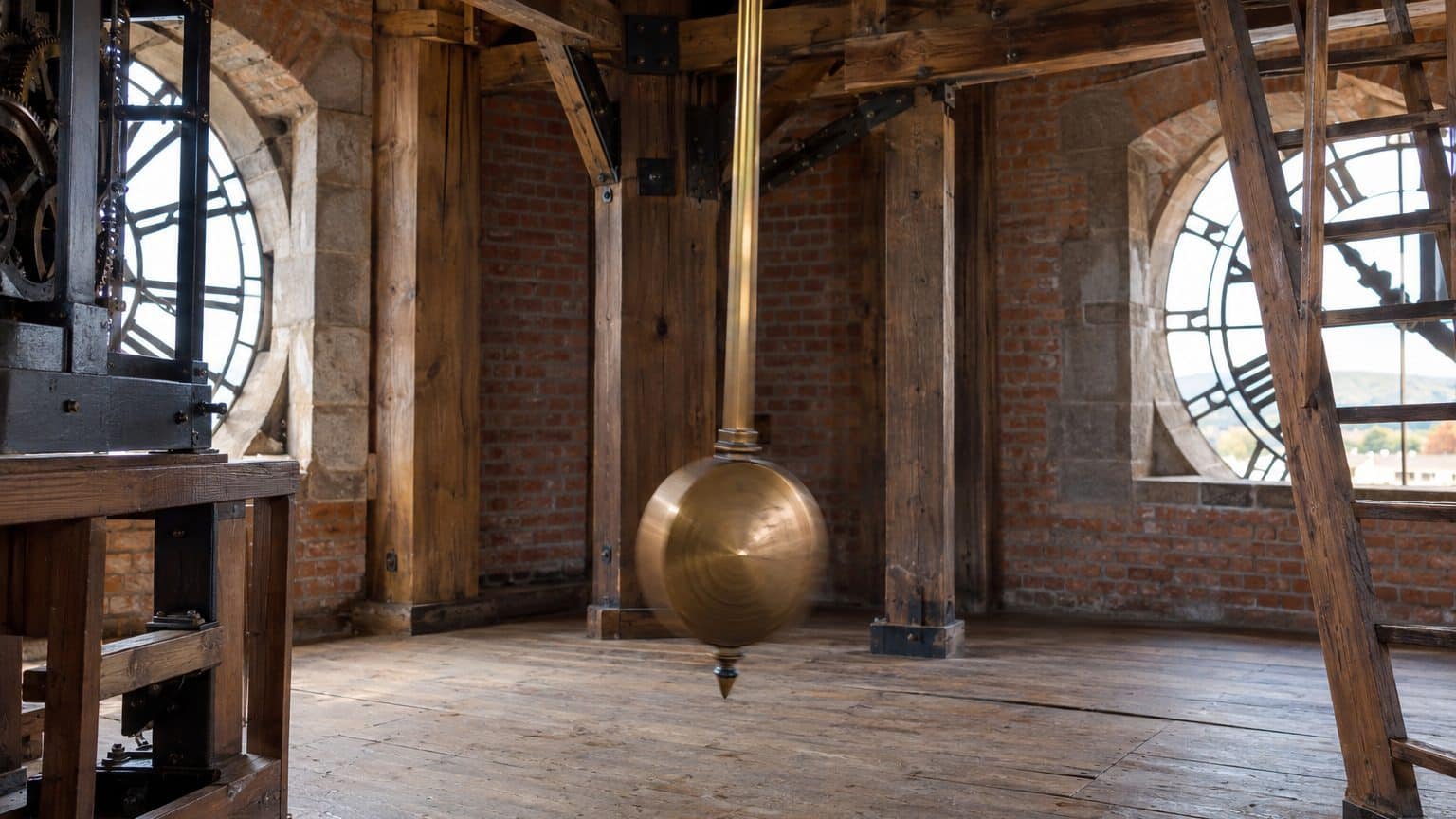
By placing a single pre-decimal penny on the pendulum of Big Ben, Britons have literally moved the clock forward by 2/5 of a second over 24 hours. The British Parliament details this in its technical sheets: it is with coins from another age that the Great Clock, the tower’s clock completed in 1859, is regulated.
One coin, and London time shifts.
- A pre-decimal penny adds or subtracts 2/5 of a second per day
- The Big Ben pendulum weighs 310 kg and beats every 2 seconds
- The tower mechanism weighs 5 tonnes and each minute hand weighs 100 kg
A 310 kg pendulum regulated by the coin
The pendulum measures 4.4 meters in length and weighs 310 kg, roughly the weight of four adults of 75 kg each suspended on the same rod. Each swing lasts 2 seconds, yielding 43,200 oscillations for a 24-hour day. The slightest deviation in a single back-and-forth cycle propagates to the 43,199 following ones. The precision of the whole system thus rests on a mechanical regularity that nothing continuously corrects.
To compensate drift, no one touches the gears. According to Parliament, these are pre-decimal pennies used to adjust the mechanism, added or removed depending on whether the clock is losing or gaining time. The operation is performed with an object you could slip into a coat pocket, on a machine weighing hundreds of kilograms.
These coins have long since disappeared from British pockets, but they continue to work up there, safely out of sight of the public. The contrast is striking: a monument filmed from every angle, whose precision depends on a small pile of demonetized money.
2/5 of a second per day: the arithmetic of a penny
The rule is simple: one extra penny on the pendulum yields 2/5 of a second gained in 24 hours, i.e., 0.4 seconds. A coin removed produces the opposite effect. Spread over 43,200 daily oscillations, this gain amounts to about 9 millionths of a second per beat. No human ear can perceive such a difference, but the 24-hour period eventually reveals it.
If extended over a year, the effect of a single penny left in place would reach about 146 seconds, a little more than two and a half minutes. It’s a calculation based on Parliament’s figures, not a measurement taken on site. Yet it shows why adjustments are made in such tiny increments.
A margin of error of 0.4 seconds per day is less than what most people tolerate on their watches.
Your smartphone resynchronizes automatically with a time server as soon as it catches a network. In Westminster, the same role is fulfilled by a hand that places or removes a coin, followed by someone comparing the result to a reference. The adjustment has an artisanal feel, but the objective is the same as any timekeeping system: a touch forward, nothing more.
5 tonnes of mechanism, 100 kg per minute hand
Behind the pendulum, the mechanism weighs 5 tonnes, about the equivalent of five city cars weighing one tonne each. This block of steel and iron drives the four clock faces of the tower, whose hands do not resemble those of a domestic clock. Each minute hand weighs 100 kg.
Over a year, these hands sweep 190 km. That’s more than four marathons, performed at a pace the eye cannot perceive as movement. The pendulum sets the tempo, and the rest of the machine follows, without a hitch, for more than a century and a half.
The scale disparity is what makes the penny method so singular. On one side, 5 tonnes of mechanism and 100 kg per minute hand. On the other, a coin that shifts the entire system’s pace by 0.4 seconds per day. The fine adjustment fits in the palm of a hand, while the entire apparatus occupies a full room inside the tower.
This way of proceeding also stems from the instrument’s very form: a pendulum is sensitive to tiny mass variations, and the penny’s gain is known with precision. Parliament provides the value of a penny, the duration of a beat, and the dimensions of the pendulum. With these figures, any curious person can redo the calculation at their kitchen table.
One detail that the official documentation does not specify remains: the exact date when this penny-based adjustment began. The tower was completed in 1859, but nothing in Parliament’s records pins the practice to a particular year. Nevertheless, the principle, itself, remains in force: adding a penny advances the clock by 2/5 of a second per 24 hours.
Sources: mariuscomper.uk | parliament.uk
