
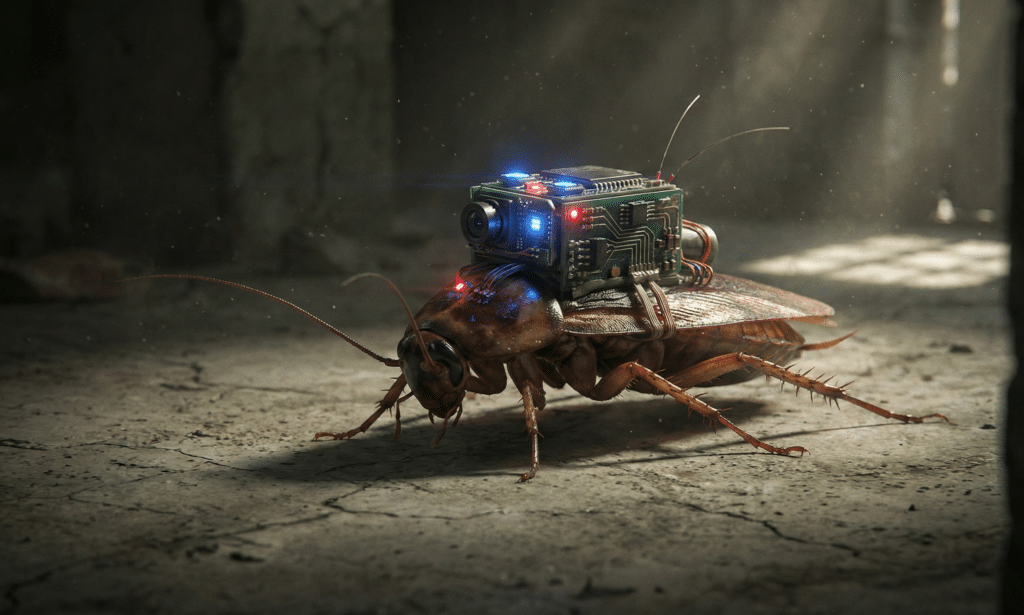
What yesterday resembled a science-fiction scenario is now being developed in a German laboratory. A company named SWARM Biotactics is working to transform living cockroaches into genuine tools of espionage and reconnaissance. Thanks to miniature backpacks housing sensors, AI, and communication modules, these insects become biorobots capable of operating where machines fail. Discreet, resilient, and intelligent, they could well redefine the future of surveillance.
When Biology Becomes Technology
The concept is simple on paper, yet devilishly ingenious: outfitting living cockroaches with a tiny device strapped to their backs, capable of controlling them and collecting data. These backpacks harbor cutting-edge technology, integrating environmental sensors, neural stimulation systems, and a secure communications interface. Taken together, they enable guiding the insects, monitoring their surroundings in real time, and transmitting the gathered information, even in areas inaccessible to drones or conventional robots.
The objective is clear: to leverage the cockroaches’ natural mobility, their agility, their discretion, and their capacity to survive in extreme conditions. Through artificial intelligence and swarm operation, these augmented insects can undertake reconnaissance, search, or surveillance missions in locations previously unexplorable.
Miniature Spies for Inaccessible Areas
In a tense and increasingly digital geopolitical context, the ability to collect information discreetly represents a major strategic advantage. SWARM Biotactics’ cyborg cockroaches are designed to intervene in complex and dangerous environments: collapsed buildings, conflict zones, underground structures, or hostile terrains. Anywhere traditional robots fail, they can pass through.
Their extremely low electronic signature makes them almost undetectable, and their natural appearance helps them blend into their surroundings without raising suspicion. They are living sensors, silent, inexpensive, and above all capable of moving where humans or machines cannot reach.
A Novel Hybrid Robotic Paradigm
The CEO of SWARM Biotactics, Stefan Wilhelm, presents this technology as a new category of robotics: biologically integrated, evolving, and adapted to the challenges of the twenty-first century. The company positions itself at the forefront of a revolution where living beings become a platform for intelligent systems.
Unlike drones or traditional robots, these biorobotic insects benefit from the autonomy of living organisms and the precision of digital systems. They can be guided remotely or operate in swarms autonomously, following collective algorithms inspired by animal behavior.
The challenge is not limited to espionage. These swarms could also serve in rescue operations after natural disasters, locating survivors amidst rubble, or measuring air quality in unstable structures.
Solid Funding for a Sensitive Technology
In October 2026, SWARM Biotactics announced a €10 million seed round, bringing its total to €13 million. This financial backing, coming from investors in Europe, the United States, and Australia, signals growing interest in these hybrid technologies at the frontier of robotics, AI, and biology.
According to the company, this investment will enable moving from the research phase to operational deployments, particularly for security agencies and armed forces. The challenge will not be purely technical but also ethical: how far are we willing to go to exploit living beings for strategic purposes?
