
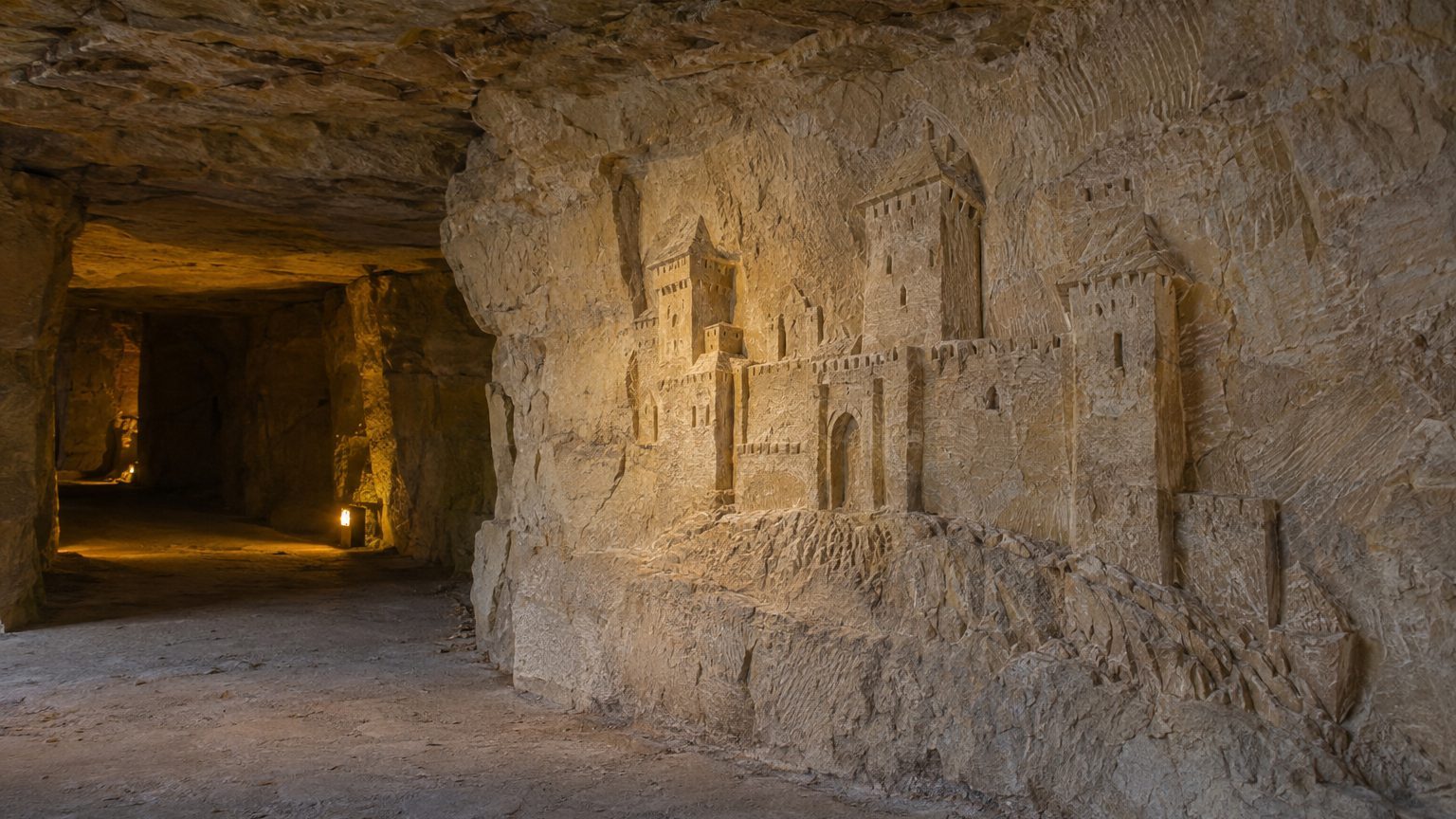
- Décure, a former soldier and quarry worker, carved after his day’s work between 1777 and 1782
- The fort represents Port-Mahon, on the island of Minorca, where he had served
- According to an 1829 work, a fontis caused by his staircase killed him on the spot
- The sculptures were restored in 1854 after damage during the Revolution
A Soldier Turned Carrier, a Fort Carved After the Day
Under Paris’s 14th arrondissement, a stone fortress has waited in the dark since 1782. It represents Port-Mahon, on the island of Minorca, and it was carved by a quarry worker named Décure. According to a publication from 1829, he may have died there.
The sculptures were created from 1777 to 1782.
Five years, the length of a five-year term. Décure, nicknamed Beauséjour, was a veteran of Louis XV’s armies. Discharged, he had joined the Carriers Inspection to supplement his modest pay. By day he worked on stabilizing the galleries under Guillaumot’s supervision, and he sculpted after work. The fort was thus born from his evenings, in the galleries he supported during the day.
What he carved is not abstract. It depicts a model as well as various views of Port-Mahon Fort, the main town of Minorca in the Balearic Islands. He knew the island from his service during the Minorca campaign, where he had served as a soldier.
After the day’s work, a fort took shape in the limestone.
The Staircase, the Fontis, and an 1829 Account
Wishing to perfect his work, Décure undertook the construction of a staircase providing access from the upper level of the quarry.According to Le Conducteur portatif, a 1829 work cited by Wikipedia, this in turn caused a fontis—a collapse of the quarry’s ceiling that breaks away in one block—and it killed him instantly.
No date of death is known. The episode rests on this 1829 work and on sites devoted to catacomb tours, and the sculptor’s first name varies across sources.
The phrasing of the title, “never resurfaced,” thus belongs to tradition rather than a documented death. Yet it carries the force of a news item: a man, a staircase, a rock ceiling. If one follows the 1829 text, the tool designed to facilitate access to his sculptures hastened his end. He left no death date or certain given name, only his stones.
A Gallery That Survived the Revolution and the Closures
The work did not remain intact. Damaged during the Revolution, the sculptures were restored in 1854, and have undergone several restorations since. Seventy-two years elapsed between the fort’s completion and this first dated restoration.
The gallery later experienced closures. The sculptures were no longer part of the ossuary’s visiting route since 1995, and the gallery reopened in April 2008.
The fort also gave its name to an entire district.
The Historic Monuments Research Laboratory produced a file on this sector, recorded in 2023. It focuses on white coverings observed on the sculpted wall, between the Cazerne Quarter and Fort Philippe. The indexed subjects are biological deterioration and the sculptures. A specialized site argues that permanent lighting is “likely” the cause, but this hypothesis is not established.
Under Tombe-Issoire Street, a Listed Quarry
The quarry that houses this décor is itself a historic monument. Its exploitation is documented before 1492, and the Mérimée notice describes an exceptional state of preservation. The double-storey quarries were dug from the 14th century, and inscriptions from the 16th century are found there. Protection happened in two stages: inscription by decree on May 18, 1993, then listing by decree on January 4, 1994.
The Conseil d’État confirmed this listing four years later. It noted that the quarry is the only one from that era known under Paris.
The quarry belongs to a private company. A closed gate blocks access to the Port-Mahon path quarry. The Décure Fort is therefore not open to visitors as a public monument.
The Paris Administrative Court rejected in 2014 the lawsuit of an association against the December 21, 2012 decree authorizing restoration, stabilization, and enhancement works on the quarry. The ruling is final. Nothing in these sources indicates, as of October 2026, what will become of the fortress itself.
Sources: lrmh.fr | paris.tribunal-administratif.fr
