
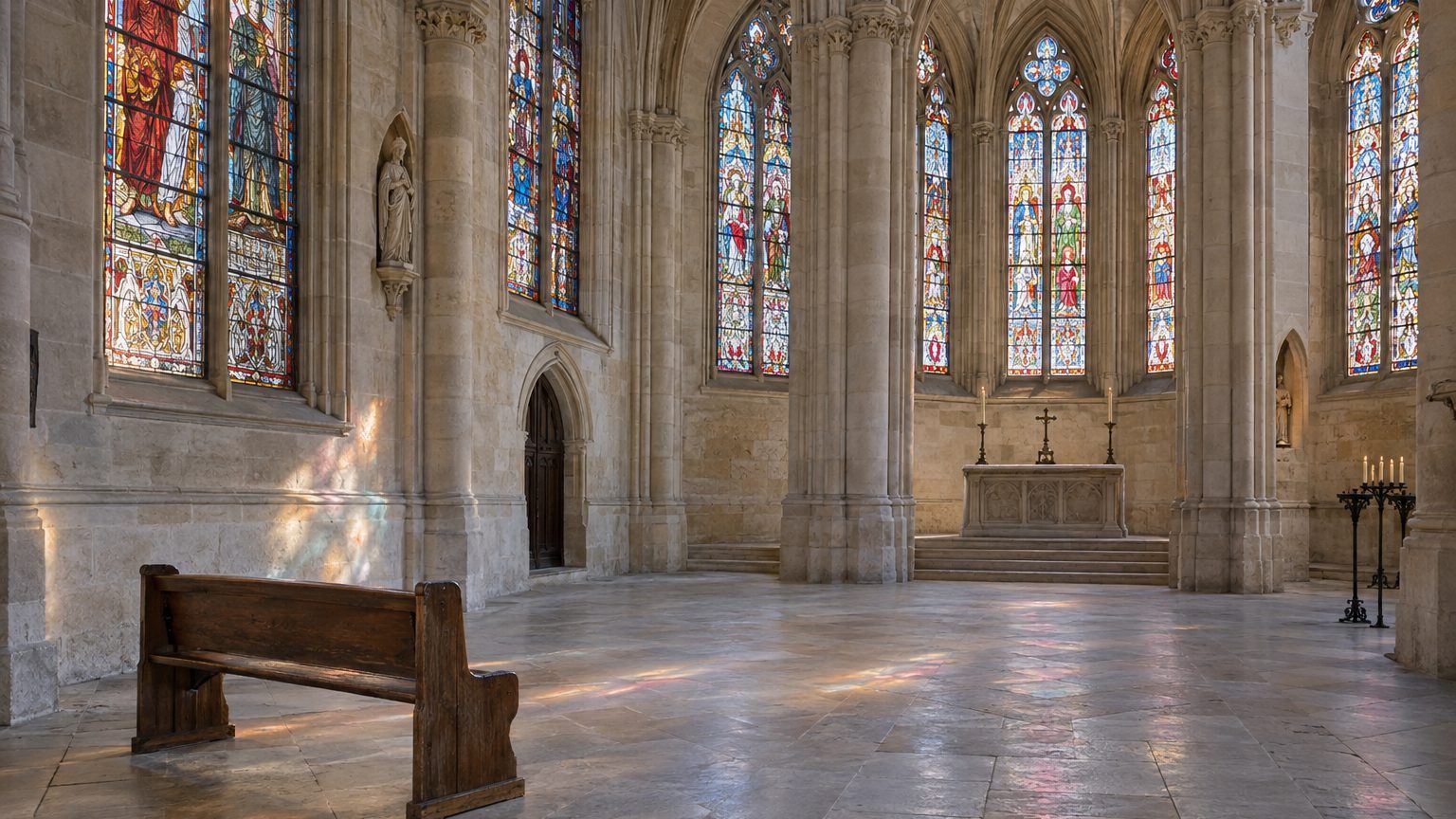
The most expensive thing at Sainte-Chapelle isn’t the Sainte-Chapelle itself. In 1239, Saint Louis pays 135,000 livres tournois for the Holy Crown, the crown of thorns of Christ, while the building meant to enshrine it would cost about 40,000 livres tournois. The burden of the content therefore weighs more than three times the price of the container.
Three chapels at that price would not have sufficed.
A owner who would pay the safe three times as much as the house would come across as whimsical. Louis IX, however, performs precisely that calculation, and history remembers him for a gesture of piety and power.
- The Holy Crown cost 135,000 livres tournois in 1239.
- The Sainte-Chapelle cost about 40,000 livres tournois.
- The crown was pledged in Venice before being repurchased by Louis IX.
We admire the glass, we forget the relic’s price tag
On the Île de la Cité, Sainte-Chapelle is regarded as a masterpiece of Gothic art, and that reputation leads one to think that the majority of funds went into stone and stained glass. That is the common belief. According to Wikipedia, the total cost of the works amounts to 40,000 livres tournois. The Holy Crown, by contrast, cost 135,000, i.e., 95,000 more than the building itself.
The project took time, but its starting date remains fuzzy. Universalis places the beginning between September 14, 1241 and May 12, 1244, which, with a dedication in 1248, yields a duration of 4 to 6 years according to Wikipedia.
For the relic, a single year suffices: 1239.
More than six months of royal revenues for a pledged object
We compare this with the king’s finances. According to Universalis, the sum surpassed half the royal domain’s annual income, i.e., more than six months of revenues. The 40,000 livres for the chapel, spread over several years of work, weighs far less in the scale.
The object nonetheless changes hands in a context of financial distress. Baudouin II, Latin emperor of Constantinople, faced severe money troubles, and, according to the Cluny Museum, he pledged the crown to Venice as early as 1237. Wikipedia suggests a pledge in 1238 to a Venetian merchant, leaving the precise date uncertain. Louis IX redeemed these pledges in 1239 by paying the 135,000 livres.
According to Claves, after June 1239 the crown may have returned to the lender in Venice.
Before paying, the king verified. Wikipedia notes a sequence of negotiations designed to confirm the relic’s authenticity before acquiring the Holy Crown for 135,000 livres tournois. Other relics of the Passion, including a fragment of the True Cross, joined the royal collection from the same year, 1239.
A case designed as a reliquary, not as a pilgrimage site
Once the collection was assembled, Saint Louis decided to erect a chapel crafted as a genuine reliquary. It replaced the Saint-Nicolas-du-Palais chapel on the Île de la Cité.
The king had no intention of making it a national sanctuary or a foremost pilgrimage destination, as shown by the absence of outside access to the upper chapel, where the great reliquary is displayed. The arrangement evokes Imperial palatine chapels: in Constantinople, the emperor moved from his palace to Hagia Sophia, and Louis likewise enjoyed direct access from his own palace. Art historians read this as a way of placing himself in the lineage of Charlemagne and his Aachen chapel.
Procurement of the relic also carried political weight. According to Culturez-vous, it confirmed the strength of the French kingdom and the legitimacy of its divine-right lineage.
Both levels were consecrated on the same day: April 26, 1248.
The papal legate Eudes de Châteauroux consecrated the upper chapel, dedicated to the Holy Cross, while the Archbishop of Bourges, Philippe Berruyer, consecrated the lower chapel, dedicated to the Virgin. According to Claves, the crown, initially placed at Notre-Dame upon its arrival in Paris, was moved in 1248 to the chapel built for it. During the Revolution, the relics were removed from Sainte-Chapelle and entrusted to Notre-Dame de Paris, where they are preserved today.
Comparing sums across nearly eight centuries remains perilous: Claves notes that the idea of “half of the royal budget” is not accepted by all historians, and there is no reliable euro equivalent. The approximately 1 to 3.4 ratio between the price of the chapel and that of the crown does not rely on any currency conversion.
Sources: x.com | culturezvous.com
