
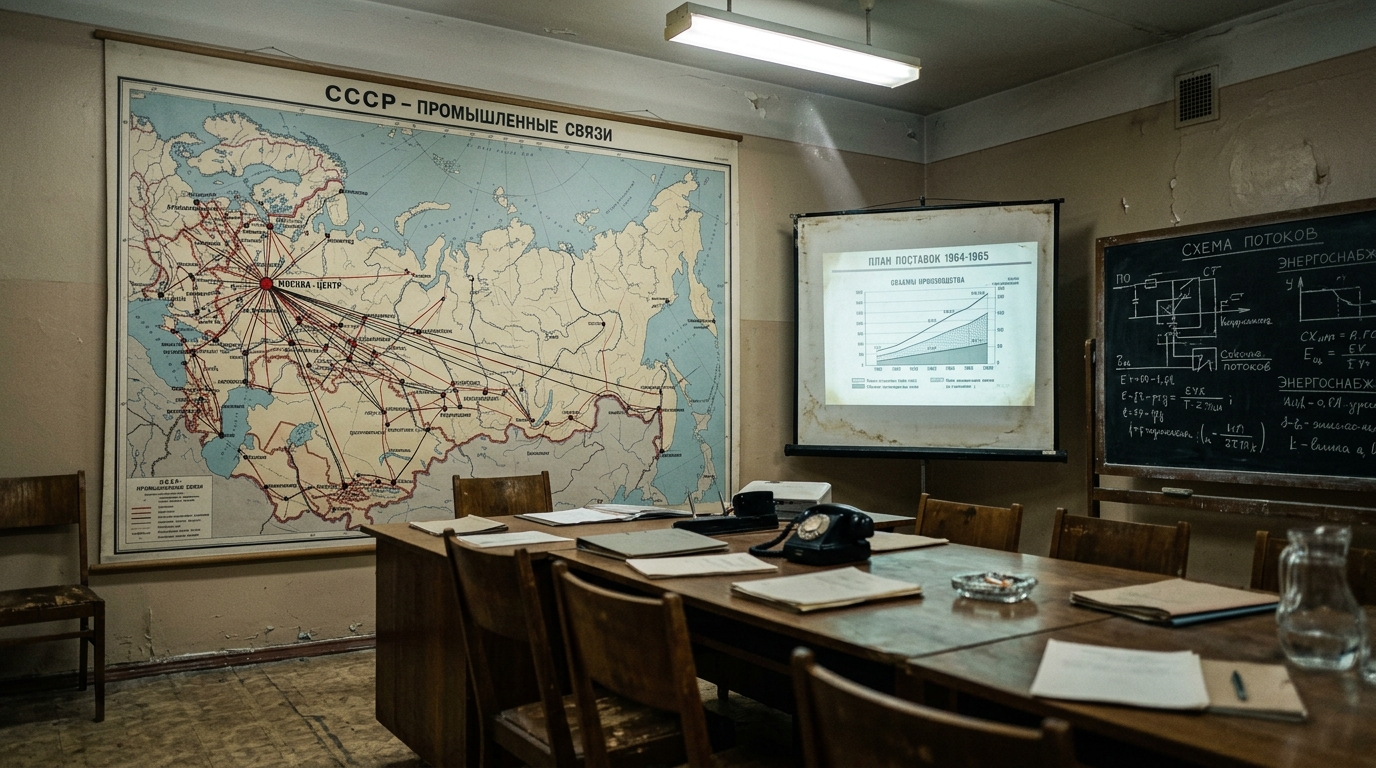
Imagine for a moment a gigantic electronic web linking every factory, every kolkhoz, and every planning office in a country spanning eleven time zones, all controlled from a single computing center in Moscow. This is not science fiction, nor a dream born in the Silicon Valley of the 1990s. It is a real project, conceived in the midst of the Cold War by a Soviet engineer, at a moment when even the Americans had not yet imagined anything so ambitious. Named OGAS, this network could have altered the face of the world economy. It never came to be. And curiously, it wasn’t a lack of technology or a shortage of computers that doomed it, but something far more human, almost banal: a power struggle at the top of the State.
- In 1962, the cybernetician Viktor Glushkov conceived OGAS, a network meant to connect every factory and planning center to a central computer in Moscow to run the economy in real time
- The USSR possessed the skills and technologies needed, but the project failed in 1970 due to lack of funding, rejected by Finance Minister Garbuzov who saw a threat to his ministry
- The absence of Brezhnev and Kosygin during the decisive presentation to the Politburo deprived Glushkov of political backing, dooming OGAS to a diluted, non‑interoperable patchwork of local systems
- An Electronic Brain to Direct the Entire Economy
- Technology Was Never the Problem
- The Politburo, or the Art of Killing a Project Without Saying It
- What OGAS’ Failure Reveals About Centralized Systems
In 1962, the cybernetician Viktor Glushkov does not settle for imagining a mere calculating device to ease the Soviet bureaucrats. He designs a system of unprecedented scope: a national network capable of linking every factory and every planning center to a central computer placed in Moscow. The idea is almost dizzying for the era. This giant electronic brain would analyze production needs in real time, adjust quotas, anticipate shortages, in short, pilot the Soviet economy as if it were a single, perfectly well‑oiled machine.
The project’s full name already hints at its overbearing ambition: the Automated System of the State for the Collection and Processing of Information for the Accounting, Planning, and Governance of the National Economy. In concrete terms, the architecture envisioned a central computer in Moscow, several hundred regional centers in major cities, and as many as 20,000 local centers scattered across factories and enterprises throughout the Eurasian expanse of the Soviet Union. This was a territorial mesh worthy of the world’s largest networks, conceived decades before the Internet would become a tangible reality.
The ultimate aim went far beyond mere economic efficiency. It aspired to realize what Soviet theorists called socialist electronism, a technocratic way to guide the socialist experiment one step closer to communism. Nothing short of that. And this project did not escape American scrutiny: as early as 1962, the U.S. government already regarded OGAS as a major strategic threat, with historian Arthur M. Schlesinger Jr. even alluding to a significant advantage the USSR could gain in the realm of production technology.
Technology Was Never the Problem
Contrary to a stubborn myth, the Soviet Union did not lack computers or cybernetics expertise in the 1960s. Soviet engineers mastered the concept of distributed networks long before ARPANET, the precursor of the Internet, arose in the United States. The infrastructure envisioned by Glushkov leaned precisely on a logic of technical decentralization paired with centralized supervision, an architecture that was remarkably forward‑looking for its time.
The real obstacle did not lie in the laboratories but much higher up, in the hushed corridors of Moscow’s power centers. This is the paradox at the heart of the story: a country capable of conceiving a system of striking technical sophistication proved unable to implement it, not for lack of material means, but because of human resistances. It was as if one had all the ingredients for a sophisticated dish, yet the kitchen itself refused to light the ovens.
The Politburo, or the Art of Killing a Project Without Saying It
On October 1, 1970, Glushkov finally presents his full funding request before the Politburo. The sum requested is dizzying: at least 100 billion rubles, roughly the equivalent of $850 billion in today’s terms, with a hoped‑for return on investment of five times the initial outlay over about fifteen years. He also warns the leaders: without a complete OGAS, the country’s economy would face serious difficulties in the second half of the 1970s, and sooner or later the project would have to be revisited—but too late.
Facing him is a formidable adversary: Vasily Garbuzov, the Finance Minister. Officially, he saw no benefit in real‑time, optimized computer networks to govern the economy. He preferred, he claimed, simple computers playing music in poultry houses to stimulate egg production, a device he had observed during a visit to Minsk. A seemingly comical argument, but it masked a far less candid motive: Garbuzov wasn’t defending economic common sense; he was defending the budget and the influence of his own ministry.
On the decisive day, Glushkov makes a troubling discovery as he steps into Stalin’s former office in the Kremlin: the chairs of Brezhnev and Kosygin are empty. Their absence is officially attributed to other state obligations. But that vacancy at the apex changes everything. Without the two most influential men to arbitrate in his favor, Glushkov loses his principal support. The Politburo, which had nearly tilted in his favor, judges it wiser to back Garbuzov. The OGAS project remains mired in administrative limbo for another full decade.
At the 1971 Party Congress, which should have sanctioned the plan, the outcome is the expansion of local information‑management systems only—a dulled version far from the original ambition. The rejection was never technical but institutional: OGAS failed chiefly because of internal bureaucratic struggles, encountering a minister who saw it as a direct threat to his own territorial jurisdiction.
What OGAS’ Failure Reveals About Centralized Systems
Without state funding, the grand national network imagined by Glushkov gradually fragmented through the 1970s and 1980s. What was meant to be a unified system turned into a patchwork of dozens, then hundreds, of locally controlled factory governance systems, isolated from one another and wholly non‑interoperable. The image is almost brutal: the dream of a single electronic brain ended up as a multitude of small, disconnected brains incapable of communicating with one another.
The OGAS story encapsulates a fascinating paradox: a technological innovation can fail not because of its scientific limits, but due to human and institutional resistance. This Soviet case sheds a peculiar light on today’s debates about data centralization and algorithmic governance—questions that regularly surface in the tech world, whether around artificial intelligence or large public databases. Between cybernetic ambition and bureaucratic reality, the USSR missed a historic opportunity, not for lack of vision, but because of an excess of internal mistrust among its own institutions.
Ultimately, the OGAS narrative is less about a technological failure than about a political system that could not trust its own innovations. It, with an almost tragic irony, reminds us that the greatest technical revolutions often stumble not on the limits of science but on the rigid egos and interests of people. A lesson that, more than half a century later, still resonates with our contemporary debates over the centralization of digital information.
