
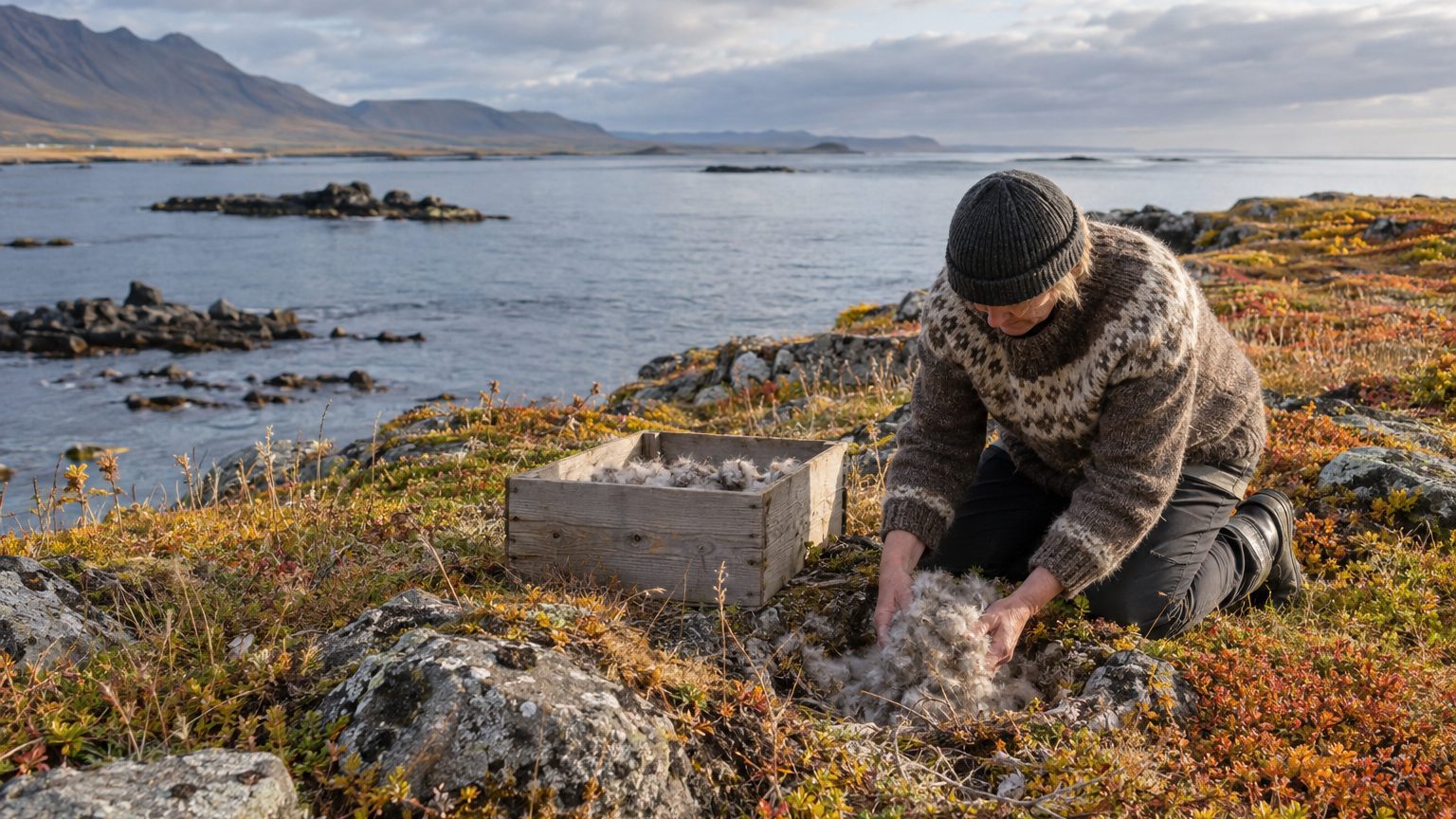
By emptying 60 to 80 nests, an Icelandic farmer literally has enough to fill a single kilogram of down. The number is dizzying as you pull the winter duvet from the closet and wonder what it contains. The eider, this wild duck that returns each summer to nest on Icelandic farms, provides only a tiny fraction of the down produced worldwide.
The bird is called the eider, and its down obeys an arithmetic all its own.
- It takes down from 60 to 80 nests to obtain 1 kg.
- Iceland supplies about three-quarters of the world’s eider down harvest.
- Eider down is dried, heated to 120 °C, then sorted by hand.
60 to 80 Nests for 1 kg of Down
The calculation begins with the Icelandic producer Teigarhorn: you need the down from 60 to 80 nests to obtain 1 kg. A Reuters/AFP dispatch published in July 2021 notes a nearby figure, roughly 60 nests per kilo. A simple calculation (1,000 g divided by 60 or 80) yields 12 to 17 g of down per nest, about the size of two or three sugar cubes.
At the scale of the country, Teigarhorn estimates Iceland’s production at around 3,000 kg of eider down per year. Multiplied by 60 to 80 nests per kilo, this figure implies 180,000 to 240,000 nests emptied each season (an order-of-magnitude estimate provided here, not an official statistic). Global harvest does not exceed 4 tonnes per year, of which about three-quarters come from Iceland, according to the AFP dispatch. Nearly 400 Icelandic farmers, according to the same source, are involved each summer.
Three tonnes is the weight of two or three small cars, but dispersed into tufts of a few grams. These data come in part from a producer who has a vested interest in the image of his product, but the AFP dispatch provides magnitudes that are broadly compatible.
How do these figures translate into a duvet? The same dispatch mentions duvets containing between 600 and 1,600 g of down, depending on the chosen quality. With 60 to 80 nests per kilo, that would correspond to 36 to 128 nests emptied for a single duvet (0.6 kg × 60 on one side, 1.6 kg × 80 on the other). If the 3,000 kg of Icelandic down were shared equally among nearly 400 farmers, each would harvest about 7.5 kg, theoretically enough to fill 5 to 12 duvets.
From Surveillance to Hand Sorting
No down while the female is on the nest.
The eider has been a fully protected species in Iceland since 1847, at a time when France was still under the July Monarchy. So more than 175 years later, that rule still stands. During nesting, farmers monitor the colonies day and night. They only harvest the down once the female has left it and when it is safe for the birds.
The word “farm” can be misleading: the bird remains wild, and it is he who decides to return to nest each summer. The farmer provides a guarded colony in which the left-behind down becomes a harvest.
The calendar thus belongs to the birds, not the producers. The figure of 3,000 kg per year is merely a rough order of magnitude, and it shifts with the year’s weather. At 60 to 80 nests per kilo, plus or minus around a hundred nests changes the final volume by about 1.25 to 1.7 kg.
Once collected, the down follows Teigarhorn on a multi-step journey. It is first dried, then heated to 120 °C to disinfect. Next comes mechanical cleaning, followed by hand sorting, nest by nest. The producer notes that the entire process takes place without any chemical products.
This procedure is that of a single producer, Teigarhorn. There is nothing to extend this 120 °C treatment to all farms in the country. For other operations, the steps could differ, and only their own descriptions would reveal them.
175,000 tonnes on One Side, 4 on the Other
175,000 tonnes: that is the global production of down, across all birds.
This estimate, echoed by AFP, dwarfs the eider harvest, which tops out at 4 tonnes per year, or about 0.002% of the total. The Eiffel Tower weighs a little over 10,000 tonnes, so global down weighs roughly 17 times as much. Within this mass, the eider weighs so little that the winter duvet pulled from the closet almost certainly contains another kind of down.
On the buyer’s side, the word “down” covers very different realities. The eider amounts to 4 tonnes per year, while all down together reaches 175,000 tonnes. Precise labeling (species of bird, country, harvesting method) allows you to know what you are buying. A product that merely advertises eider without naming a producer or country of origin deserves a few questions before checkout.
Iceland supplies about three quarters of the world’s eider harvest, or around 3,000 kg per year according to Teigarhorn. A duvet lined with one kilogram of this down would require 60 to 80 nests, emptied after the females depart.
