October 12, 2026
Imagine an instrument designed, funded, maintained and improved for more than twenty years, whose sole stated purpose was to never carry out the task it was built for. Yet that is precisely what Le Redoutable represents, the French submarine that has crossed the world’s oceans without ever releasing a single warhead in a real situation. An industrial and strategic feat that continues to command respect today when one measures the technical challenge it posed at the time.
À retenir
- Launched in Cherbourg in 1967 and in service from 1971 to 1991, Le Redoutable was the first French ballistic missile submarine, marking France’s entry into the club of strategic oceanic powers.
- Equipped successively with the M1, M2 and then M20 missiles (from 1977, with a one-megaton payload and a range of 3,000 km), it remained the only one in its class to never receive the M4 missile.
- In twenty years of service, it carried out more than fifty patrols and accumulated nearly 3,500 days at sea, without ever firing an armed missile, before being converted into a museum ship at La Cité de la Mer in Cherbourg in 2000.
Sommaire
- Un sous-marin conçu pour ne jamais tirer
- Cherbourg, 1967 : la naissance d’une dissuasion made in France
- Le M20, cette arme que personne n’a vue exploser en vrai
- 1991, le rideau tombe sur vingt-quatre ans de patrouilles silencieuses
As autumn begins and commemorations of France’s nuclear deterrence regularly return to the headlines, it is interesting to examine this paradoxical object: a weapon designed to deter rather than strike, a giant of steel whose effectiveness lay precisely in its inactivity. Here is the story of a vessel that embodies, better than any other, the chilling and fascinating logic of nuclear deterrence.
A submarine designed to never fire
There are few military objects whose value rests entirely on the fact that they will never be used for their primary purpose. Le Redoutable belongs to this very special category of deterrence weapons, where the mere existence of danger is enough to neutralize its use. Specifically, this submarine-launched ballistic missile boat, or SNLE, was not meant to engage in combat: its mission was to stay invisible, silent, undetectable, somewhere beneath the waves, ready to respond in case of a nuclear assault on France.
This philosophy, known as deterrence by the weak against the strong, rested on a principle that is simple to state but devastating to implement: convince a potential adversary, even a much more powerful one, that an attack on France would trigger a devastating nuclear retaliation, making aggression irrational. For this logic to function, you needed a tool capable of surviving a first strike while remaining hidden. An underwater submarine, able to stay submerged for weeks without surfacing, perfectly met this requirement.
Cherbourg, 1967: the birth of a deterrence made in France
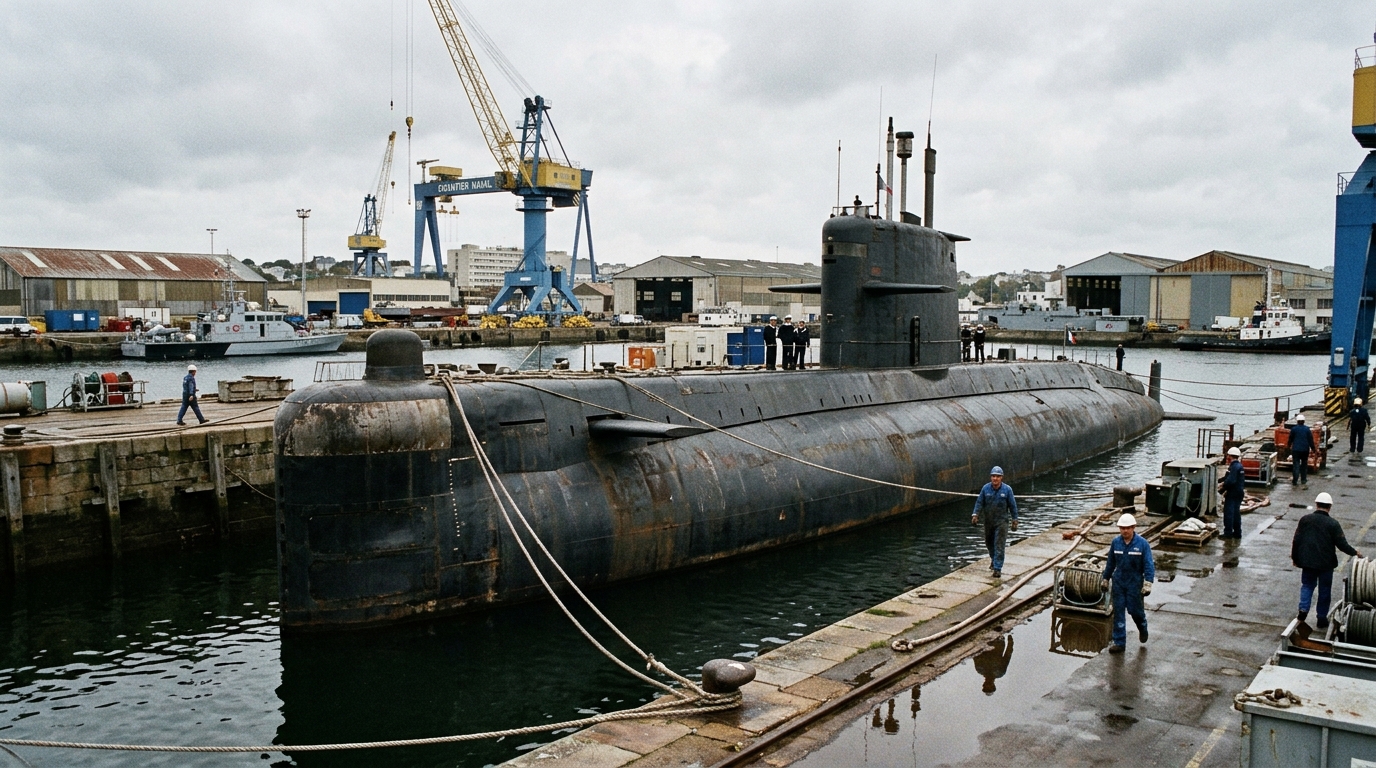
It all began in the shipyards of Cherbourg. The construction of Le Redoutable started in 1964, in utmost secrecy, at a time when France sought to assert its strategic independence from the two great powers of the Cold War. Three years later, on March 29, 1967, the vessel was launched in the presence of General de Gaulle himself, a symbol of the political importance attached to the program. The event marked a turning point: France became the fourth nation in the world to possess a strategic oceanic force.
With its 128 meters in length, Le Redoutable impressed as much by its size as by the onboard technology it housed. However, it would be necessary to wait until December 1, 1971, for the submarine to enter active service, after several years of technical development required to reliable a system of such complexity. On board, sixteen missile tubes were initially equipped with M1 missiles, later replaced by the M2 starting in 1974. This gradual evolution reflected France’s desire to continually modernize its strike force, in a perpetual technological race with other nuclear powers.
The M20, this weapon no one ever saw explode in real life
In 1977, a new generation of missiles joined Le Redoutable: the M20. This missile carried a thermonuclear warhead of one megaton, capable of striking a target up to 3,000 kilometers away. To put this in perspective, this yield far exceeds the bombs dropped on Japan in 1945, illustrating how nuclear arms racing had scaled up in just a few decades.
Notably, Le Redoutable would remain the only submarine in its class never to receive the more capable M4, unlike the five other vessels built to the same design. It retained its M20 missiles until its retirement in December 1991, thereby becoming the last operational user of this weapon. In total, around a hundred M20 missiles were produced between 1977 and 1991 to equip France’s entire SNLE fleet.
And this is where the story’s peculiarity lies: between 1976 and 1987, Le Redoutable and its sister ships conducted M20 missile firings for training, but always with nuclear warheads disarmed. In other words, never, under any circumstances, was a armed missile fired in wartime conditions from this submarine. The most destructive weapon France ever built is also the one that never exploded in reality. A paradox that captures the essence of deterrence: to exist in order not to be used.
1991, the curtain falls on twenty-four years of silent patrols
Over nearly two decades of active service, Le Redoutable completed more than fifty patrols, accumulating nearly 3,500 days at sea. In other words, years during which entire crews lived confined beneath the waves, isolated from the world, solely to guarantee the credibility of France’s deterrence. These sailors, rarely mentioned, spent a significant portion of their lives in the deep’s silence, never knowing whether the fatal order would someday come.
In December 1991, after twenty years of service, Le Redoutable was finally decommissioned. It had traversed the entire Cold War, keeping watch in silence while the world held its breath at the specter of nuclear confrontation. Far from fading into oblivion, the submarine found a second life: in 2000 it was converted into a museum ship and installed in a dry dock at the Cité de la Mer in Cherbourg, just a few meters from the very place where it had been launched more than thirty years earlier. A completed loop that now allows visitors to step into the innards of this war machine, which has become a historical testament.
The story of Le Redoutable goes far beyond a purely technical narrative of a submarine. It recounts how a nation invested colossal resources in a weapon whose success was measured precisely by its absence of use. Today, as geopolitical tensions repeatedly remind us of the importance of strategic balances, this old submarine moored at Cherbourg continues to pose a question that remains relevant: how do you measure the effectiveness of a weapon that never needed to fire to fulfill its mission?