
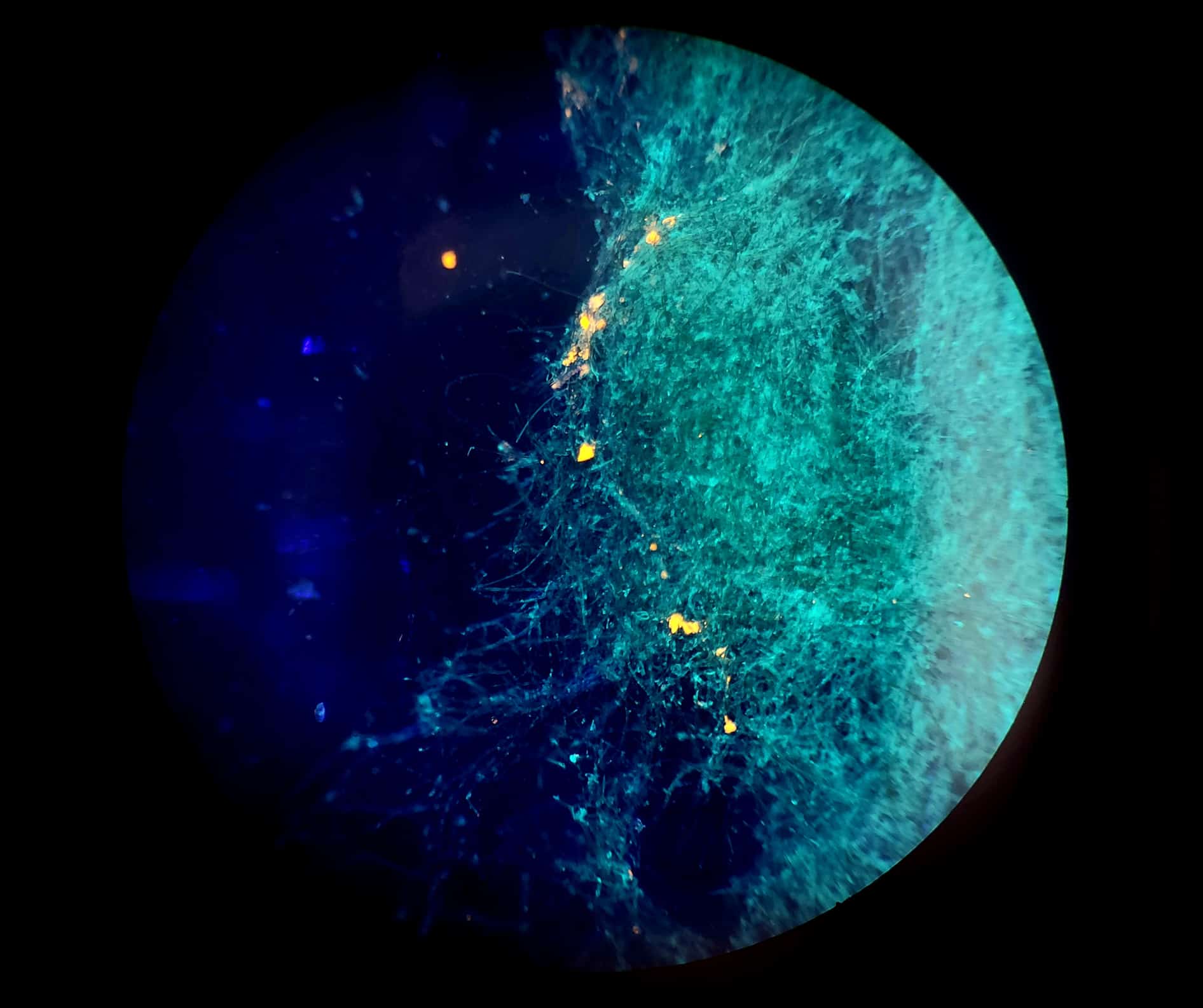
For decades, researchers have wrestled with a troubling mystery: where did the billions of tons of missing plastic in our oceans vanish to? The answer has just been found, and it is terrifying. Dutch scientists have discovered that the North Atlantic teems with 27 million tons of plastic particles so minuscule that they escaped all our measurement instruments. These “nanoplastics” are invisible, already contaminating our brains and climbing up the entire food chain to reach our plates.
The Mystery of Phantom Plastic Finally Solved
Picture a detective at a crime scene where half of the evidence seems to have vanished. That was precisely the challenge oceanographers have faced for years. We know humanity has produced astronomical quantities of plastic, we see waste floating on the surface of seas, we find microplastics all around our environment. Yet, when scientists tried to tally the pollution, a huge portion remained unaccounted for.
This “missing plastic paradox” has finally found its explanation thanks to the groundbreaking work of researchers at the Royal Netherlands Institute for Sea Research. The key to the mystery lay in the infinitesimally small: the nanoplastics, particles so microscopic that they slip through all our detection filters.
An Invisible Yet All-Pervasive Pollution
Sophie ten Hietbrink, a doctoral student at Utrecht University, led a meticulous scientific expedition across the North Atlantic. Aboard a research vessel sailing from the Azores to the European coast, she collected water samples at twelve strategic sites. Her mission: to track these phantom particles smaller than one micrometer.
The results of her molecular analysis stunned the scientific community. Extrapolated to the entire North Atlantic, her calculations reveal 27 million tons of nanoplastics suspended in the water. A figure the researcher herself calls “shocking,” but which finally sheds new light on the true scale of the plastic catastrophe.
These findings suggest that nanoplastics are actually the dominant fraction of marine pollution. In other words, the visible portion of pollution was merely the tip of the iceberg of a far larger and more insidious contamination.
A Widespread Contamination of the Biosphere
The origin of these nanoplastics is multiple and troubling. Some arrive via rivers, carried from continents. Others literally fall from the sky with precipitation, confirming that even Earth’s atmosphere is now contaminated. More troubling still, these particles also form through the degradation of plastic waste already present in the ocean, fragmented by the combined action of waves and sunlight.
Once in the water, these nanoparticles begin a terrifying journey through every tier of marine life. They first contaminate bacteria and micro-organisms, then climb relentlessly up the food chain to fish, to marine mammals, and finally to humans.
Geochemist Helge Niemann, a co-author of the study, does not mince words: “We already know that nanoplastics can penetrate deeply into our bodies. They are even found in brain tissues.” This brain contamination marks a threshold crossed in the history of human pollution, with health consequences still largely unexplored.
A Planetary Emergency with No Return
The discovery, reported in Nature, raises a crucial question: what impact will this invisible pollution have on Earth’s ecosystems and on our health? Scientists acknowledge that we are navigating uncharted territory, but the early indicators are alarming.
The message from researchers is unequivocal: unlike the macro-waste we can still collect, these nanoplastics can never be eliminated from the environment. They have now become an integral part of the earth’s biosphere.
This reality demands a radical conclusion: our only option is to stop all new plastic pollution immediately. Because every additional gram of plastic dumped into the environment will sooner or later join this invisible army of contaminants that quietly poison our planet.
