
A routine test that nearly ended in catastrophe: in orbit, a Russian cargo spacecraft struck and pierced the hull of a crewed module of the Mir space station, forcing the crew into a life-or-death sprint to save the station and their own lives.
- In June 1997, the Progress M-34 cargo vehicle, tested in manual piloting via the TORU system, collided with and breached the Spektr module of the Mir space station, triggering depressurization.
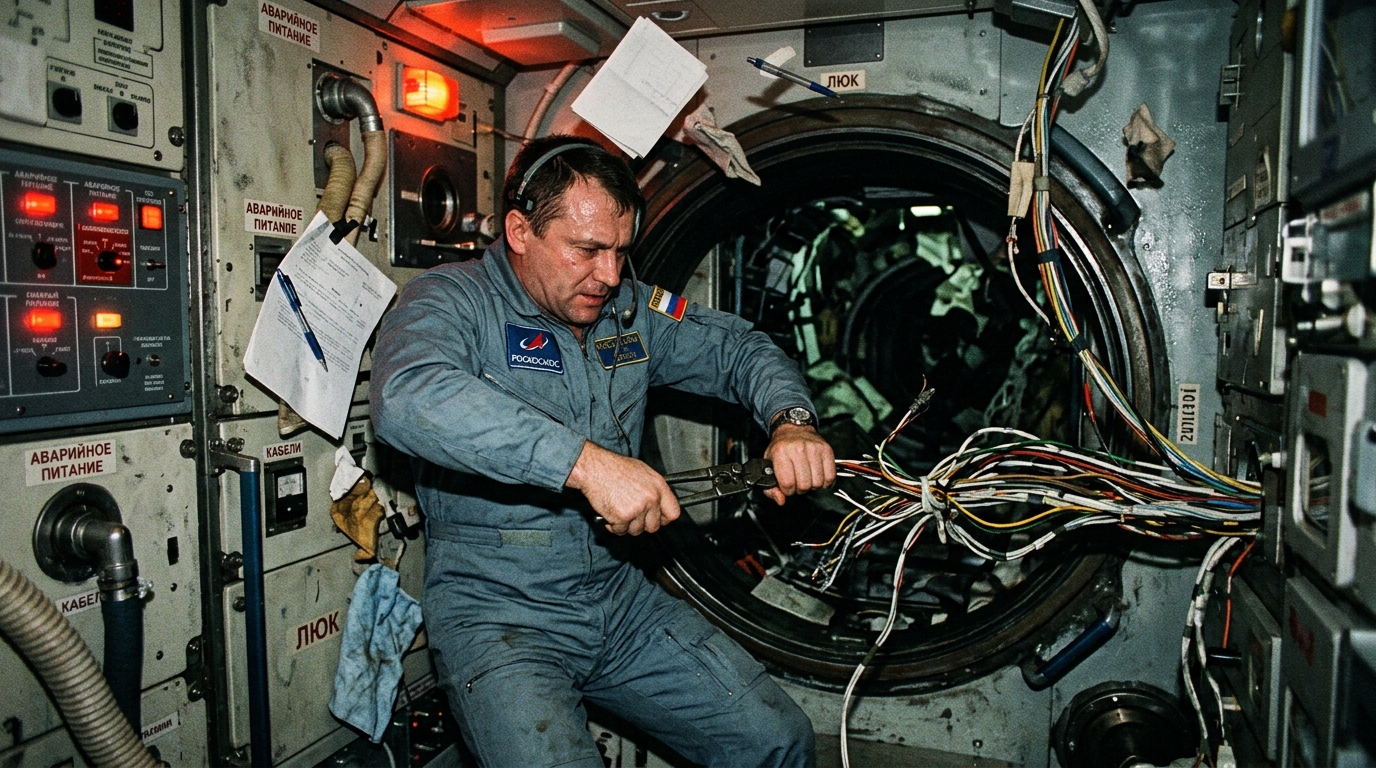
- The crew, including astronaut Mike Foale, manually severed the electrical cables crossing the airlock to isolate Spektr and stop the air leak before suffocation ensued.
- The incident deprived Mir of nearly half of its electrical power production, with the Spektr module remaining damaged until the station’s deorbit in 2001.
- Why Russia Sought to Do Without Ukraine for Docking Its Vessels
- A Manual Simulator That Turns into a Nightmare
- Race Against the Clock: Cutting the Cables Before Total Asphyxiation
- Mir Survived, but at What Price for Russian Space Exploration
Some space accidents leave a mark on the collective memory, and this one certainly did. For decades, the Mir space station stood as a symbol of Russia’s prowess in long-duration human spaceflight, an impressive technical achievement assembled module by module since the mid-1980s. Yet behind this triumph lay a troubling technological dependency for Moscow: the automatic docking guidance system used to guide cargo ships, known as Kurs, was manufactured in Ukraine. After the Soviet collapse, this posed a strategic problem, and in the attempt to break free from it Russia unleashed one of the most critical incidents in the history of its space station.
Why Russia Sought to Do Without Ukraine for Docking Its Vessels
Following the dissolution of the Soviet Union, industrial infrastructure ended up scattered across several newly independent states overnight. The Kurs system, indispensable for autonomously guiding Progress spacecraft to Mir’s docking point, happened to be one of these inherited assets that became problematic because it was produced in Ukraine. For Russian engineers, depending on a foreign supplier for a process as vital as docking a resupply ship represented a strategic and logistical risk that was hard to accept in the long term.
It was in this context that the TORU system emerged, a fully Russian alternative allowing a cosmonaut to manually pilot the approaching cargo ship from inside the station, using a control console and a video feed. The concept looked appealing on paper: take back direct control, literally, over an operation that had previously been entirely automated. But it also required trusting a human eye and the reflexes of a pilot to slow a multi-ton vessel launched at orbital speed, a task far more delicate than it might appear.
A Manual Simulator That Turns into a Nightmare
The full-scale test of the TORU system was scheduled for the height of summer. Commander Vassili Tsibliev, already seasoned from involvement in a prior orbital collision in 1994 with a Soyuz, was at the controls from inside the station. Facing him, the uncrewed Progress M-34, a craft weighing more than 7 tons—about the size of a school bus—was to dock manually with the Kvant-1 module.
However, the investigation that followed the accident revealed that the cargo’s center of gravity had been altered by a ground team’s overload, making its trajectory unpredictable and its response to Tsibliev’s commands offset from what he anticipated. The vessel did not slow as planned. It first collided with a solar array attached to the Spektr research module, and then literally pierced the Spektr hull itself. In mere seconds, the station began to lose air pressure, one of the sternest alarms any crew could face in space.
Race Against the Clock: Cutting the Cables Before Total Asphyxiation
In the moments that followed, every second counted. Following his training to the letter, the American astronaut Mike Foale, aboard as part of an international cooperation mission, immediately sought shelter inside the Soyuz spacecraft serving as a lifeboat. But realizing that his two colleagues, Tsibliev and flight engineer Alexander Lazutkin, had not joined him, he chose to come back out to help rather than evacuate alone.
The crew then undertook a high-risk operation: to isolate the Spektr module before the air leak rendered the station uninhabitable. This required sealing the airlock connecting Spektr to the rest of the station, but the airlock was crisscrossed by numerous electrical cables, including those feeding the solar panels of the damaged module. Without hesitation, the cosmonauts cut these cables by hand to allow the airlock to be closed and locked, thereby isolating the breach from the habitable portion of the station. It was a drastic move, but it succeeded in stopping the depressurization before it became fatal.
Mir Survived, but at What Price for Russian Space Exploration
The crew endured, but the station paid a heavy toll. By sacrificing Spektr’s power supply, Mir abruptly lost almost half of its energy generation, severely complicating life-support operations and ongoing scientific experiments. It would be several weeks before an internal spacewalk, conducted in August 1997, allowed the cosmonauts to inspect the damage more closely and attempt to reconnect certain circuits through the sealed airlock.
The Spektr module, damaged and never fully restored, remained a visible scar for the remainder of Mir’s operational life, until the station was deliberately deorbited and disintegrated in the Earth’s atmosphere in 2001. Today this episode stands as a textbook case in the history of space exploration: it shows how a legitimate pursuit of technological independence, if ill-prepared or rushed, can expose entire crews to substantial dangers.
Nearly thirty years later, as modern space stations rely on far more reliable automated docking systems, this June 1997 accident continues to remind us of a simple but essential truth: in space, even the smallest margin for error can turn a technical test into a life-or-death crisis. A lesson we should hope every new generation of aerospace engineers, Russian or otherwise, takes to heart.
