
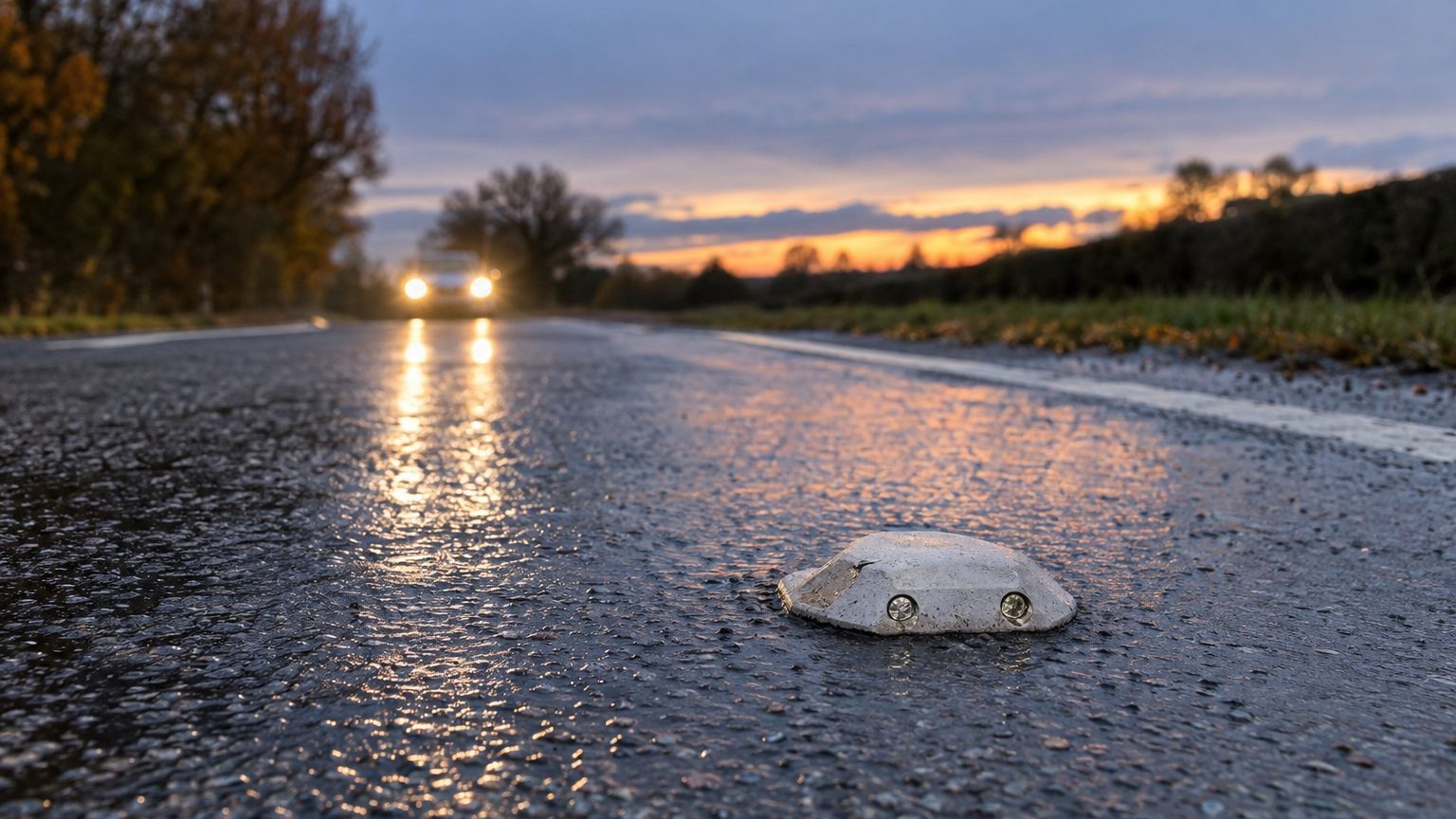
As drivers rolled over a stud laid out under patent GB 436 290 dated April 3, 1934, British motorists literally pressed two pairs of glass eyes into a rubber windshield wiper. Neither a street sweeper with a bucket nor a downpour: the cleaner is the wheel. The mechanism sits in a cast-iron base, in the middle of the roadway, for over 90 years.
The stud is washed with every passage of a vehicle.
- The GB 436 290 patent was filed on April 3, 1934 by Percy Shaw in Halifax.
- Wheel passage depresses the dome and sweeps the catadioptrics with a rubber blade.
- Rainwater collected in the base serves to rinse the glass eyes.
- The blackout of World War II massively accelerated plot sales.
A patent filed in Halifax on April 3, 1934
The document bears the number GB 436 290. It was filed on April 3, 1934 by P. Shaw, of Boothtown, Halifax, under a plain title: “blocks for road surface marking,” i.e., blocks for marking road surfaces. A second patent, GB 457 536, complemented the first. According to Wikipedia, a later patent by Percy Shaw added a rainwater reservoir to the rubber base, tasked with rinsing the glass eyes as a car passes.
Percy Shaw, born in 1890, the son of a dye-house worker, lived in Boothtown since 1892 and never moved. On March 15, 1935, he founded Reflecting Roadstuds to manufacture his invention. The original form combines two pairs of catadioptrics within a white rubber dome, mounted in a cast-iron housing: one pair faces each direction of traffic along the road’s axis.
Two stories explain the origin of the idea, and neither can be verified. In the first, Shaw navigated at night by the polished rails of the Ambler Thorn tramways, and their passing deprived him of a reference point. In the second, the eyes of a cat reflecting a car’s beam along the roadside allegedly inspired the principle, hence the English name “cat’s eye.”
A windshield wiper hidden beneath the road surface
The rubber dome is pliable, and the passage of vehicles distorts it. Under load, the catadioptrics sink beneath the road surface. A fixed rubber wiper then sweeps their face as a vehicle passes. The base tends to hold water after a shower, which makes the operation even more effective.
Without a vehicle passing, the wiper does not operate.
Rain, therefore, serves as rinse water, never as a motor. As for the metal lips protecting the dome from impacts, they also send vibrations and noise to the driver, nudging him off his line.
The family has expanded since then. A single-faced version, offered in several colors, lines the roads and separates traffic lanes. These studs prove valuable in fog and are said to withstand snow plows, according to the description Wikipedia provides of the device.
The blackout boosted sales
The beginnings were slow. Approval by the British Ministry of Transport, followed by the World War II blackout, gave production a huge boost. The company, based close to Shaw’s home in Boothtown, eventually produced more than a million plots per year, exported worldwide.
Between 1939 and 1945, towns turned off their lights.
One plot, however, requires neither cable nor bulb: the light comes from the approaching car. According to the James Dyson Foundation, the company even won in 1937 a government-initiated competition to find a robust road catadioptre, before struggling to secure customers. More than a million plots per year equates to about 2,700 per day, weekends included. Shaw received the OBE (Order of the British Empire) in 1965 for services to exports.
What changes when nights fall early
With nights falling earlier, the return journey increasingly takes place in darkness on a wet surface. It is under these conditions that the device demonstrates its full capacity: water stored in the base, the wheel depressing the dome, the rubber wiping. The 1934 patent describes a principle, and nothing guarantees that every encountered plot today reproduces all of its details.
In Boothtown, near Halifax, the company founded on March 15, 1935 still exists, and Catseye is its registered name. At the next stud crossed, the slight shake under the wheel signals the dome lowering and the wiper passing.
Sources: findagrave.com | jamesdysonfoundation.co.uk
