
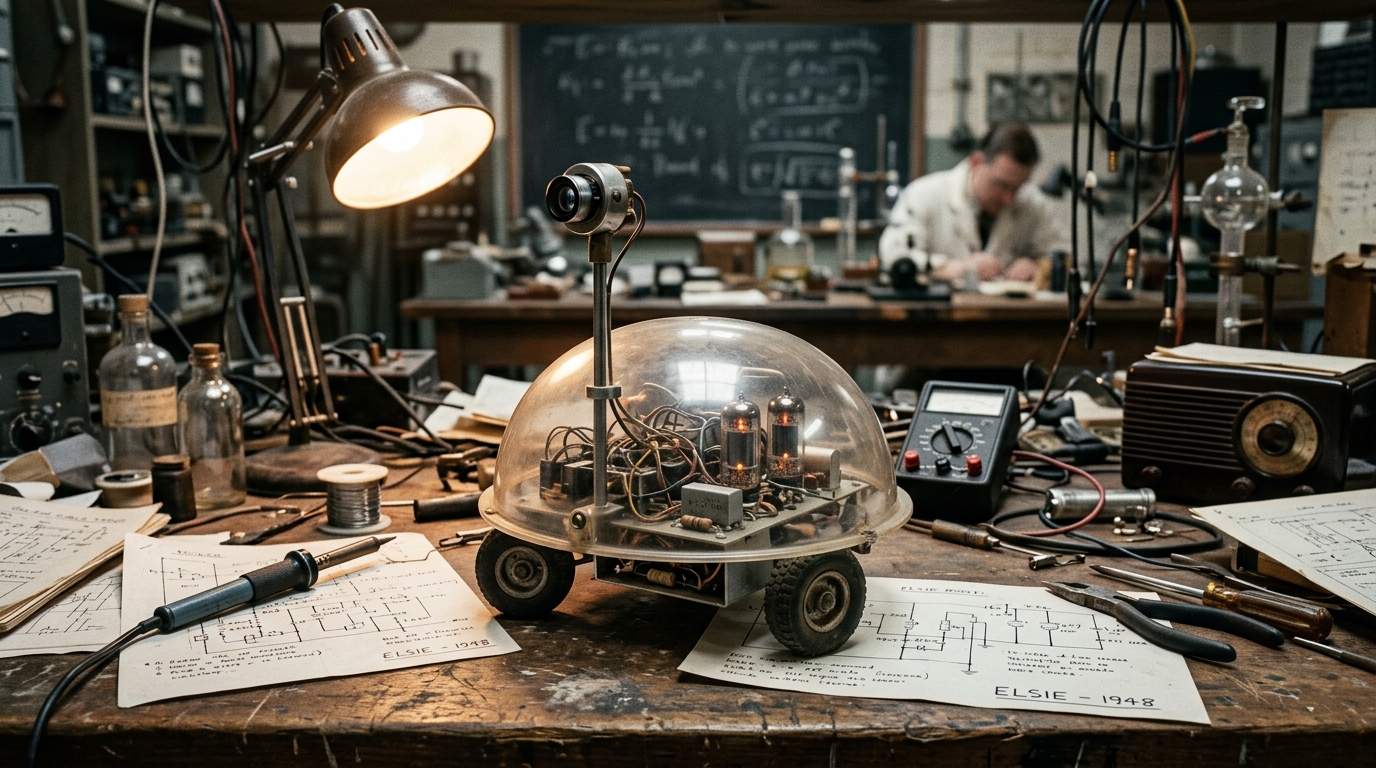
Imagine a machine capable of seeking out light, avoiding walls, and even returning to recharge on its own, without any computer directing its movements. It may sound like science fiction, but this feat actually occurred in England, decades ago, in a discreet Bristol laboratory. Two small mechanical tortoises, named Elmer and Elsie, demonstrated that behavior that looks intelligent can spring from a system of remarkable simplicity. Their story shines a new light on our current debates about artificial intelligence, reminding us that before algorithms there was wiring.
- In 1948, the neurologist Grey Walter designed in Bristol the tortoises Elmer and Elsie, each powered by only two electronic tubes acting as artificial neurons, with no memory or computer program.
- Through direct connections between sensors (light, contact) and motors, these machines explored their environment, avoided obstacles, searched for light, and autonomously returned to recharge.
- Kept experimental, these cybernetic tortoises laid the theoretical foundations of behavioral robotics and are regarded as conceptual ancestors of domestic robots like the Roomba.
- A brain built from two tubes, against all odds
- When two tubes are worth more than a computer
- Intelligence without calculation, a paradox that still unsettles
- Two tortoises, an experimental stage, a vast legacy
A Brain Built from Two Tubes, Against All Odds
The United Kingdom did not possess personal computers or programming languages in 1948, yet a machine was already capable of thinking in its own way. Elmer and Elsie, two mechanical tortoises devised by the neurologist Grey Walter at the Burden Neurophysiological Institute, hunted for light on their own, as if they had a will of their own. Their secret lay in a modest component for the era: two electronic tubes, and nothing more.
This technical detail is surprising. There was no memory, no software, no calculation in the sense we understand today. Yet this minimalist wiring was enough to produce coherent, almost living trajectories. Here is how such a modest setup could simulate a form of intelligence long before the digital era.
When Two Tubes Are Worth More Than a Computer
Grey Walter was not working on robotics per se, but on the functioning of the human brain. His research question was captivating: how can a small number of neurons generate complex behavior? To answer it, he came up with an idea both elegant and radical: construct a machine with a minimum of components to observe a maximum of effects.
The tortoises Machina Speculatrix, the nickname given by their creator, carried only two electronic tubes, which Walter freely equated to two functional neurons. No memory, no code, no calculation in the modern sense. A rotating light sensor, a contact sensor to detect obstacles, and motors connected directly to these two tubes. That was all that was needed to give the impression of reasoning.
Yet, this minimalist setup produced behaviors that seemed perfectly deliberated. The machine explored its surroundings, eased around obstacles with grace, sought a moderate light source, and avoided light that was too intense. It could even sense when its batteries were running low and automatically returned to a charging station. No program dictated what it should do at every moment: everything depended on direct electrical connections between sensors and motors.
Intelligence Without Calculation, a Paradox That Still Dismays
The cybernetic tortoises’ behavior rested on a principle of almost disorienting simplicity: the sensor responses directly modified the activity of the motors. There was no intermediate processing step, no decision in the computer sense. What we perceived as a choice was, in fact, an instantaneous electrical response.
This analog operation nevertheless yielded trajectories that were unpredictable and captivating. Elmer and Elsie sometimes paused before a mirror, as if they recognized themselves, a phenomenon that strongly challenged observers of the era. The control system, with its cells connected to the sensors and motors, enabled four distinct behaviors: exploration, obstacle avoidance, and two forms of phototaxis, one positive and the other negative, depending on the light intensity encountered.
Grey Walter saw in this a particularly powerful demonstration: complex behavioral patterns can emerge from simple connections, without explicit calculation being necessary. This idea unsettled the budding certainties of computing at the time and foreshadowed debates that still traverse AI research today, especially the blurred boundary between mechanical reaction and genuine cognition.
Two Tortoises, an Experimental Stage, a Vast Legacy
Despite their ingenuity, Elmer and Elsie never left the laboratory. There was no mass production, no practical application at the time. An engineer at the Burden Neurophysiological Institute, W. J. Warren, did indeed build a new version in 1951, but their role remained strictly experimental, confined to scientific observation and theoretical demonstration.
Their influence, however, extends far beyond their technical simplicity. These small machines directly inspired emergent cybernetics and laid the theoretical groundwork for behavioral robotics, a field that would later explore far more sophisticated architectures. In the genealogical tree of domestic robotics, the most probable ancestors of the Roomba would indeed be Elmer and Elsie, marking a conceptual lineage rather than a direct industrial one.
In short, two electronic tubes were enough to prove that adaptive behavior does not require a computer or a software program. Grey Walter showed, with utterly modest means, that a machine could appear to think without truly calculating. This experiment remains a foundational milestone, long before the emergence of artificial intelligence as we know it today.
This small turtle made of plastic and metal, born in a Bristol laboratory, continues to challenge us: do billions of calculations are truly necessary to produce a behavior that seems intelligent, or can well-thought-out simplicity sometimes suffice to create the illusion of thought? The question, posed in 1948, remains astonishingly current.
