
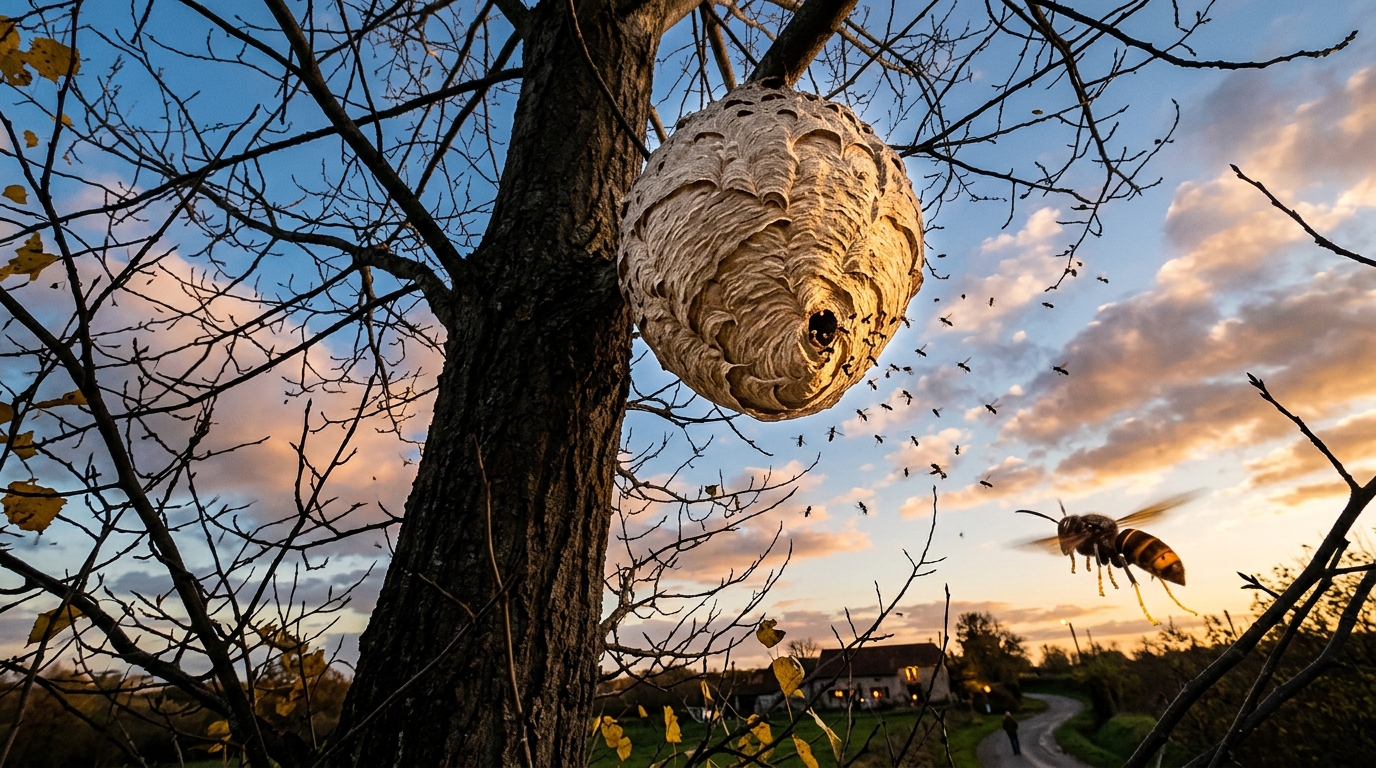
What if a seemingly modest cargo of pottery was enough to permanently disrupt the French fauna? In 2004, in a warehouse in Lot-et-Garonne, a fertilized queen hornet slips away from a container bound for China. Twenty years on, millions of her descendants have colonized the entire country, and autumn each year reveals the scale of this silent invasion.
- In 2004, a queen of the Asian hornet escaped from a shipment of Chinese pottery delivered to Lot-et-Garonne, and according to a study from University College Cork (2022), the entire European population would descend from this single specimen.
- Seventy percent of nests are perched above ten meters and become visible in autumn when the leaves fall, revealing the scale of the invasion.
- A national fight plan with a budget of 3 million euros was adopted on September 16, 2026, as nest reports rose by 42% in 2025 (18,879 nests), a rise nonetheless less steep than in 2024 (+76%).
- The mystery of a container that changed the French ecosystem
- How a few queens were enough to invade an entire territory
- Why autumn reveals each year the scale of the invasion
The mystery of a container that changed the French ecosystem
It all begins with a seemingly ordinary delivery. In 2004, Chinese pottery arrives in Lot-et-Garonne, destined for the garden decoration market. No one at the time imagines that this shipment carries a stowaway.
During the unpacking, a fertilized queen of the Asian hornet quietly escapes. This detail, almost anecdotal at the moment, would nonetheless have major ecological consequences for the entire country.
It was entomologist Jean Haxaire who officially identified the species, with a scientific publication in 2006. The name given to this invader is Vespa velutina nigrithorax, today better known as the yellow-legged Asian hornet.
A single container of pottery was enough for an invasive species to colonize France from the Southwest. An anecdote illustrating how ecological balances can tilt because of a tiny, almost invisible moment.
How a few queens were enough to invade an entire territory
How can a single queen escaped from a carton give rise to a population that today numbers millions of individuals? The answer lies partly in the insect’s peculiar biology.
A study published by a team at University College Cork, in Ireland, in the Journal of Hymenoptera Research in October 2022, allowed researchers to trace the genealogical tree of the species in Europe. The scientists analyzed DNA from specimens collected on different continents.
Their conclusion is unequivocal: the entire European invasion would descend from a single specimen that arrived from China. In other words, a single fertilized queen would be the origin of all colonies currently present on the continent.
This scenario is explained by the reproductive biology of the Asian hornet. Each year, a queen can found a new colony capable of producing several hundred individuals, including new fertile queens that will swarm again in the following spring. A devastatingly effective snowball effect.
Why autumn reveals each year the scale of the invasion
By the end of summer, the nests of Asian hornets reach their maximum size. Many of them are built high up, hidden in the dense foliage of trees, far from view.
According to data from the National Museum of Natural History, 70% of nests reported to INPN were perched more than 10 meters high. In another sample of 15,000 nests, nearly half were located in urban settings, sometimes just a few meters from homes.
It is precisely between October and December, when the leaves fall, that these nests suddenly become visible. What the vegetation hid all summer reappears at the tops of trees, sometimes in the form of impressive gray spheres.
This year, 2026, marks a regulatory turning point. A national plan to fight the yellow-legged hornet was adopted by an interministerial decree published in the Official Journal on Wednesday, September 16, co-signed by Annie Genevard, Minister of Agriculture, and Mathieu Lefèvre, Minister Delegate for Ecological Transition.
With a budget of 3 million euros, this framework classifies departments into four exposure levels. Local adaptations must be drawn up under the authority of the prefects within six months, with national leadership to coordinate actions on the ground.
On the numbers side, the 2025 season recorded 18,879 nests reported on the regional reporting platform, up from 13,290 the previous year, a 42% increase. The growth continues, but is clearly more moderate than the +76% documented in 2024.
A climatic factor could explain this relative slowdown. The heat waves of summer 2026, with temperatures sometimes exceeding 40 degrees in several regions, made conditions less favorable for colony development. The result: nests overall smaller and populations fewer than in previous years.
Twenty years after the accidental arrival of this single queen in Lot-et-Garonne, the Asian hornet has established itself as a lasting inhabitant of the French landscape. Each autumn, as these nests resurface at the tops of bare trees, we concretely see how a tiny event can shape an entire ecosystem, and how crucial collective vigilance remains in the face of species from elsewhere.
