
A fragment of ablative insulating material torn from the forward crown of the right-hand solid rocket booster detached just 85 seconds after liftoff and struck the shuttle’s belly at a velocity that made the impact nearly as dangerous as a projectile. On board, no one knew yet, but this grainy image, filmed by an onboard camera and viewed during the flight, would haunt the crew for the entire mission. That December day in 1988, the shuttle Atlantis was about to endure one of the tensest missions in the history of the American space program, an episode long kept in the shadows because of its military nature.
- During the secret STS-27 mission in December 1988, a piece of thermal insulation detached 85 seconds after liftoff and damaged 707 tiles on Atlantis, including one completely torn away.
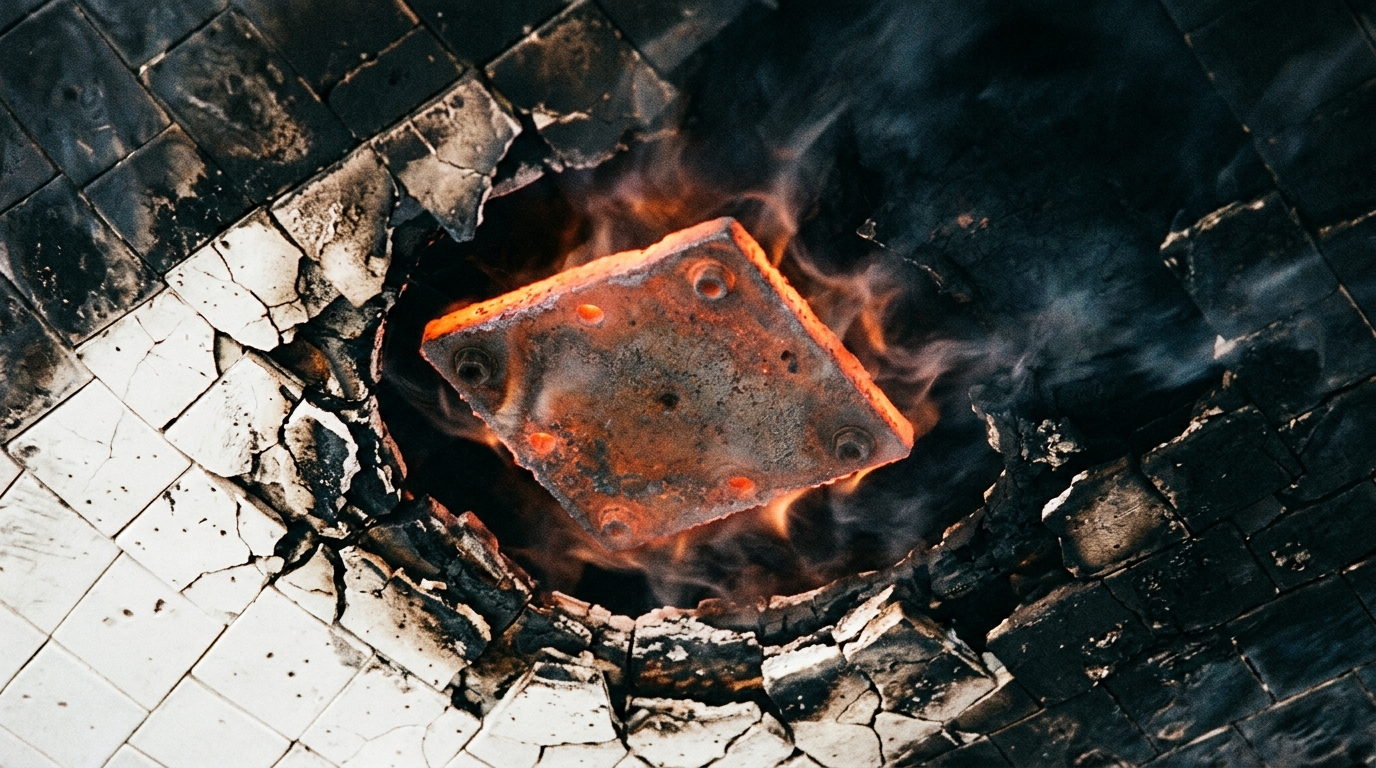
- The missing tile happened to cover a mounting area for a steel plate intended to anchor an antenna, which ended up acting as an improvised backup shield during reentry.
- If the tile had detached a few centimeters farther, over a thinner structural zone, the scenario could have turned catastrophic, as in the loss of Columbia in 2003.
- A military mission that already bears its scars
- 707 impacts and a tile missing
- The forgotten antenna that changes history
- What NASA learned from its greatest silent fear
A Military Mission That Already Bears Its Scars
The STS-27 mission lifts off from Launch Complex 39B at Cape Canaveral aboard the shuttle Atlantis for its third flight. It was, at the time, only the second shuttle mission organized after the Challenger disaster of January 1986, a context that weighed heavily on NASA and the entire space agency. The payload remained classified, but would later be identified as a Lacrosse-type reconnaissance satellite intended for the U.S. Department of Defense. The launch, originally scheduled for the previous day, had to be postponed by one day because of a thick cloud cover over the Kennedy Space Center.
From the very first seconds of ascent, a piece of thermal insulation tore free and struck the shuttle’s flank with brutal force. The five crew members did not yet grasp the full extent of the damage. It was only in orbit, watching the imagery transmitted from a camera mounted on the robotic arm, that Commander Gibson and his crew understood the scale of the problem. What they saw chilled them: charred, cracked, and torn tiles across a substantial portion of the shuttle’s belly—the area designed to shield the orbiter from the blistering heat of reentry.
707 Impacts, and a Tile Missing
The post-mission tally was dizzying: 707 damaged tiles spread over nearly half the length of the shuttle’s underside. A scholarly French-language source even notes that one tile was entirely missing, while 175 others had been seriously damaged by the loss of that piece of insulation. Never before had a spacecraft returned to Earth with such extensive damage to its thermal protection system yet managed to land safely.
During the four days of the mission, the crew lived with the silent terror of what awaited them on the return. They knew that reentry would subject the shuttle to temperatures exceeding 1,500 degrees Celsius, and that any breach in the thermal shield could permit plasma to penetrate the aluminum structure. Commander Gibson would later say that at the moment he believed his crew would never see Earth again. He also believed that, if Atlantis had been destroyed, Congress would likely have terminated the shuttle program, given how fragile the political balance remained in the wake of Challenger’s trauma.
The Forgotten Antenna That Changed the Course of History
Here, chance steps into the narrative with a nearly unsettling irony. The tile that was completely torn away wasn’t just anywhere: it covered an antenna mounting point—an area surrounded by a thicker aluminum skin than usual, originally designed for something other than withstanding a heat-soaked reentry without protection. Beneath that missing tile lay a steel mounting plate, intended solely to anchor the antenna, which, by sheer happenstance, ended up acting as a makeshift shield during the reentry.
If the same tile had detached a few centimeters farther, over a structurally thinner portion of the wing, the scenario could have been radically different. The scorching plasma could have penetrated the internal structure, causing a failure akin to the one that claimed the lives of the Columbia crew on STS-107, fifteen years later. Atlantis had sustained more extensive damage than Columbia, but it hit areas that were overall less critical, and this providentially placed antenna, though accidental, provided essential additional protection to the vehicle’s frame.
What NASA Learned from Its Greatest Silent Fear
After four days, nine hours, five minutes and thirty-seven seconds of flight, covering almost 2,916,252 kilometers in 68 orbits around the Earth, Atlantis finally touched down at Edwards Air Force Base in California. The crew alighted unharmed, but the engineers who inspected the shuttle remained stunned by the magnitude of the damage. This episode, long kept under wraps due to the military secrecy surrounding the mission, would become a case study for NASA—a kind of dress rehearsal for a catastrophe scenario that would not fully unfold until years later.
This fright, largely unknown to the public at the time, could have spurred a more urgent examination of the risks associated with falling foam insulation at liftoff, a phenomenon that would tragically return to the forefront with Columbia’s loss. It also serves as a reminder that space exploration, even with proven technologies, remains subject to a degree of unpredictability, where a component never designed to protect human lives can, someday, prove decisive.
Reflecting on this late-1988 secret mission makes it clear how the boundary between success and tragedy can hinge on mere centimeters of metal and an antenna installed where no one expected it. So, as new spacecraft stand poised to push the frontiers of exploration even further, this little-known story invites us to consider how many other silent fears have quietly shaped the safety of today’s space missions.
