
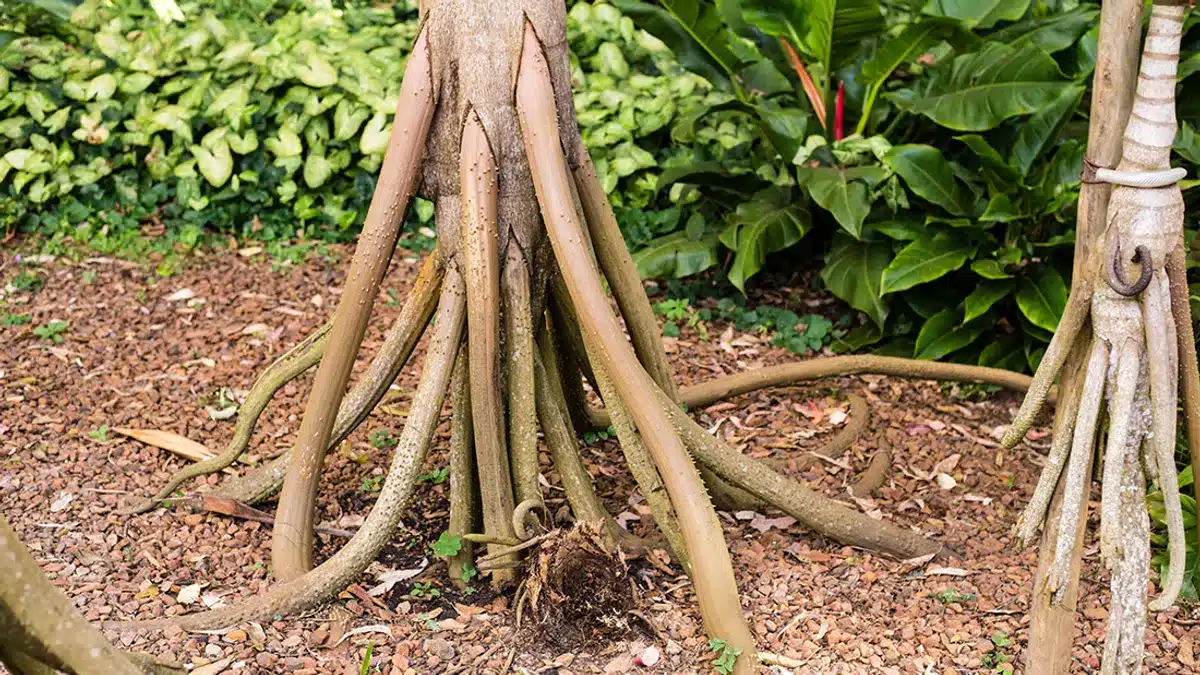
The walking palm of tropical America has captivated travelers and online audiences for decades. Its extraordinary stilt roots are said to have allowed the tree to move about 20 meters per year through the forest. This remains a complete myth — yet the true reason behind these peculiar roots is just as fascinating.
What you will learn
- How the idea of the walking palm originated from a 1980 article and grew into a tropical legend
- What a 2005 study demonstrated about the actual movement of these roots
- What the real function of these stilt roots is according to the latest research
A myth born from a misinterpreted observation
It all begins in 1980, with a scientific article on palm ecology in eastern Peru. Researchers studied Socratea exorrhiza — the palm with those spectacular stilted roots that keep its base more than a meter above the ground — and observed that it sometimes appeared to rise again after being toppled by a neighboring tree, its roots seeking the ground and slowly lifting it.
The authors used the term “walking” to describe this movement, explicitly clarifying that they did not intend to assign a purpose to the tree. But scientific caution waned as time passed: the idea of a palm capable of moving on its own through the tropical forest took on a life of its own in the popular imagination, amplified by local tour guides who saw a compelling anecdote to tell visitors.
20 meters per year: a claim that does not hold up
Online, the legend grew with precise numbers — up to 20 meters of movement per year, the palm drifting along the forest floor in response to canopy light.
In 2005, Gerardo Avalos, one of the leading experts on this species and today the director of the Center for Sustainable Development Studies in Costa Rica, conducted a rigorous study on the matter. His conclusion is unequivocal: the tree’s roots do not move. Not at all. The walking palm is nothing more than a myth, sustained by tour guides who find the tale entertaining — which is understandable.
The real purpose of these spectacular roots
If these stilt roots do not exist to help the palm walk, what are they for? A 2007 study provided the most convincing answer to date. These structures enable the palm to invest in vertical growth — its height — without simultaneously needing a thicker trunk or a broader underground root system.
In other words, the stilt roots represent an elegant engineering solution: they provide the tree with mechanical stability while allowing it to shoot upward toward the light quickly when a gap opens in the canopy. A strategy that gives it a substantial competitive edge over palms without stilts — especially useful when mature trees approach the theoretical limits of stability.
