
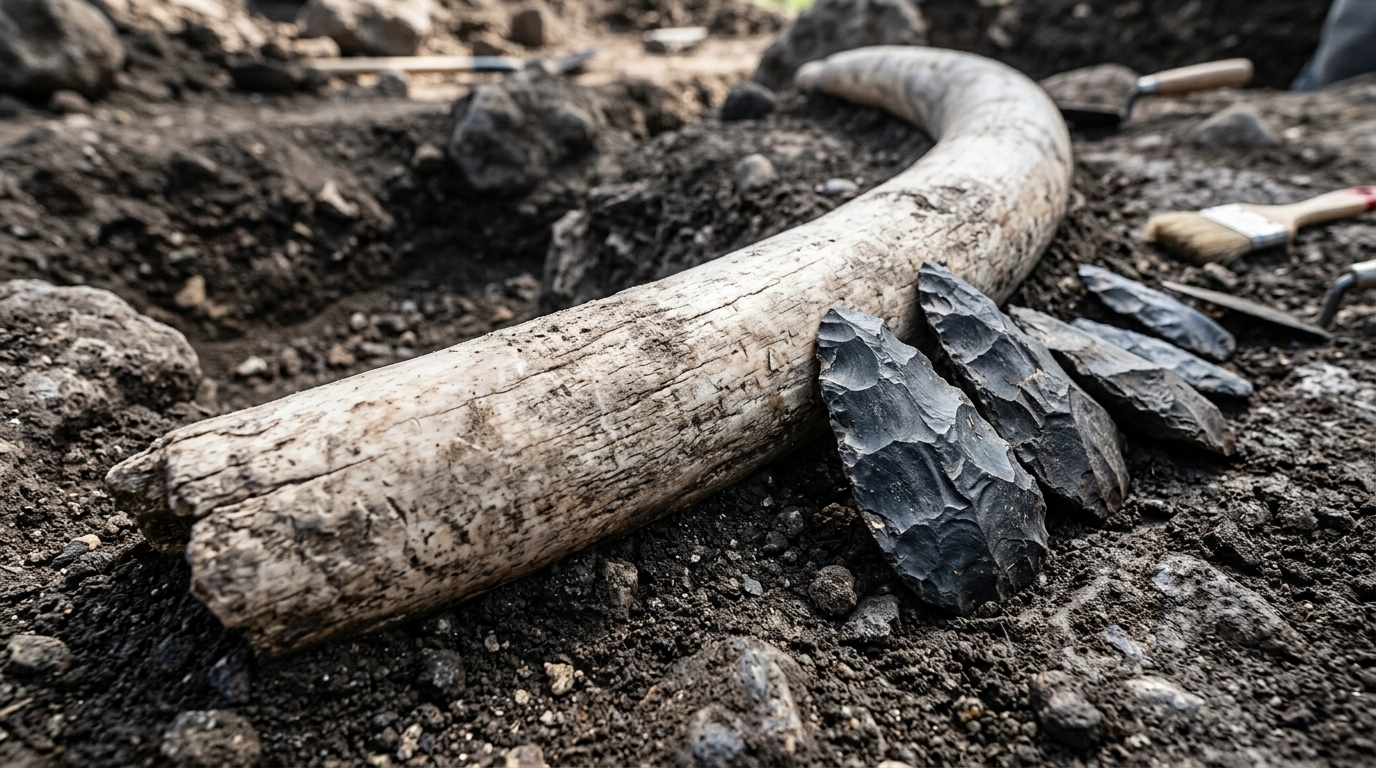
Imagine a 700,000-year-old elephant tusk buried in the soil of Galilee, right beside stone tools shaped by hands that were not quite our own. This tableau, unearthed at the Gesher Benot Ya’aqov site, tells a story as old as time: the earliest steps of humanity beyond Africa.
- At Gesher Benot Ya’aqov, remains of Palaeoloxodon antiquus were found near Acheulean tools dated to around 700,000 years ago
- Isotopic analyses of the tooth enamel show the elephant fed on both forest vegetation and riverbank vegetation along the Jordan Valley
- Pollen analyses reveal a mosaic of natural habitats (Mediterranean forests, wetlands, riverbanks) that would have allowed hominins and wildlife to thrive along this migratory corridor between Africa and Eurasia
- An unseen Hula Valley: the forgotten pantry of our migratory ancestors
- When an elephant tusk meets Acheulean hand axes: the clue that changes everything
- 700,000 years later, what the isotopes of a molar reveal about a vanished Eden
An unseen Hula Valley: the forgotten pantry of our migratory ancestors
Credit: © Tel-Hai University, Kiryat Shmona in Galilee and Hannah Farrell, University of Haifa
Long before Homo sapiens contemplated leaving the African continent, another hominin, related to Homo erectus, had already set out on an extraordinary journey. Destination: East Asia, via a natural corridor linking Africa to Eurasia—the Levant.
This migratory corridor, far from being a barren arid passage, apparently teemed with megafauna. That is what new research at the Gesher Benot Ya’aqov archaeological site in the Hula Valley suggests.
This site is no stranger to discovery. It has already yielded the oldest known traces of fire use, with charred remains of a fish prepared 780,000 years ago. A true treasure for anyone interested in our distant kin.
This time, researchers uncovered remarkably well-preserved tooth and tusk fragments. They belong to Palaeoloxodon antiquus, an extinct proboscidean better known as the straight-tusked elephant.
When an elephant tusk meets Acheulean hand axes: the clue that changes everything
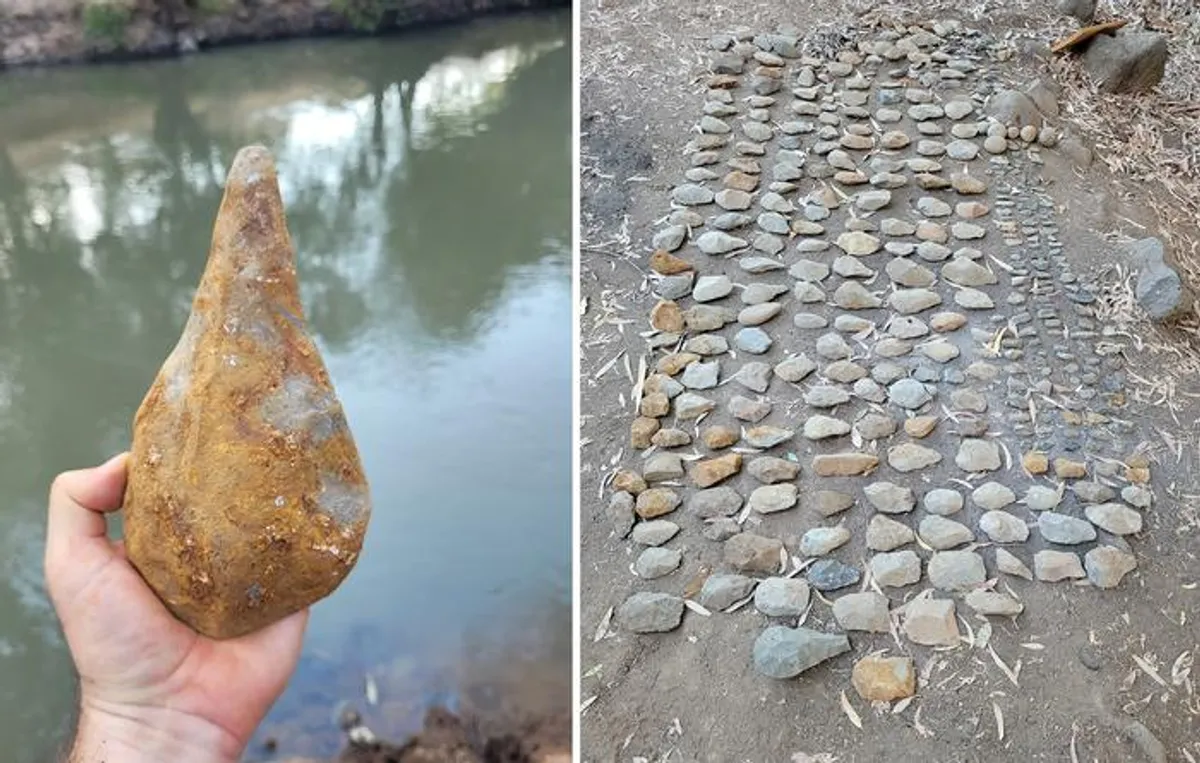
What makes this discovery particularly interesting is the immediate proximity of these fossil remains. Right next to them, archaeologists found stone axes and other tools typical of the Acheulean technological complex.
For non-specialists, the Acheulean denotes a lithic industry characterized by carefully crafted bifaces, true prehistoric Swiss Army knives. This technology would have appeared about a million years before the events addressed here.
Moreover, its rise coincides precisely with the earliest traces of proboscidean exploitation by our ancestors. In the Levant, these bifaces are typically linked to hominins hunting elephants, among the largest land mammals of the Pleistocene.
However, beware not to jump to conclusions: nothing proves that this particular elephant was hunted or killed by tool-makers. The proximity of the two discoveries remains a strong hint, not definitive proof.
That is precisely where the significance of this find lies. A prehistoric elephant tooth and tusk help researchers reconstruct humanity’s early experiences outside our ancestral continent, illuminating the backdrop in which these migrating populations evolved.
700,000 years later, what the isotopes of a molar reveal about a vanished Eden
Credit: © Tel-Hai University, Kiryat Shmona in Galilee and Hannah Farrell, University of Haifa
To learn more about this vanished ecosystem, scientists subjected an elephant’s lower molar to advanced isotopic analyses, studying the stable carbon and oxygen isotopes contained in the tooth enamel.
The results indicate that this animal fed in a mixed diet, drawing from both forest vegetation and riverbank vegetation, probably along the Jordan Valley. A varied diet, typical of a rich and generous environment.
Pollen analyses conducted in the underlying sediments complete this picture. They reveal the presence of Mediterranean trees, open-field plants, riverbank vegetation, and aquatic taxa, signaling a mosaic of natural habitats.
All things align to sketch a region of open forests crisscrossed by rivers, offering ideal conditions for hominins and their prey to prosper together, in a fragile yet durable balance.
“The availability of water, vegetation, and animal resources determined the places where humans and wildlife could survive,” explains Gonen Sharon, one of the study’s authors, in a statement. The wetlands, rivers, and forests of the Hula Valley would thus have sustained life along one of the oldest migration corridors in the world.
The Levant, the only land bridge between Africa and Eurasia, represented a mandatory passage for these early travelers seeking new territories. Without the generous resources of the Hula Valley, it would be hard to say whether these hominins could have completed their journey.
Fortunately for them, the region looked like a true paradise for elephants, ensuring abundant food along this migratory route. A detail that, on the scale of human history, may have made all the difference. This study is published in the journal Quaternary Science Reviews.
