
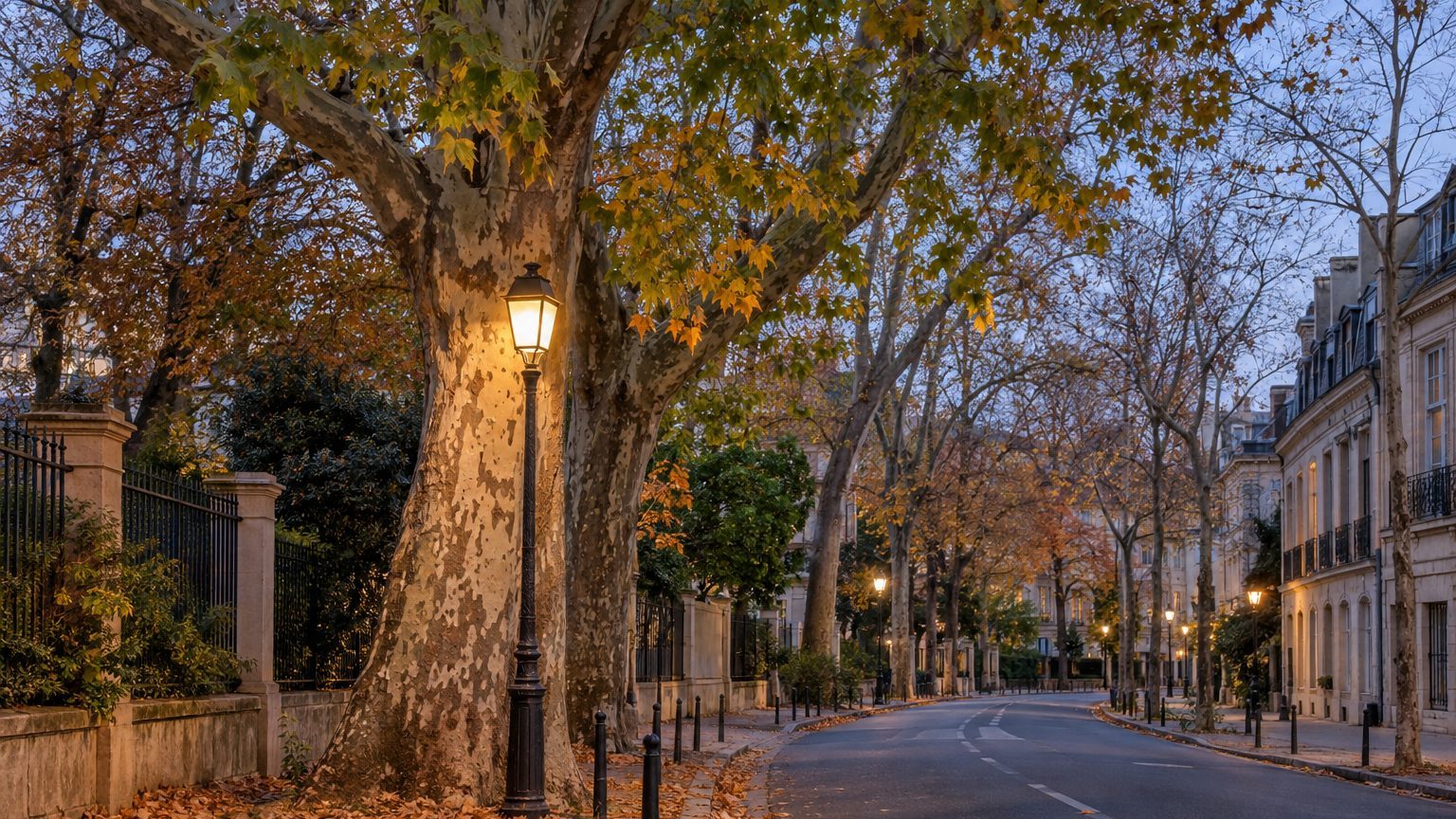
By lighting their streets all night, Florentines effectively shifted the calendar for their plane trees, and two Italian teams ultimately quantified it. The figure in circulation, two months of winter removed, arises not from a street survey but from a controlled experiment at the University of Pisa. The two studies complement one another: one observes the city as it is, the other isolates the effect of light, and both point in the same direction.
- Illuminated plane trees keep their green leaves from mid-December through late January in Florence
- In Pisa, the plane tree’s dormancy is delayed by about two months under LED lighting
- The lime tree shows no comparable delay under the same lighting
Florence: 283 Plane Trees Monitored Over Four Autumns
The plane tree accounts for more than 4,000 trees in Florence, about 6% of the city’s public greenery. To determine what nocturnal light does to it, Luciano Massetti of the CNR-IBIMET in Florence followed 283 trees during leaf-fall from 2014 to 2017, representing less than 7% of the population. His study, published in 2018 in Urban Forestry & Urban Greening, relies on a presence-or-absence method for green leaves. The observations drew on participatory science.
Across all sites, the share of trees retaining green leaves is higher under the streetlights, with statistical significance. The observation window spans from mid-December to the end of January, right in the heart of winter. The effect intensified during the winter of 2016-2017, colder than the earlier seasons.
The Cascine Park provides the most striking contrast, because it is darker than the other sites. The period without green leaves began at least 20 days earlier there, nearly two-thirds of a December.
As early as 1936, Matzke observed that branches close to a lamp could keep their leaves.
Pisa: 2 Months of Dormancy Delay for the Plane Tree, None for the Lime
In Pisa, six researchers (Guidi, Landi, Lauria, Lo Piccolo, Massai and Remorini) gathered 15 plane trees and 15 lime trees with large leaves, two widely planted species in urban areas. For each species, 10 trees were illuminated by LEDs placed about 2 meters above ground and 30 cm from the canopy, while the remaining 5 served as controls.
Verdict: winter dormancy onset is delayed by about two months, only in the plane tree.
Among the three months of a meteorological winter (December, January, February), two months account for two-thirds of the season. The winter-delay framework thus captures the effect in an experimental setup, not the entire city.
The lime tree did not show such a delay, and the university describes it as less responsive to nocturnal lighting than the plane tree. The researchers also noted a “hangover” effect: in mature leaves, CO2 assimilation is lower at dawn. The LEDs used have a spectrum with blue and red peaks. These results appeared in Science of the Total Environment and were accompanied by a university press release on June 29, 2023.
What remains to be known is the potential cost to the tree. The researchers propose hypotheses, including a frost risk for leaves still green in mid-winter and possible effects on the tree’s reserves.
What the Two Months Do Not Reveal
The two studies do not measure the same thing. In Florence, researchers note whether a tree retains green leaves under a light or not. In Pisa, they track the physiology of 30 trees in a setting where light is the changing variable, up to CO2 assimilation at dawn. The first study describes what happens in the street, the second demonstrates that light alone can shift the plane tree’s dormancy—and not that of the lime.
These two months do not translate directly to the plane trees lining our avenues, because they stem from a LED placed 30 cm from the crown in a controlled setup, not from a street luminaire. No French study was consulted for this article, and no figure will be offered for a city in France.
About 326 million street lamps worldwide, 361 million projected by 2029.
That amounts to 35 million extra light points, almost the population of Poland. For a greenspace manager, the simplest approach is Florence’s: in mid-December, compare plane trees near a luminaire with those remaining in the shade. Florentine differences appeared between mid-December and the end of January, a window of observation that only requires a careful eye.
One final nuance: Pisa’s experiment involves 30 trees and only 2 species, and Florence’s study focuses on a single tree, the plane tree. The behavior of the other street-tree species remains, in the sources consulted, to be documented.
Source: researchgate.net
