
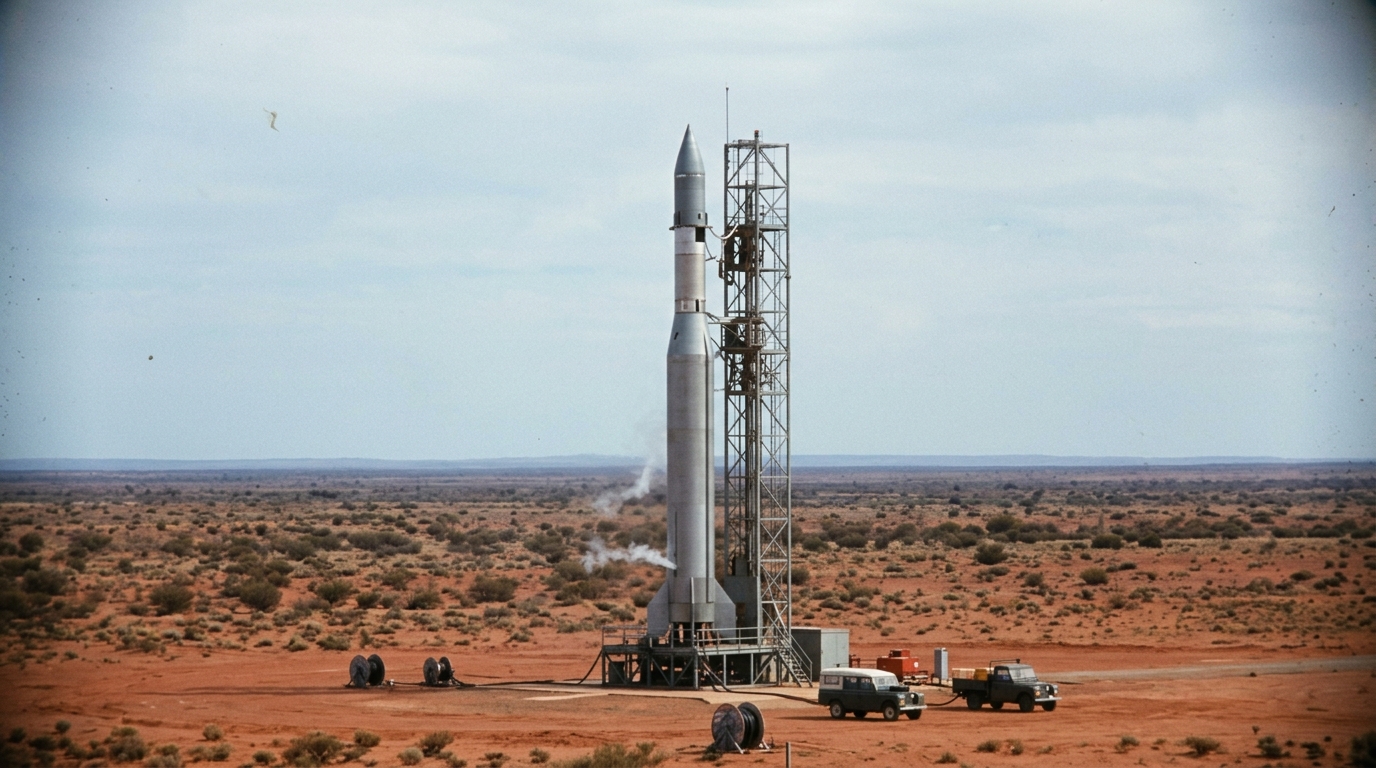
No Europa rocket ever reached orbit. Eleven launches, eleven failures to pierce the sky to the end, and yet the most obvious scapegoat in this European space debacle is not to blame. Blue Streak, that former British nuclear missile repurposed as the first stage, performed perfectly every time it flew. The real culprit was hidden higher up, in the subsequent stages.
- The first stage Blue Streak, derived from a British nuclear missile, operated perfectly during its five test flights between 1964 and 1966
- The Europa program’s failures stem from the Coralie (French) and Astris (German) stages, which experienced ignition failures during launches from 1967 to 1969
- After eleven unsuccessful launches between 1964 and 1971, the Europa program was definitively halted, the United Kingdom withdrawing from ELDO to develop its own launcher, the Black Arrow
- Blue Streak, this nuclear missile turned scapegoat despite itself
- Coralie, the French stage that drags down the European launcher
- Astris, the German stage that finally closes Europa for good
- Europa, a launcher sabotaged by its own weak links
There are stories that seem straight out of a Cold War espionage novel, except they really happened. At the turn of the 1960s, the United Kingdom possessed an intercontinental ballistic missile capable of carrying a nuclear warhead, fully operational, ready for deployment. And yet London decides to abandon it outright, not for technical reasons but for budgetary ones. Rather than letting this costly technology fade into oblivion, the Brits give it a second life: as the first stage of a European rocket named Europa. An ambitious, collective project, led by six countries under ELDO, the European Launcher Development Organisation. On paper, the idea is appealing. In practice, it would turn into a resounding fiasco, but not for the reasons one might imagine.
Blue Streak, the nuclear missile turned scapegoat
Blue Streak had been designed as a weapon of nuclear deterrence, capable of rivaling the Soviet and American capabilities of the era. Its propulsion technology, robust and proven, made it an ideal candidate to become the first stage of a space launcher. That is precisely the role entrusted to it within the Europa program, paired with two other stages provided by France and Germany. The ELDO principle could be summed up in one sentence, almost naïvely simple: each country builds a stage, they are stacked, and the launcher must fly.
And on this point, Blue Streak delivered on its promises. Between 1964 and 1966, the British stage logged five test flights with no failures. Not a single malfunction, not a misfire, nothing. The nuclear missile repurposed as a space launcher behaved exemplarily, proving that military-to-civilian conversion could work beautifully. At this stage of the program, everything suggested Europe had finally secured its entry ticket into the exclusive club of space powers able to place satellites in orbit by its own means.
Coralie, the French stage that drags down the European launcher
It is precisely at the moment the second stage, named Coralie and designed by French engineers, is added that the troubles truly begin. In August and then December 1967, two flight attempts with this live stage are undertaken. Result: in both cases, Coralie fails to ignite. The British stage, meanwhile, continues to operate flawlessly, but that obviously does not save the mission since the link to the remainder of the flight cannot be established.
This double failure casts a cold shadow over the program. It becomes clear that the very principle of international assembly, where each country works on its own stage without necessarily sharing all its methods and reliability standards with its partners, contains a structural fault. British engineers can deliver an impeccable first stage, but that does not guarantee that the subsequent stages will follow the same rigorous approach. The Europa program’s weak link had just revealed its first face.
Astris, the German stage that finishes Europa off for good
Once the Coralie problem seemed to be overcome, attention turns to the third stage, provided by Germany and named Astris. The first test flight incorporating this active stage took place on November 29, 1968. A second followed on July 31, 1969. In both cases, the verdict was the same: the Astris engine shut down prematurely, causing the launches to fail. The European launcher thus piled up setback after setback, stage by stage, as if each nation involved had to endure its own failed baptism by fire.
June 12, 1970 could have finally marked the long-awaited turning point. For the first time, all three stages operated correctly from start to finish. But then the payload fairing, the structure meant to protect the payload before separation in flight, refused to detach at the right moment. A new failure, despite propulsion finally being flawless. This anecdote alone sums up the entire tragic absurdity of the Europa program: each technical success seemed immediately canceled by a new problem, often completely different from the previous one.
Europa, a launcher sabotaged by its own weak links
In total, between 1964 and 1971, the Europa program logged eleven launches, never managing to put a single satellite into orbit. A harsh tally that gradually eroded the partners’ confidence. The launcher’s overall unreliability, combined with budget and schedule overruns, slowly pushed member countries to doubt the viability of the project itself. The United Kingdom, tired of seeing its impeccable stage repeatedly penalized by others’ failures, decided to withdraw from ELDO to focus on its own national launcher, the Black Arrow.
The final chapter of this saga unfolds in November 1971, from the ELA-1 launch pad in Guyana, at what would later become Europe’s spaceport in Kourou. This launch, Europa’s sole flight from the Guiana Space Centre, ends in another failure. The program then halted definitively, even as the Blue Streak stage destined for the next flight, Europa 2, was already en route to South America. A nearly symbolic ending for this former nuclear missile that never deserved to fail, condemned by the weaknesses of its assembly partners.
This story deserves to be told for what it truly reveals: behind Europa’s collective failure lies a technical success well concealed, that of a Cold War missile brilliantly repurposed into a civil launcher. The true culprits of the fiasco bore the names Coralie and Astris, not Blue Streak. Europe’s space community will draw lessons from this chaotic adventure by radically reforming its approach, giving birth a few years later to a launcher that, itself, would have a very different fate. One is left to wonder how many other military technologies lie forgotten in drawers today, awaiting their own conversion.
