
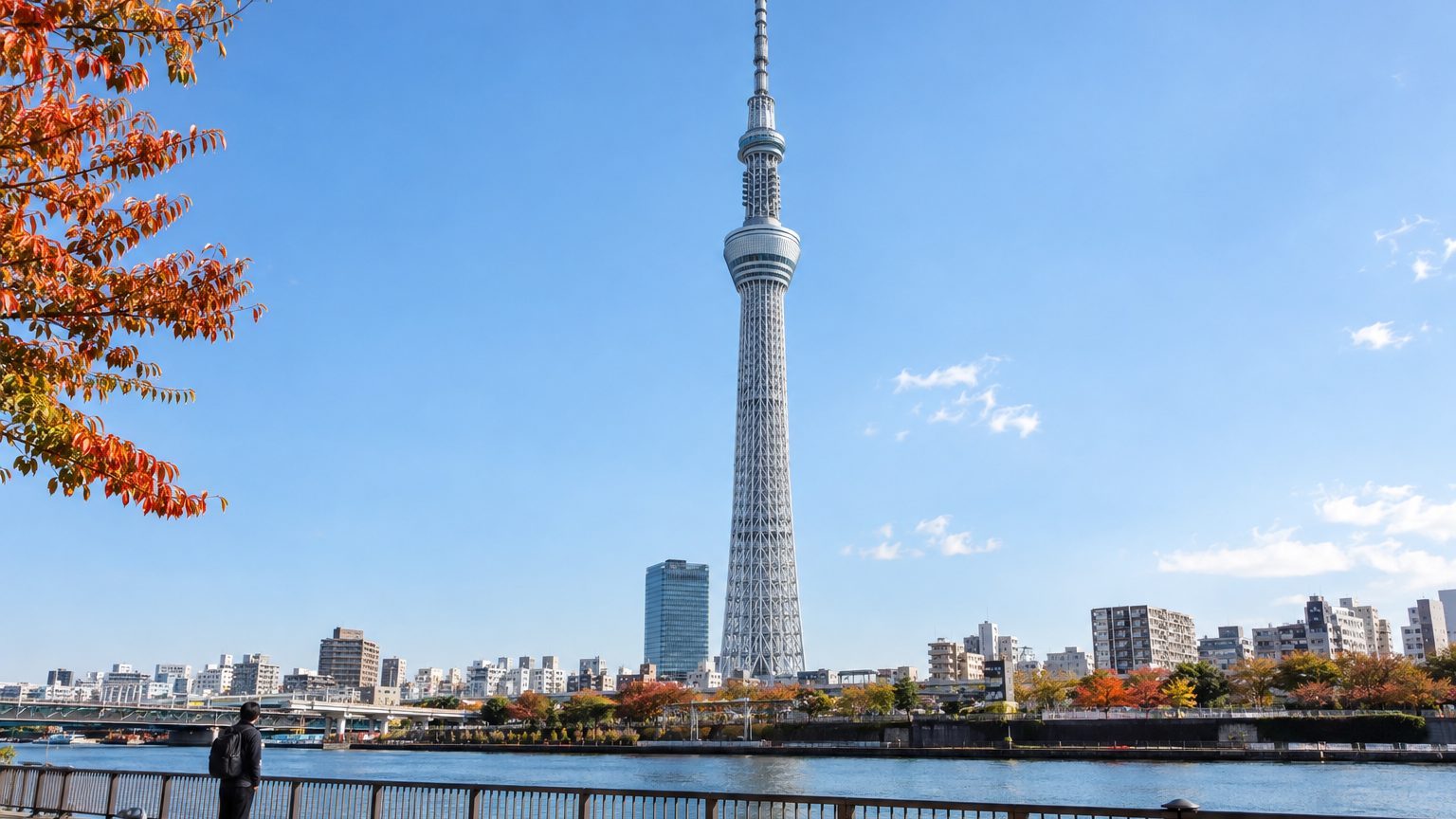
The answer can be stated in one sentence: it is a central reinforced concrete pillar, decoupled from the surrounding steel frame, with the upper portion acting as a weight. This tower is the Tokyo Skytree, 634 meters tall, holder of the Guinness title for the tallest self-supporting tower, opened to the public on May 22, 2012. Neither a pendulum suspended at the summit nor merely a bundle of steel: its secret lies in a concrete cylinder that moves at its own pace.
634 meters, in a country where the ground trembles regularly.
- A central reinforced concrete pillar is decoupled from the surrounding steel framework.
- The pillar remains connected to the frame up to a height of 125 meters.
- Oil dampers occupy the zone between 125 and 375 meters.
- The tower withstood the March 2011 earthquake without damage reported by the government.
A concrete cylinder that does not follow the tower
The principle is unusual for a building of this size. The operator explains having adopted a system that structurally separates a central reinforced concrete cylinder from the surrounding steel frame, the upper part of the central pillar acting as a “weight.” According to Wikipedia, the pillar remains connected to the frame up to 125 meters in height. Between 125 and 375 meters, oil dampers take over, which makes it inaccurate to speak of a tower with “no dampers.”
According to the Japanese government, the core of the tower is a 10-meter-diameter void that rises to about 475 meters. A reinforced concrete cylindrical column eight meters in diameter and 375 meters tall, the shinbashira, has been installed through this void, as if it pierced the tower.
A 375-meter cylinder slipped into the central void of a tower.
Two masses that counteract each other at the right moment
On paper, the logic resembles a swing being slowed by pushing against it out of time. The operator speaks of an “additional mass mechanism,” a modern vibration-control technology capable of reducing roughly 40% of the shear effort during a major earthquake. When the steel frame moves in one direction, the heavier concrete pillar, tied to it in a different way, responds with a phase lag. The overall sway is then damped by a device that oscillates out of sync inside the building.
Oil dampers placed between 125 and 375 meters sit precisely in this dialogue zone between the pillar and the outer structure. They would absorb part of the relative motion between the two, much like a car damper between wheel and chassis. Concrete provides the mass, oil slows the dance, steel takes the rest.
About 40%, that is a shear demand reduced to 60 out of 100 during a major earthquake. The figure comes from the operator itself, not an independent body, and applies to the scenario of a major quake. It does not address the tower’s behavior under strong winds or a milder earthquake.
The pagoda, claimed heritage
The name of this technology, “shinbashira,” is borrowed from five-story Japanese pagodas, in which a central pillar runs the height of the building. The operator says it chose the term with deep respect for that ancient wisdom, drawing an analogy with the pagoda. He adds that there are no recorded cases of pagodas collapsing because of an earthquake, a claim that stands with him and which we report under his responsibility.
The exact cause of this resistance remains debated.
In this regard, caution is warranted. The operator himself writes that one would suppose the secret of pagodas lies in their central pillar, and he also cites several theories. The Skytree does not copy a proven recipe: it translates a seductive hypothesis into today’s materials and calculations. The overall structural plan, however, was provided by the Nikken Sekkei office.
The March 2011 test, an unfinished tower
The calendar gave the tower a real-world test even before its opening. According to Wikipedia, it had reached 625 meters during the March 2011 earthquake, and its final height of 634 meters was reached on March 18, 2011. The Japanese government states that the tower was not damaged in the earthquake, and it cites among the reasons the central-column control system, used for the first time.
The key word: “one of the reasons.” The official source does not present the pillar as the single explanation. It would thus be misleading to attribute the tower’s entire resilience to this device alone, especially since the pillar works in concert with the steel frame and the oil dampers.
A useful note for visitors: this architecture is invisible from the observation deck, since the pillar sits inside the central void. What is visible is a steel silhouette. What works is a concrete cylinder whose effect has been extolled by the operator since the tower’s opening on May 22, 2012, more than a year after the March 2011 tremor.
Not a sphere of steel nor a rigid frame: the Skytree rests on a pillar that agrees to not follow the tower at the same pace. An idea drawn from pagodas, whose exact effectiveness remains, as admitted by the operator, a hypothesis.
Sources: alimautocad.blogspot.com | en.tokyo-skytree.jp
