
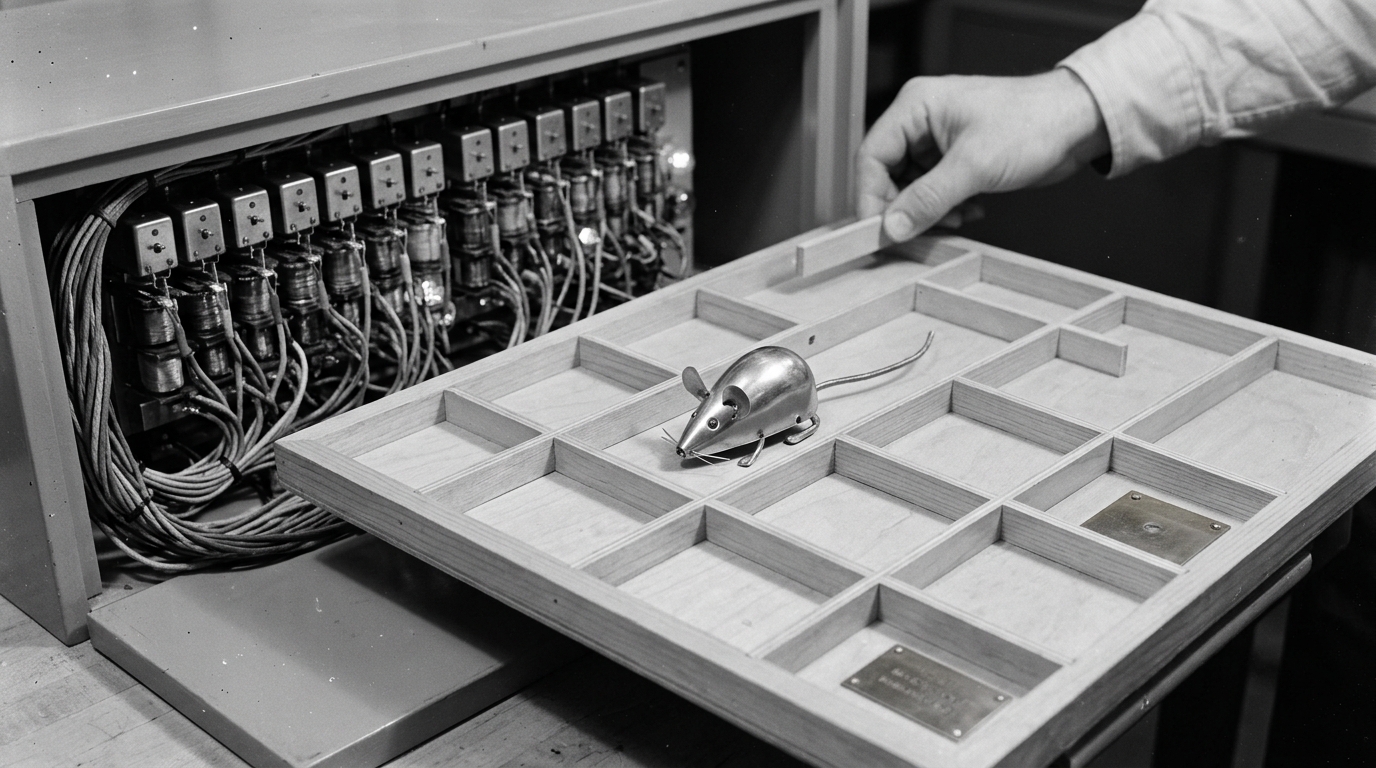
Imagine a small wooden mouse, barely bigger than a matchbox, able to remember a route it has never travelled before. No chip, no processor, not a single line of code in the sense we know today. Just metal, copper wires, and a handful of recycled telephone relays. Yet with this device, whose appearance is almost childlike, one of the brightest minds of the twentieth century quietly laid one of the very first cornerstones of what we now call artificial intelligence. And the story is all the more delightful because it unfolded far from official laboratories, almost in secret, in the living room of a pair of mathematicians who were passionate about their craft.
- In 1950, Claude Shannon conceived Theseus, a mechanical mouse guided by 90 telephone relays hidden beneath the platform, capable of learning by trial and error to traverse a 25-cell maze.
- Learning emerges on the second pass: the mouse retraces the discovered path without any error.
- Although a film-documented demonstration by Bell Labs in 1952 exists, no patent or commercial product followed, but the principle influenced future research in machine learning.
- Why a mathematical genius started tinkering with a mouse
- Under the wood, telephone relays that think like a brain
- The 25-cell maze where it all happened
- A mouse with no heir, but an idea that crossed the century
Why a mathematical genius started tinkering with a mouse
Claude Shannon was not the type to settle for problems that were too easy. A founding father of information theory, he worked in the 1950s at Bell Labs, that American temple of telephone research where the transistor and many other innovations that shape our daily lives were born. But Shannon also indulged a taste for curious objects, for machines that play chess, for automata that juggle. He wanted to understand whether a machine could, like a living being, learn from its mistakes rather than merely execute a fixed set of instructions.
It is in this spirit that he imagined Theseus, a name that carries meaning. It directly refers to the hero of Greek mythology who threads his way through the Minotaur’s labyrinth with a thread unwound along his path. Shannon playfully echoed that image: his mouse would, too, learn to find its way out of a maze, not with a thread, but with the electromecanical memory he would build for it. The project began at his side, with the invaluable help of his wife, Betty Shannon, a mathematician at Bell Labs who actively helped wire the relays. Far from a mere domestic anecdote, this collaboration nicely illustrates the artisanal spirit of research at the time, where great ideas sometimes sprang from a kitchen table rather than a lecture hall.
Under the wood, telephone relays that think like a brain
Viewed from the outside, Shannon’s mouse hardly looks impressive. It is a small wooden device, fitted with a magnet and adorned with actual mustaches made of iron wire—a cheeky nod to the animal it imitates. Shannon himself acknowledged that this body was far too small to house any computing machinery. And that is precisely where the ingenuity lay: the real brain was not inside the mouse, but beneath, on the maze’s plate.
That hidden brain consisted of no fewer than 90 telephone relays, the electromechanical components that ordinarily directed calls within Bell’s switching centers. By combining them cleverly, Shannon created a rudimentary memory: every explored square, every dead end encountered, was recorded as electrical states. The mouse advanced via a magnet placed beneath the board, guided by this relay network that remembered the paths already tried. In short, it wasn’t the mouse that thought; it was the whole maze learning to guide it—a conceptual nuance that surprisingly foreshadowed modern machine-learning systems.
The 25-cell maze where it all happened
Theseus’ playing field is a 25-square grid, arranged in five rows and five columns. At first glance the layout seems almost ordinary, worthy of a board game. Yet it is precisely this simplicity that makes the demonstration possible. When the mouse is placed in the labyrinth for the first time, it knows nothing about the path ahead. It moves forward, bumps into walls, steps back, tries another direction—a process that mirrors the trials and errors of a child learning to walk in a cluttered room.
The magic occurs on the second pass. Once the correct route has been discovered by trial and error, the relays preserve that information and the mouse can traverse exactly the same path again, without a single mistake, as if it had always known it. This shift—from tentative exploration to perfect execution—renders the idea of learning tangible. In 1952, Bell Labs filmed this feat in a famous documentary, deliberately educational, to illustrate the intelligent switching capabilities promised by the telephony of tomorrow. In the footage, Shannon stands, almost shyly, before his creation, even though he had just laid down a major milestone.
A mouse with no heir, but an idea that crossed the century
Despite the fascination it inspires, Theseus never ventured into commercial use. Bell built a few variants for internal demonstrations, including a version nicknamed Philbert, used by Southwestern Bell Telephone to illustrate advances in switching. But no patent was filed for production, and no industry partner took up the concept to create a consumer product. The machine remained what it always was: a principle demonstration, brilliant yet isolated, designed more to intrigue than to be sold.
Today, the original Theseus is housed at the MIT Museum, where it is sadly no longer functional, time having worn down its delicate mechanisms. The museum also preserves the original plans, period photographs, and the famous 1952 film, all traces that reveal the scale of this experiment. Although no company ever commercialized a direct descendant of this mechanical mouse, its foundational principle—that a machine can memorize an experience and apply it later without error—eventually irrigated decades of research in machine learning and robotics.
There is something deeply moving about this story of a machine born from a wooden labyrinth and telephone relays, with no industrial successor, but whose spirit continues to haunt our current algorithms. As artificial intelligence now sits at the center of our lives, it is worth remembering that its earliest steps were as modest as a wooden mouse seeking its way out of twenty-five little squares. One wonders how many other visionary ideas lie in the shadows, awaiting an industrial partner to bring them to life.
