
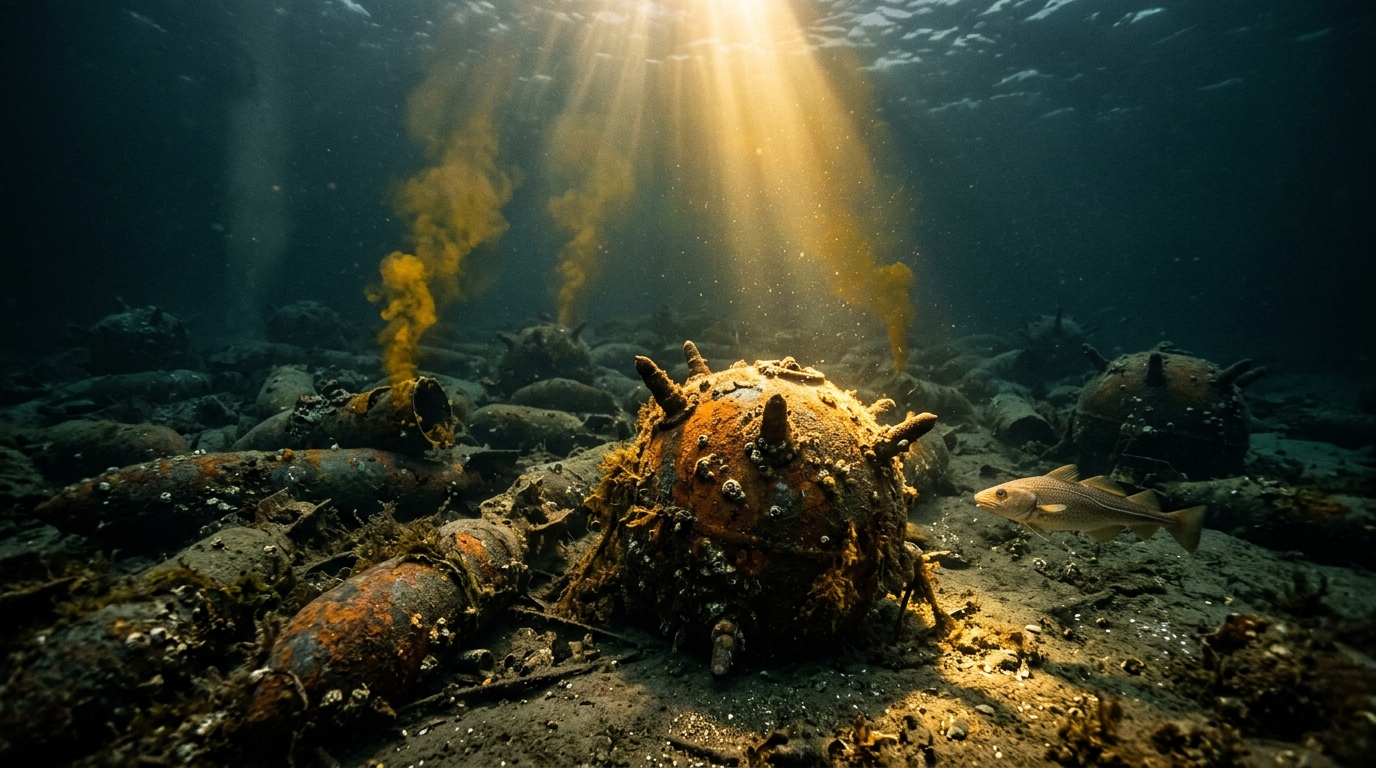
Under the North Sea and the Baltic, roughly 1.6 million tonnes of shells and mines have lain undisturbed since the end of World War II. Their metal casings are corroding, cracking, and releasing TNT straight into the water. The result: German researchers are now finding explosive compounds in the flesh of wild mussels, sometimes kilometres away from the immersion sites.
- About 1.6 million tonnes of conventional munitions and around 5,000 tonnes of chemical agents have rested on the seabed of the German North Sea and Baltic since 1945.
- Corrosion of metal casings releases TNT, toxic compounds, and heavy metals such as mercury into seawater.
- To address the risk of contaminating the food chain, Germany launched a demining program backed with €100 million.
- A sunken arsenal no one has ever found
- The TNT leaking from rusted hulls
- When the mussel becomes an explosives detector
- What these phantom munitions reveal about our seas
There is something vertiginous in imagining that, just a short distance from beaches where people stroll this season, tens of thousands of bombs, shells, and mines have quietly rested, never defused. This isn’t theory or journalistic exaggeration: it is a geological and chemical reality that slips into our food supply without a sound.
A Sunken Arsenal No One Has Ever Found
At the end of the war, disposing of stockpiled munitions posed a colossal logistical puzzle. Rather than dismantling them piece by piece, the quickest and cheapest solution was simply to dump them at sea. Tons of bombs, shells, and mines ended up sinking off the German coast, with almost total indifference to the future consequences.
Today, the scale of the problem is staggering. It is estimated that about 1.6 million tonnes of conventional munitions, to which roughly 5,000 tonnes of chemical warfare agents add, lie on the seabed of the German North Sea and Baltic. A more precise breakdown suggests that nearly 1.3 million tonnes are in the North Sea, versus around 300,000 tonnes in the Baltic. In other words, a genuine submerged military cemetery, for which no one has ever drawn a comprehensive map.
The TNT Leaking from Rusted Hulls
The problem is that these devices were not designed to endure indefinitely in saltwater. After more than eight decades of immersion, their metal casings begin to fail: they rust, crack, and allow their explosive contents to seep into the marine environment. The compound released chiefly is TNT, accompanied by other nitroaromatic substances known to be toxic, and potentially carcinogenic and mutagenic.
Added to that are heavy metals like mercury, which are also released gradually as the metal hulls degrade. In the Baltic Sea, the situation is even more worrying: this basin connects to the Atlantic only through a narrow channel, which greatly limits water renewal. Pollutants pouring into it can therefore stagnate for decades before being diluted or flushed away.
When the Mussel Becomes an Explosives Detector
That is where the story takes an unexpected turn. Mussels, like many filter-feeding mollusks, spend their lives pumping seawater to feed, absorbing whatever is suspended in it, including the most elusive toxic residues. Analyses conducted on the German coast have detected TNT and its derivatives directly in the water, in sediments, and in the tissues of several marine organisms, mussels leading the way.
So far, the concentrations measured remain generally below levels deemed dangerous to human health. Yet in some zones near the densest dumping sites, they approach critical levels, fueling concerns about the possible entry of these compounds into the food chain. In other words, the mussel no longer simply filters water: it, unwittingly, narrates the chemical history of a sea floor still haunted by war.
What These Phantom Munitions Reveal About Our Seas
Faced with this assessment, German authorities eventually took action. The Federal Environment Minister, Steffi Lemke, launched an emergency program backed with €100 million, designed to initiate a systematic demining of the most contaminated areas in the North Sea and the Baltic. A monumental undertaking, given how numerous, dispersed, and sometimes too unstable the submerged munitions are to handle safely.
This issue goes far beyond Germany. It reminds us that the wars of the last century left invisible scars that continue to disseminate into the environment, decades later. European seabeds likely hold other similar arsenals, in the Adriatic Sea, the English Channel, and elsewhere, whose real impact remains largely unknown.
Behind this chilling conclusion lies a broader question: how much longer will these military remnants keep contaminating our marine ecosystems, and above all, how many other surprises such as these might our coastlines have in store?
