
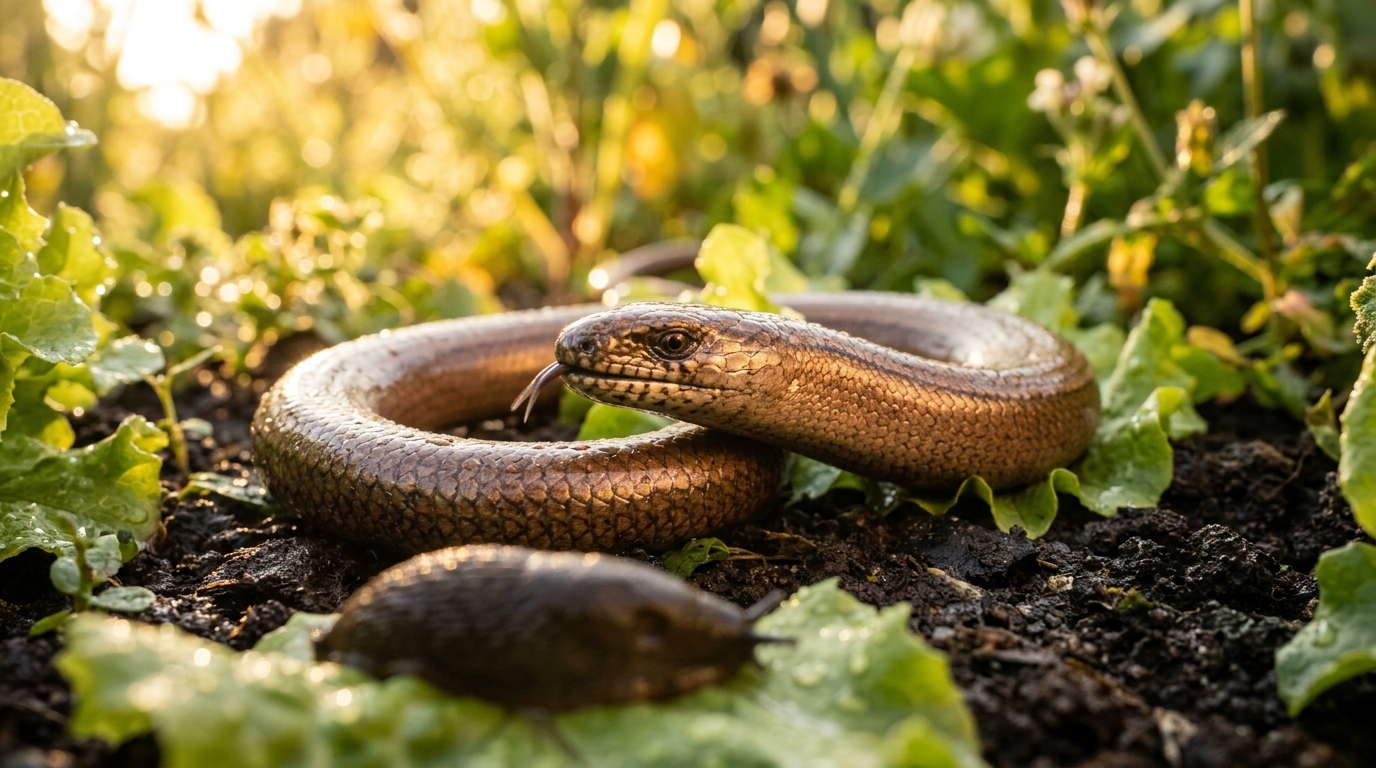
Two small round eyes, framed by delicate eyelids that blink slowly in the autumn sun: that is the detail that immediately betrays the impostor. For beneath this appearance of a snake wandering among the cauliflower patches and the rows of lettuce lies, in fact, a very different creature, far more harmless than people imagine. Each year, especially when gardens are carpeted with fallen leaves and slugs emerge in large numbers after October rain, the same scene repeats: a gardener comes face to face with a slender, gray silhouette and reflexively raises a hoe or a shovel. Yet, a simple look would be enough to prevent this unfortunate gesture and to understand that one is dealing with a precious ally of the vegetable garden rather than a threat.
- Unlike snakes, the slow-worm has movable eyelids, proving it is actually a legless lizard.
- The fragile slow-worm is a protected species in France, and destruction or capture is prohibited by law.
- As a major predator of slugs, worms, and insects, the slow-worm is completely harmless to humans and makes a valuable ally in the garden.
- Eyelids that change everything: the detail no one looks at
- Why French law forbids killing it
- The slug predator every gardener would dream of having
- What to know before crossing an orvet in your garden
Eyelids that change everything: the detail no one looks at
At first glance, the confusion is easy to understand. The creature in question has a long, slender body without visible limbs, and a smooth skin that immediately evokes the image of a snake. But it is precisely by watching its face that the truth reveals itself. Unlike snakes, which have no eyelids and whose eyes are permanently covered by a transparent, fixed scale, this animal can literally close its eyes. This anatomical detail, tiny in appearance, is in fact a fundamental difference between two groups of animals that are both classified among reptiles.
It is actually a lizard, but a lizard that has lost its limbs over the course of evolution. It is commonly called the fragile slow-worm, a name that perfectly summarizes its true nature: a legless lizard, whose skeleton retains traces of limbs inside its body that it no longer uses. This peculiarity makes it a fascinating case of convergent evolution, where two very different lineages of animals ended up resembling each other on the outside without sharing the same biological history.
Why French law forbids killing it
Beyond simple biological curiosity, there is a much more tangible reason to tuck away your hoe at the sight of this animal: French law protects it strictly. The fragile slow-worm is indeed among the species for which destruction, capture, or intentional disturbance is prohibited across the entire territory. This protection is not insignificant: it reflects the decline observed in many native reptiles, weakened by the progressive disappearance of their natural habitats, notably hedges, piles of wood, and grassy margins that intensive farming and urbanization are tending to erode.
Killing a slow-worm out of misrecognition theoretically exposes you to penalties, even though the enforcement of this rule is obviously complex in amateur gardening. But beyond the legal aspect, it is mainly a matter of ecological common sense: protecting these discreet little reptiles means safeguarding a often-overlooked link in biodiversity that populates our gardens, our embankments, and our forest edges.
The slug predator any gardener would dream of having
Here is perhaps the most convincing argument for changing how we view this unloved animal: far from being a nuisance, the slow-worm ranks among the best natural allies of the vegetable garden. Its diet mainly consists of slugs, but also includes worms, small insects, and various larvae, all of which regularly damage young shoots and developing vegetables. A single individual can thus consume a substantial amount of these particularly voracious mollusks over a season, especially in autumn when humidity fosters their proliferation.
Unlike chemical treatments or beer traps that many gardeners deploy each year, the slow-worm performs this regulatory work completely for free and quietly, without requiring any human intervention. It moves slowly, often hides under flat stones, boards, or piles of compost, and usually avoids confrontation. When threatened, its defense strategies typically involve freezing, fleeing, and occasionally biting or striking.
What to know before crossing an orvet in your garden
Next time a gray, shiny silhouette appears between two rows of leeks, you simply need to approach calmly and study its face. Movable eyelids, a complete lack of aggression, and a generally small size—often under fifty centimeters—are all clues that confirm it is indeed an orvet and not a snake. Contrary to common belief, this animal poses no danger to humans: it has neither venom nor a bite powerful enough to pierce the skin.
The right reflexes remain straightforward: leave it alone, avoid brusquely turning over the hiding places it loves, and above all never kill it in a hurry. By protecting this small, discreet lizard, we are ultimately safeguarding a natural balance that benefits the garden directly, without effort or expense.
Behind this recurring confusion between snake and lizard lies a beautiful lesson in observation: sometimes, you merely need to slow down a few seconds and look in the right place to avoid a regrettable mistake. So, the next time you cross paths with this familiar silhouette in a flower bed, will you take the time to check its eyes before reacting?
