
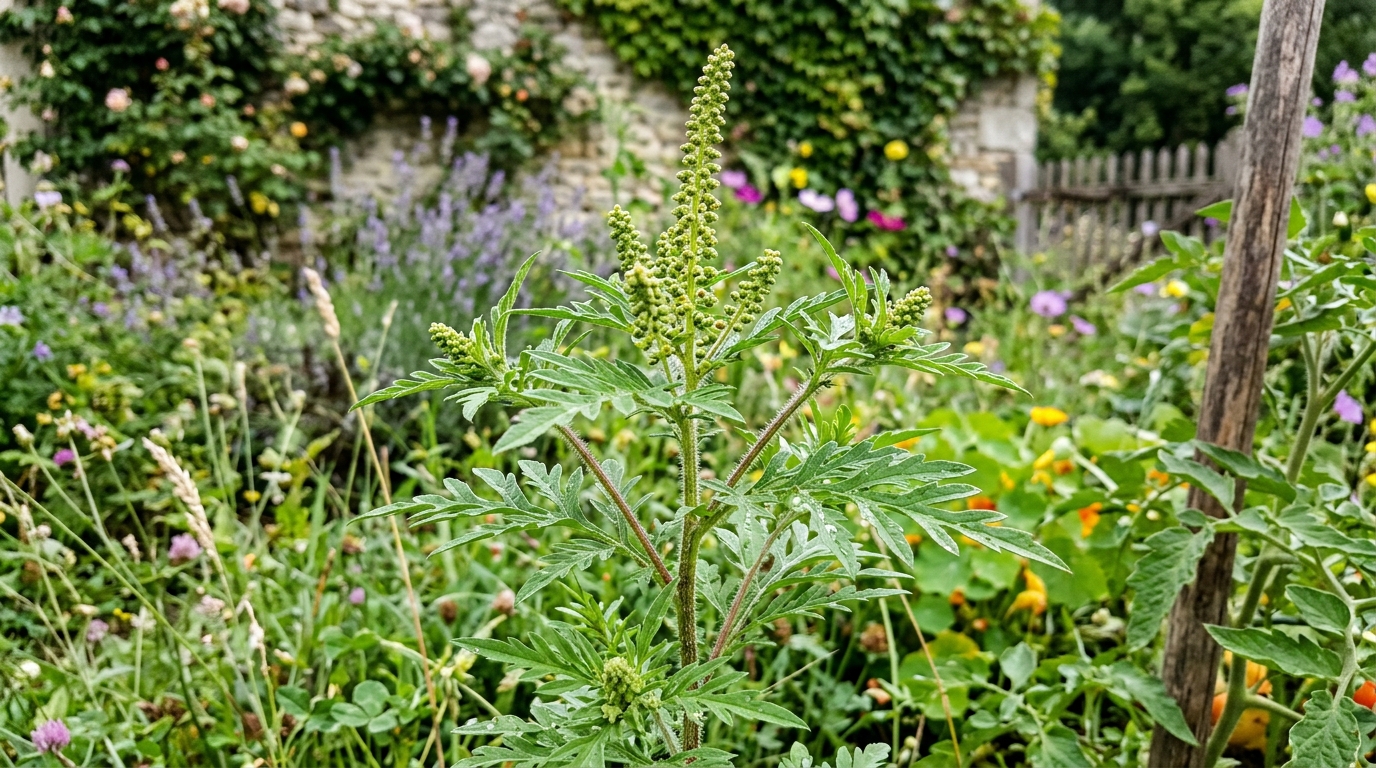
A discreet, green stalk rooted at the back of a garden, almost invisible among the wild grasses. And yet, a few streets away, people sneezing for no obvious reason, eyes stinging, throats itching. The culprit? A simple stem capable of releasing up to one billion pollen grains in just a few weeks. A dizzying figure for a plant that most people can’t even identify. How can a handful of pollen invisible to the naked eye transform an entire neighborhood into an allergist’s waiting room?
- Only 5 ragweed pollen grains per cubic meter of air are enough to trigger allergic symptoms, and this pollen can travel over 200 kilometers carried by the wind.
- Ragweed is recognizable by its reddish, hairy stem and its green, dissected leaves on both sides; do not confuse it with mugwort.
- Each property owner or occupant is legally required to remove ragweed from the plot before it flowers, by the end of July, under penalty of a fine.
- Five grains per cubic meter, the threshold that changes everything
- A plant from elsewhere, outlawed
- Uproot before flowering, the act that protects an entire neighborhood
Five grains per cubic meter, the threshold that changes everything
Hard to believe, but it takes barely five ragweed pollen grains per cubic meter of air to trigger allergic symptoms in sensitive individuals. A ridiculously low threshold compared with other pollens, which makes ragweed one of the most allergenic plants in Europe. Rhinitis, conjunctivitis, tracheitis, asthma attacks: the body can react violently to this minimal exposure. In half of the cases, this allergy can even provoke or worsen asthma that is already present. And the worst part is that this pollen doesn’t stay neatly in the plant’s own garden. Carried by the wind, it can travel over 200 kilometers, reaching homes far from the offending plant. In other words, even without ragweed on your own land, nobody is truly safe if a neighbor’s patch or a neglected lot in the neighborhood hosts it discreetly.
A plant from elsewhere, outlawed
Ragweed is not native to the region. Originating in North America, it arrived in Europe in the 19th century, likely slipped into seed shipments intended for agriculture. Since then, it has settled in, colonizing wastelands, roadside verges, building sites and agricultural fields—any soil that has been disturbed or left bare, offering it a perfect playground. To recognize it, a few details suffice: a reddish, hairy stem, and green, cut leaves on both sides. It resembles mugwort, but mugwort is distinguished by the underside of its leaves being whitish. This frequent confusion helps explain why many plants go unnoticed. In response to its spread, French law has stepped in: several articles of the Public Health Code now frame the fight against this invasive plant, with a clear objective—preventing its flowering.
Uproot before flowering, the act that protects an entire neighborhood
This is where the real solution lies: manual uprooting before the plant flowers. And contrary to a common belief, this responsibility does not fall solely on farmers or municipalities. Every property owner or land occupant, whether private individual, tenant, farmer, or land manager, is legally required to remove ragweed on their plot, built or not. A national decree has structured this obligation, and failure to comply exposes one to a fine. The action window is precise: seeds germinate between April and June, once temperatures reach 10 to 15 degrees Celsius, and flowering begins at the end of July, peaking around mid-August. Acting during this period, before the ears appear, prevents the dispersion of millions of pollen grains. In certain departments like Drôme, networks of municipal referents—sometimes hundreds of agents—patrol the lands each summer to identify hotspots and remind residents of this rule. In Auvergne-Rhône-Alpes, the region most affected in France, more than 20% of the population is exposed to ragweed pollen, a figure that conveys the scale of the phenomenon when no one removes it in time.
A single plant left standing can turn a quiet garden into a real source of respiratory contamination for an entire neighborhood. Uprooting ragweed before its flowering is not just an administrative formality; it is a collective preventive gesture, almost a neighborly duty. Next time a reddish, hairy stalk quietly peeks from the back of a garden, it’s better not to let it settle in.
