
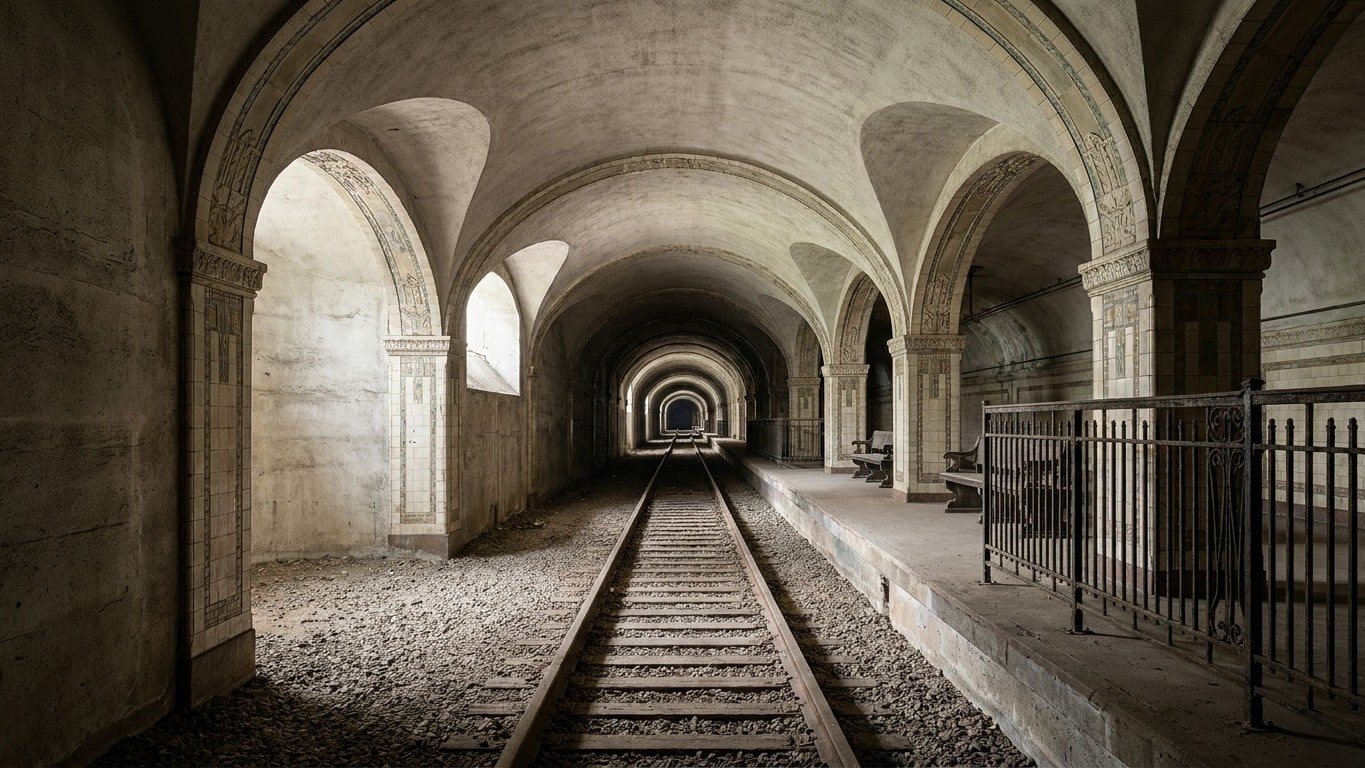
Beneath the cars racing along Central Parkway in Cincinnati, just a few meters below the asphalt, six subway stations have waited for passengers for more than a century. Not a single traveler has ever moved between the six built stations. Not a single train, not a single ticket, not even a single Platform inaugurated. This is no urban legend: more than three kilometers of tunnels were dug, of which a little over two miles remain today, forming the largest abandoned subway network in the United States.
Key takeaways
- A canal-turned-sewer became an ultra-ambitious subway project approved by 80% of residents
- How inflation, the Great Depression, and political infighting stalled a near-completed project
- Tunnels in perfect condition that served only to carry water mains and fiber-optic cables
An Obsolete Canal Transformed into a Transport Dream
The tale begins with a foul-smelling trench. From 1825 to 1920, the Miami-Erie Canal separated Cincinnati’s residential neighborhoods from its downtown business district. It carried goods and travelers to the Ohio River, until the railway made it obsolete. The canal then became an open-air sewer, abandoned by the city for good in 1877. Recasting this canal bed as a transportation infrastructure seemed, at the time, almost elegantly logical.
In March 1912, a Rapid Transit Commission was created to modernize movement in Cincinnati. The project, initially valued at $12 million, was trimmed to $6 million for budgetary reasons. The planned loop, stretching 16 miles, would use the canal’s old bed to dig tunnels beneath what would become Central Parkway. Cincinnati was then one of the seven largest cities in America. The ambition matched the scale.
Over 80% of residents voted in favor of the new rail network. A plebiscite. The city buzzed with anticipation. Yet the works would begin only much later: the outbreak of World War I delayed the project, and construction officially began on January 28, 1920.
The Cascade of Failures That Halted It All
Right at the start of 1921, the dreaded inflation arrived. Construction costs spiked, and the available funding could cover only eleven of the sixteen planned miles. The portion of the line nearest to the canal route was abandoned first. But that was only the start of a long collapse.
The two-mile underground tunnels were completed in early 1923. The surface sections were nearly finished by early 1927, but there was no money left to equip anything. Rails had not been laid, several essential connections were missing, and the coffers were nearly empty. A concrete skeleton, utterly unusable.
What follows reads like a comedy of errors, if it hadn’t cost so much. The rising use of automobiles fed opponents’ arguments and they began to call the project Cincinnati’s “white elephant.” Political quarrels, the Great Depression, World War II, and the lobbying of automobile manufacturers contributed to the failure of every subsequent proposal. In 1936, the city commissioned a report on possible uses for the tunnels: the report found no use beyond what they had been designed for. Result? Three more decades of paralysis.
One plan proposed connecting the tram network to the suburbs via the underground tubes, but the trams were too long to negotiate the tunnels’ curves. In 1939, a city administrator proposed running cars there: the cars would physically fit, but the cost to complete the project was out of reach. After World War II, a private company wanted to lease a section to transport freight cars: the city even approved a five-year lease before discovering that freight wagons could not pass through the tunnels.
The Cold War as the Ultimate Twist
In the 1960s, amid the Cold War, one abandoned station was temporarily repurposed as an anti-nuclear shelter. It was renovated and outfitted with sanitation, water, and heating. Bunk beds were installed in a tunnel designed to carry thousands of suburban commuters. The image says it all about the project’s arc.
In the 1950s, a 52-inch-diameter water pipe was laid in the northbound tunnel, saving $300,000 by avoiding the digging of a new conduit. Since 2016, the abandoned tunnels have served only to convey this main water line and fiber-optic cables. Passengers? No. Data and drinking water? Yes.
A Structure in Perfect Condition That Serves No Purpose
The ultimate paradox of this phantom subway: it remains the world’s largest unused subway network, with more than three kilometers of empty tunnels. Engineers who inspected them judged them to be “in very good condition.” The stations and platforms stand waiting, pristine, for riders who will never come.
The tunnel not only sits empty, it costs taxpayers money to maintain, partly due to the quality of the original construction and partly because the city must preserve Central Parkway above it. The city simply cannot abandon it. In 2008, estimates put the maintenance cost of the tunnels at $2.6 million, filling and capping at $19 million, and bringing it into service at $100.5 million; even demolition would be a fortune.
The last serious attempt came in 2002: a plan for a regional tram network that would have used the existing tunnels. Ideally placed to link Cincinnati’s two banks, it would have saved at least $100 million in digging work. The plan required a half-cent increase in the county’s sales tax. It was rejected by more than 68% of voters. A century after the first spade, Cincinnatians kept voting against their own metro.
Today, many Cincinnatians are unaware of the tunnels beneath their feet. What no one can ignore, however, is the stark fact: six million dollars were spent in the early 1920s, the equivalent of hundreds of millions today, on an infrastructure that transported no one. Yet this phantom metro remains structurally sound, kept up each year by city crews, ready to host trains that, more likely, will never come. A guided tour is possible once a year, in May, organized by the Cincinnati Museum Center, at $50 per ticket. To see rails that were never laid, platforms never trodden, and bunk beds that would have survived a nuclear war.
Sources: flickr.com | ingeniblagues.free.fr
