
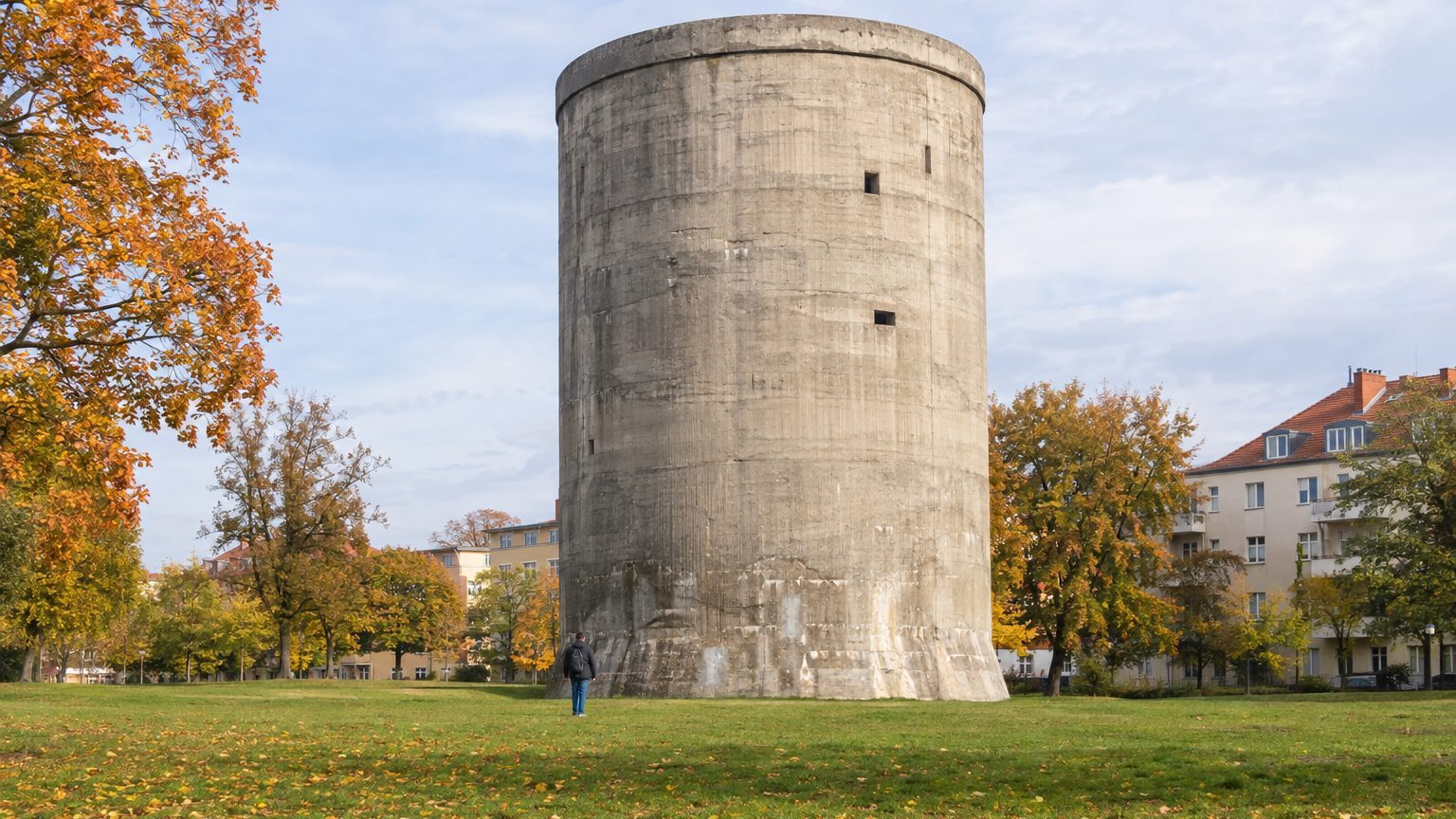
In the Tempelhof district of Berlin, since 1941 a concrete cylinder weighing around 12,000 tonnes has slept underground, never having been demolished. It measures 21 meters in diameter, extends 14 meters above ground, and sinks 18 meters below the surface. Its mission: to test whether the Berlin sand could bear the giant triumphal arch envisioned by the Nazi regime, and the ground delivered a verdict that was far from flattering.
It weighs more, in fact, than the Eiffel Tower, which comes in at about 10,100 tonnes.
- The cylinder weighs about 12,000 tonnes and sinks 18 meters into the Berlin soil.
- It tested the sand’s capacity to support a 117-meter arch.
- The block settled by 19.3 centimeters over two and a half years, a result deemed insufficient.
An arch of 117 meters, and a cylinder to test it
From 1937 onward, Albert Speer, Hitler’s architect and the chief inspector of construction for the capital, planned the transformation of Berlin into “ Germania.” Two axes were to cut the city into a cross. The north-south axis, a avenue roughly 7 kilometers long and 120 meters wide, would culminate in an arch of triumph 117 meters high.
To put the scale in perspective, the Paris Arc de Triomphe stands at 50 meters. Speer’s arch, reportedly 170 meters wide by various sources, would have surpassed it by more than twice in height, based on a sketch by Hitler from the 1920s.
Such a monument would exert an immense load on the ground, and Berlin’s soil is sandy. In 1941, the Generalbauinspektion therefore poured a concrete block very close to the intended site, with the help of forced labor, some of whom were French according to the official information site. The Berliner Unterwelten association estimates that at a depth of 18.20 meters, the block imposed a pressure of 1.26 megapascals…
I repeat without risky approximation: according to Berliner Unterwelten, at 18.20 meters depth it reached a pressure of 1.26 meganewtons per square meter, and the association describes the project as “wohl weltweit einmalig,” probably unique worldwide.
The cylinder was not the sole test. Other test loads were carried out at Matthäikirchhof, Teufelsberg, and in a caisson driven into Königsplatz, today Platz der Republik. Each time, the question remained the same: would the future buildings of the north-south axis sink into Berlin’s ground?
What the ground answered
The method comes down to three verbs: load, wait, measure. According to the German-language Wikipedia, the cylinder settled by 19.3 centimeters in two and a half years. The engineers’ objective, as reported by Berliner Unterwelten, was a subsidence of less than 5 centimeters per arch pillar. The two figures do not measure exactly the same thing (an entire block on one side, a single support on the other), but the gap gives a sense of the problem.
According to the Berlin monuments database, the ground would have required further compaction.
Measurements continued for decades, up until 1983 according to the official site. The north-south axis, however, was never realized in its planned form. If it had been, tens of thousands of people would have lost their homes, recalls the city’s urban renewal program.
Too close to residences to be demolished
After the war, the block was not destroyed: it was too close to residential areas, notes the information site. Berliners dubbed it “Naziklotz,” the “Nazi block.”
The concrete has been classified as a historic monument since 1995. The official site presents it as the sole tangible testimony of Nazi urban planning in Berlin. The Tempelhof-Schöneberg district has owned it since 2002. Renovations carried out from 2007 to 2009, totaling 925,000 euros including European funds, added an information pavilion and an observation tower.
The site opened to the public in 2009.
Go there before the end of October
The information site, at the corner of General-Pape-Straße and Loewenhardtdamm, is open until October 31, 2026. Hours: Tuesday, Wednesday, Thursday, Saturday and Sunday, from 1:00 PM to 6:00 PM. Admission is free, no reservation required.
Free guided tours are offered at 3:00 PM on the first Sunday of every month starting in May, making the last tour of the season October 4. The site is part of the Geschichtsparcours Papestraße, a 14-stop journey through the neighborhood’s history.
Sources vary on the weight: 12,000 tonnes for the official site, 12,650 for the German Wikipedia, hence the “approximately” used here. The project spanned 1941 to 1942 according to the Berlin monuments database, and the 117-meter arch never progressed beyond the planning stage. Only the cylinder remained, with its 18 meters of buried concrete.
Sources: structurae.net | berliner-unterwelten.de
