
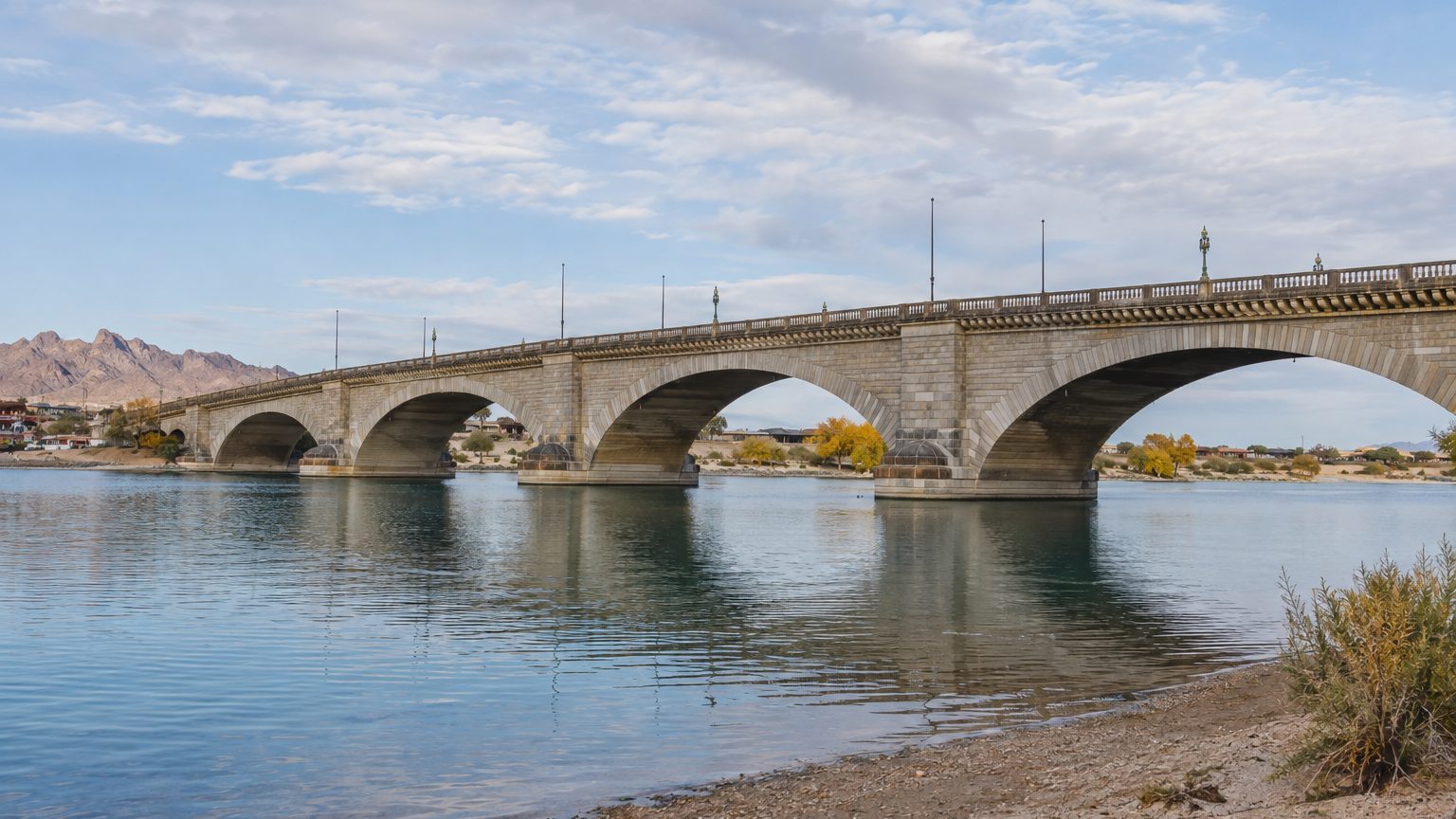
On July 4, 1968, the Port of Long Beach in California welcomed the first batch of 855 tons of granite shipped from London. American customs officials had to decide which duties to apply to these stones. Answer: none, because the cargo was recorded as an antique.
Economic savings: $270,600.
These stones formed the London Bridge, the one the British have been singing about for centuries in their lullaby about a structure that is collapsing. The U.S. Customs and Border Protection (CBP) recounts the episode in its historical archives, with a detail that tourist guides often omit: the bridge crossed continents thanks to a checkbox on a form. Four sentences suffice to summarize the setup. An industrialist wants a monument for his city, the City of London wants to get rid of a worn-out structure, and the American administration concedes that a dismantled bridge can be an antique.
- In 1968, an American industrialist buys London Bridge for $2.46 million to attract residents to his town in Arizona.
- U.S. customs classified the bridge as an antique because of its 137-year age, which waives the $270,600 duty.
- The 10,000 tons of granite are transported by sea to Long Beach, then by truck across the desert to Lake Havasu City.
A Bridge That Was Sinking, a City Short of Inhabitants
The 1831 bridge could no longer bear the strain. It was gradually sinking under the weight of traffic no designer had anticipated. The City of London decided to sell it rather than support it indefinitely.
The buyer was named Robert McCulloch. This American industrialist, known for his outboard motors and chainsaws, had founded Lake Havasu City in the middle of the Arizona desert. His town had a lake, sunshine, and land for sale, but it lacked a name the world would recognize. London Bridge was meant to attract residents.
The price: $2,460,000, with an additional roughly $240,000 in transportation costs. The bill thus exceeded $2.7 million before the first stone was ever reassembled. Three years of reconstruction followed, and several more millions, for the work to take shape in the desert. For a venture launched on the instinct of a businessman, the budget sent more than a few accountants into a tailspin.
The Customs Declaration Line
When a batch of goods crosses the American border, it is taxed according to its nature. For this bridge, the duty would have been 11%. Applied to the $2,460,000 purchase price, it would have added $270,600 to the bill.
The bridge was 137 years old, so it qualified as an antique.
The customs classified it as such, and the 11% duty was not collected. The bridge was later listed in the Guinness Book of World Records as the largest antique ever sold. The title remains in the CBP annals, which regard it as a noteworthy anecdote in its history.
Here is a twist in administrative logic that might seem odd: a work being sold because it was sinking, nearly at the end of its life, becomes a collectible the moment it crosses the border. Yet the reasoning stands, since the bridge’s old age—137 years—was a fact. McCulloch did nothing to falsify anything. He was simply the first to classify an entire bridge in the same category as a Louis XV piece of furniture.
10,000 Tonnes to Move, Batch After Batch
No one moves 10,000 tons of stone in one go. The transportation happened in several shipments, the first 855-ton batch accounting for only 8.5% of the total. This lot undertook a journey of 10,000 miles, or about 16,000 kilometers, over an entire month. The vessel passed through the Panama Canal before reaching Long Beach on July 4, 1968, and the file was assigned to customs agent Joseph D. Farrar.
For comparison, 10,000 tonnes is roughly the weight of the Eiffel Tower’s metal structure. That structure was assembled on site in two years, whereas the London Bridge had to traverse half the world in pieces.
A Bet That Paid Off
McCulloch’s calculation was simple: a famous monument is worth more than a publicity campaign. He was right. According to the CBP, his bet paid off, since the bridge remains one of Arizona’s most visited tourist attractions. City guides today promote a 1831 structure set beside an artificial lake, more than 8,000 kilometers from the Thames.
A detail of the reconstruction nuances the image of the bridge being moved stone by stone. According to several sources, including the structure’s Wikipedia entry, only the granite exterior cladding made the journey: Arizona built a reinforced concrete bridge, dressed in the original masonry. The official re-dedication took place on October 10, 1971, more than three years after the arrival of the first cargo at Long Beach.
Sources: eros.usgs.gov | en.wikipedia.org | cbp.gov
