
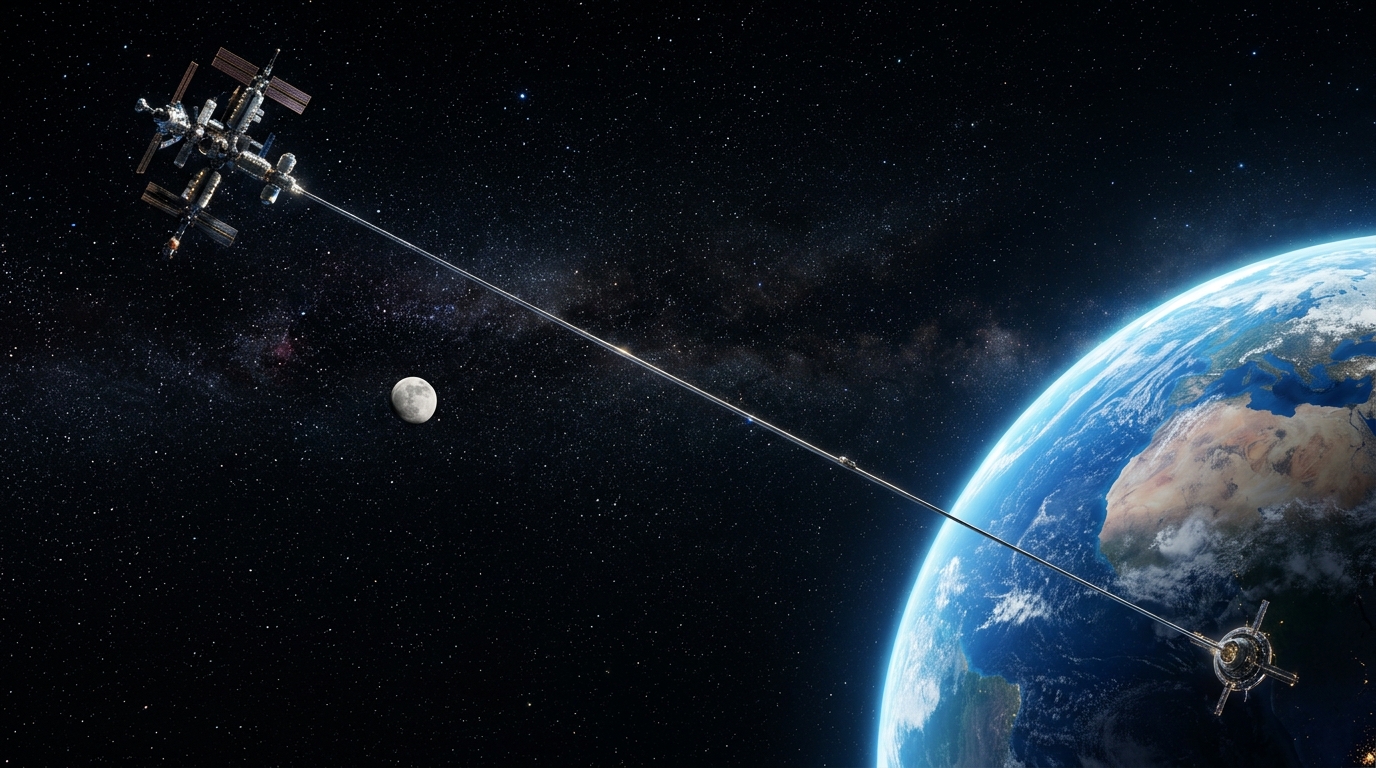
Imagine being able to ascend to the International Space Station without a rocket, without fuel, and for only a few thousand dollars. This scenario, which could easily be mistaken for a chapter straight out of a science fiction novel by Arthur C. Clarke, is nonetheless taking shape in Japanese laboratories. The construction group Obayashi Corporation is no longer content to sketch ambitious plans on paper: the company has begun testing in real conditions the material intended to form the backbone of this colossal project, a space elevator capable of linking our planet to geostationary orbit. An extraordinary technological and financial gamble, quantified and dated, that could profoundly redefine how we travel through space.
- The 35,480-kilometer cable would be made of carbon nanotubes and deployed from geostationary orbit over eight months
- An Earth Port, a hybrid land-sea hub, would be built at the equator to anchor the cable and serve as the starting point for space voyages
- The climbers would reach the ISS in two and a half hours at 150 km/h, and a journey to Mars could be reduced to forty days
- A Cable Capable of Withstanding the Impossible
- A Land Port Straddling Earth and Sea
- Two and a Half Hours to Reach the ISS, Forty Days to Mars
- A Delayed Timeline but a Project Still Alive
A Cable Capable of Withstanding the Impossible
At the core of this project lies an utterly vertigo-inducing cable: 35,480 kilometers long, a distance almost unimaginable on a human scale. This gigantic ribbon would be composed of carbon nanotubes, a material renowned for its exceptional strength-to-weight ratio, and it is precisely this component that Obayashi Corporation has recently begun testing in laboratories. The deployment logic is as dizzying as the cable itself: a spacecraft would first reach the geostationary orbit, about 22,000 miles from Earth, before gradually unrolling the tube toward the ground, a process that would span eight months.
Once this phase is complete, the vessel would not be discarded: it would serve as a counterweight, positioned at 60,000 miles of altitude, while a geostationary orbital station would act as a giant solar panel to power the entire apparatus. To support the transport cabins, called climbers, capable of hauling up to 100 tons of construction materials, the cable would need to be reinforced roughly 500 times beyond its initial version. A monumental engineering feat that is dizzying both in literal terms and in figurative sense.
A Land Port Straddling Earth and Sea
Such a structure could obviously not be anchored just anywhere. Obayashi’s engineers plan to build an Earth Port, literally a land port, strategically located on the equator. This hybrid infrastructure would include a section on land and another set out at sea, the two connected by an undersea tunnel. This placement is not incidental: it is at the equator that the orbital conditions permit the stability required for a system of such colossal scale, where even the slightest imbalance could have catastrophic consequences.
This terrestrial base would constitute the starting point for all journeys into space, somewhat like an airport, but where airplanes would be replaced by cabins clambering up an endless thread. One can easily imagine the logistical complexity involved in constructing such a facility, able to manage both anchoring a cable subjected to extreme tension and handling the flow of passengers or goods intended to depart Earth’s atmosphere.
Two and a Half Hours to Reach the ISS, Forty Days to Mars
This is perhaps the project’s most spectacular promise: the climbers would ascend the cable at around 150 km/h, enabling them to reach the altitude of the International Space Station in just two and a half hours. By comparison, today’s rockets require hours of preparation, tons of fuel, and astronomical budgets to achieve the same result. Here, each voyage would cost only a few thousand dollars, and the system would operate entirely on solar energy, without a single drop of fuel.
Yet the ambition does not stop at our near-Earth orbit. According to certain scientific estimates discussed around the project, the trip to Mars could be dramatically shortened, dropping from the usual six to eight months to merely forty days. Such a time savings would radically change manned space exploration, reducing astronauts’ exposure to radiation and limiting the risks associated with long sojourns in zero gravity.
A Delayed Timeline but a Project Still Alive
Announced in 2012, the project originally aimed to commence construction in 2025. But, as is often the case with projects of this scale, reality has caught up with the ambitions. Yoji Ishikawa, a member of Obayashi’s Future Technologies department, confirmed that construction will not begin by that deadline. The delay is not surprising given the numerous technical challenges, but it does not spell the end of the idea.
The company is currently pursuing research and development, refining its preliminary designs, forging partnerships, and continuing to promote the project among stakeholders. Recent tests on carbon nanotubes show progress, even though many more years will likely pass before the first cable actually unrolls from geostationary orbit. For now, the project remains primarily scientific and industrial, far from the spectacular imagery one might expect, but very real.
Between a cable tens of thousands of kilometers long, a hybrid land-sea port and ISS journeys measured in hours rather than days, Obayashi Corporation’s space elevator project continues to fascinate as much as it prompts questions. If timelines have stretched since the initial announcement, the persistence of the Japanese teams and the recent advances in carbon nanotubes suggest that this vision, long confined to the pages of science fiction, could someday leave the realm of dream. It remains to be seen how many more decades will be needed before we actually see this giant cable unfurl above our heads.
