
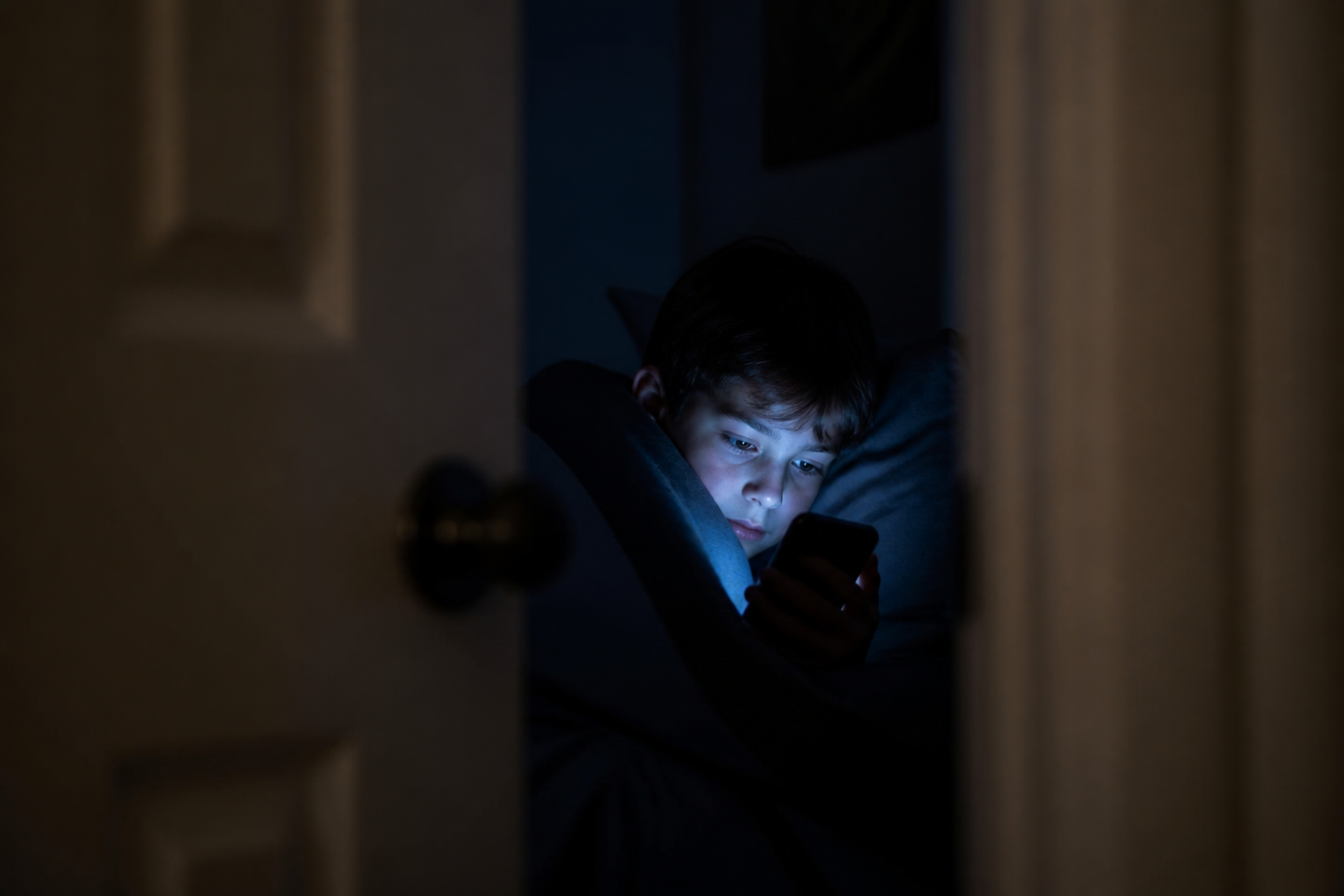
Has your 10-year-old ever shut their bedroom door, claiming they’re just going to “watch a video for five minutes”? If this moment sounds familiar, it deserves a closer look than usual. For years, the debate about screens has centered on the living-room tablet, the one you keep an eye on while you cook. Yet the latest data gathered from French families point elsewhere: it is in the child’s private space, far from parental view, that the bulk of digital exposure for 9-11-year-olds now unfolds. A discreet, almost invisible shift that nonetheless changes everything.
- 29% of 9-11-year-olds now have a personal screen in their bedroom, with an average exposure time reaching 2h33 per day.
- Solitary, nighttime use of a bedroom screen escapes parental control and fosters access to social networks, affecting 25% of 9-11-year-olds.
- This exposure is socially patterned: 40.2% of children from less educated households have a bedroom screen, compared with 19.5% among the more educated.
- The real problem isn’t the screen, it’s the closed door
- These numbers that Public Health France finally released
- Why the bedroom changes everything an screen does
- What parents can still control (and what they’ve already lost)
The real problem isn’t the screen; it’s the closed door
For a long time, parents kept a close watch on shared screens: the living-room television, the family tablet resting on the coffee table. This surveillance made sense as long as the child stayed in a common space, under the eye of an adult who could intervene at any moment. But between ages 9 and 11, a quiet drift occurs. The child grows, seeks autonomy, and well-intentioned parents end up granting a personal device that naturally migrates to the bedroom. It’s no longer the screen itself that’s the issue, but the place where it is used.
Once the door is closed, parental control changes in nature. We’re no longer talking about time limits in front of a program chosen together, but about solitary use, often nocturnal, difficult to quantify and even harder to regulate. It is precisely this shift that today worries public-health specialists much more than a simple measure of exposure duration.
These numbers that Public Health France finally released
The figures, precisely, can be dizzying. Average screen time climbs with age: it sits at 1h22 per day for 3- to 5-year-olds, rises to 1h53 between 6 and 8, and reaches 2h33 for 9- to 11-year-olds, a value that even exceeds 3h30 on days without school. But the most telling data concern personal equipment: 29% of 9- to 11-year-olds now have a screen in their own bedroom. The figure climbs further when looking at smartphone ownership, with 27% of 10-year-olds and up to 46% of 11-year-olds equipped with their own phone.
These statistics are not uniform across families. The presence of a bedroom screen is highly socially patterned: it affects 40.2% of children from the least educated households, versus only 19.5% among the most educated. Likewise, daily exposure exceeding one hour affects 72% of children from less-educated homes, compared with 35% in more advantaged households. A digital divide that mirrors, unsurprisingly, the social inequalities already known in other areas of child health.
Why the bedroom changes everything an screen does
A screen watched with the family does not have the same effects as one used alone, late at night, with no external gaze. In the bedroom, the child is no longer merely a spectator of a program: they become an actor in a parallel social world. This is especially true for access to social networks, which affected less than 2% of 3- to 5-year-olds but reaches 25% of 9- to 11-year-olds, with a share climbing to 30% among girls. Use patterns likewise differ markedly by gender: boys lean more toward gaming consoles, while girls adopt smartphones earlier and more intensely, starting at age 9.
This difference in context is not trivial. More than half of children today exceed the recommended exposure thresholds, with 55% of 9- to 11-year-olds spending more than two hours per day in front of a screen. Yet, in a bedroom, with no imposed time limits or natural interruptions, these thresholds can be easily exceeded. The screen, isolated in private, thus becomes a distinct factor in its own right, separate from simply the amount of time spent on content.
What parents can still control (and what they’ve already lost)
Given this picture, it would be tempting to succumb to fatalism. Yet some levers remain entirely in families’ hands. The first, and perhaps the simplest to activate, is to push back as much as possible the entry of a personal screen into the bedroom, favoring shared spaces even for individual uses. The second lever concerns timing: supervising the evening—the moment particularly prone to drift since it coincides with isolation and fatigue—appears to be a concrete and practical path.
But it would be naïve to believe that everything hinges solely on individual action. Public Health France emphasizes the urgency of targeting prevention efforts at the most vulnerable populations, and this from the youngest age, to reduce the social health inequalities that are already well established. These findings should also serve as the foundation for a forthcoming awareness campaign, proof that the issue goes far beyond the family sphere to become a true public-health challenge.
As autumn returns, with shorter days and more time spent indoors, vigilance around screens deserves a rethinking. Not by trying to eliminate the tablet from the living room, but by paying closer attention to what happens behind the closed door of a child’s bedroom. For it is there, far from prying eyes, that a significant portion of their relationship with digital technology—and perhaps their future well-being—now takes shape.
Source: Public Health France
