
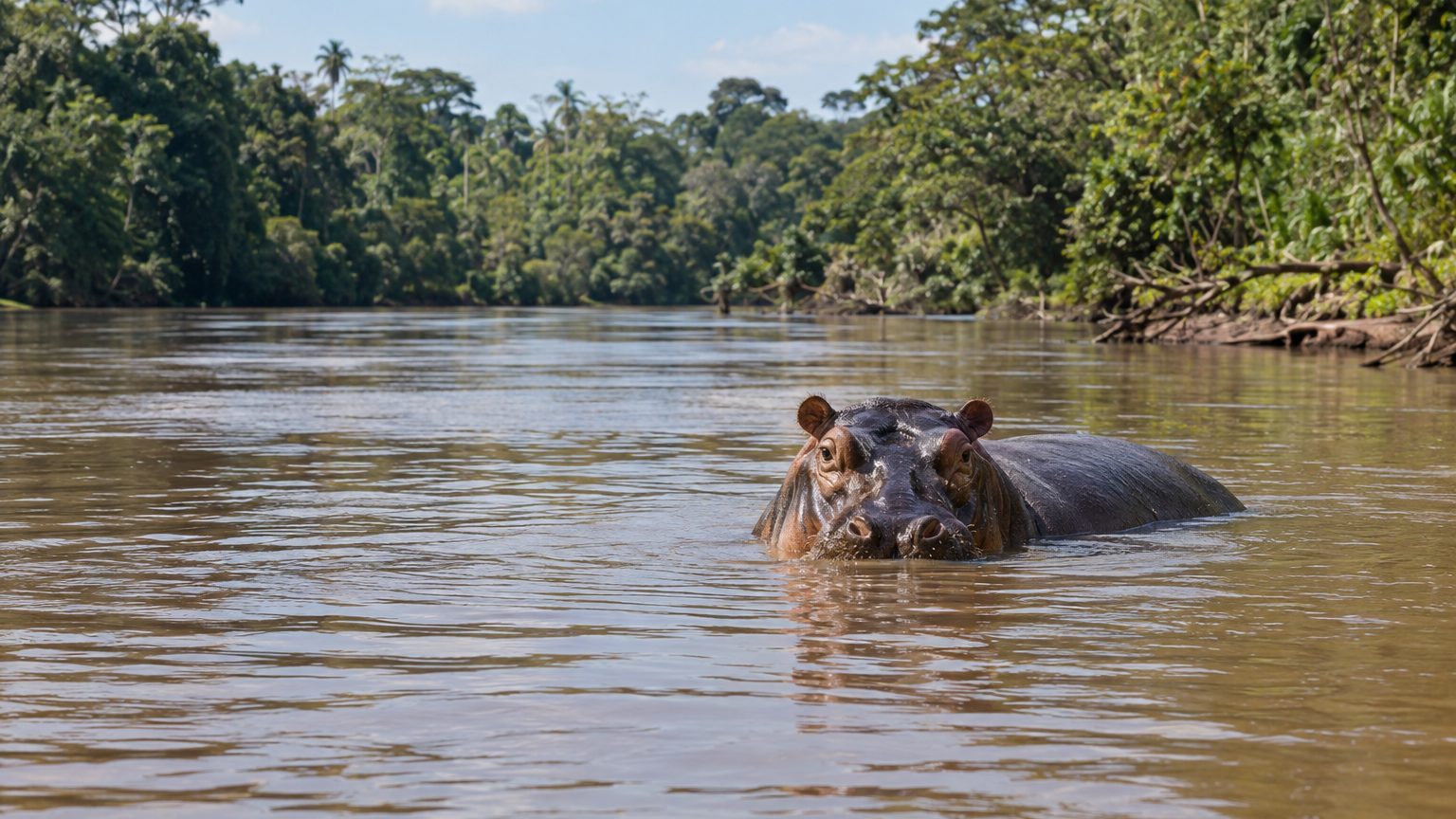
One male and three females, illegally imported for the private Hacienda Nápoles zoo about 150 kilometers from Medellín. Thirty years later, their descendants would number around 169 according to the Humboldt Institute and Cornare in 2022, and a 2022 census mentions up to 200 animals. Some media outlets describe them as arguably the world’s largest invasive species.
The Escobar quartet has multiplied by more than fortyfold.
Everything begins with the drug lord’s downfall. Escobar was killed in 1993 during a shootout with police, and the animals imported for his zoo were left free in a hot savanna region of Antioquia, crisscrossed by rivers, swamps and lagoons. Hippos, capable of walking three to five kilometers during the night, descended the Doradal stream to the Magdalena River, the country’s largest river. The other animals of the menagerie were relocated or died, while the hippos were too heavy and too dangerous to capture.
- The four hippos imported in 1993 have multiplied by more than 40, reaching approximately 169 to 200 individuals by 2022.
- The absence of predators and drought conditions not limiting in Colombia have allowed a massive reproduction compared with Africa.
- The Colombian government authorized euthanizing 80 hippos starting in 2026, after other zoos worldwide refused to take them.
- Projections estimate up to 1,000 hippos by 2035 without major intervention.
A climate free from the constraints of the continent of origin
In Africa, a hippo must cope with droughts that shrink water points, and its offspring can fall prey to lions or crocodiles. Nothing of the sort in the Magdalena Medio. According to authorities, the animals settled in a vegetation-rich zone, with no predators, and the dry season does not curb their population there as it does in their native habitat.
Rainfall worsens the problem for field teams. More grass means an overabundance of food, so baits become even less effective for capturing them, explains David Echeverry López of the environmental authority in charge of the plan.
Projections are chilling. The government estimates that in the absence of measures, Colombia could count 1,000 hippos by 2035, and Environment Minister Irene Vélez also mentioned at least 500 individuals by 2030. A study commissioned by the Environment Ministry had put the population between 181 and 215 animals, a range considerably higher than the 169 figure.
Years of half-measures
Colombia declared the species invasive in 2022, which opened the door to culling. That same year, the government launched a sterilization program. The operation is cumbersome: each surgical castration mobilizes eight people for six to eight hours, at about $9,800 per unit.
No country agreed to take even one.
Nevertheless, authorities knocked on many doors. Discussions were opened with seven countries and two international zoo and aquarium associations, and projects to relocate them to Mexico, India or the Philippines did not come to fruition. The cost of an expatriation was estimated at $3.5 million, a sum that few zoos were willing to share.
In September 2024, a Colombian court ordered that measures be taken, including controlled hunting and sterilization. By that date, sterilizations were progressing slowly and no euthanasia had taken place.
April 2026: The euthanasia choice
On April 13, 2026, Environment Minister Irene Vélez Torres signed a circular that sets out the guidelines and coordination objectives for managing and controlling the invasive hippos. Two protocols were chosen: relocation and euthanasia. The government aims for about 80 animals starting in the second half of 2026, which would mark the first authorized cull in 40 years. The planned budget is about 7.2 billion pesos, or 2 million dollars, and also covers confinement and movement of the animals. This represents nearly half of the counted herd.
The decision is divisive. It opposes environmentalists and nearby communities, while fishermen interviewed by La Presse note that children swim in the Cocorna River, which hippos frequently visit. Attacks on fishermen have been reported on the Magdalena, though no deaths have occurred. Experts also fear for manatees, which could be threatened by the hippos’ presence.
A door remains ajar on transfers. The ministry confirmed that experts and veterinarians from Vantara, a wildlife center belonging to Anant Ambani, would travel to Colombia. It remains to be seen whether these contacts will lead to a single departure. I have not found sources confirming the first culls to date.
The issue extends beyond Colombia. A 2023 study estimated that sterilization and relocation would cost at least $1–2 million just to slow growth, and that even then the hippos could remain in the landscape for another 50–100 years.
Sources: lavenir.net | lanature.ca | parismatch.be
